What to listen for
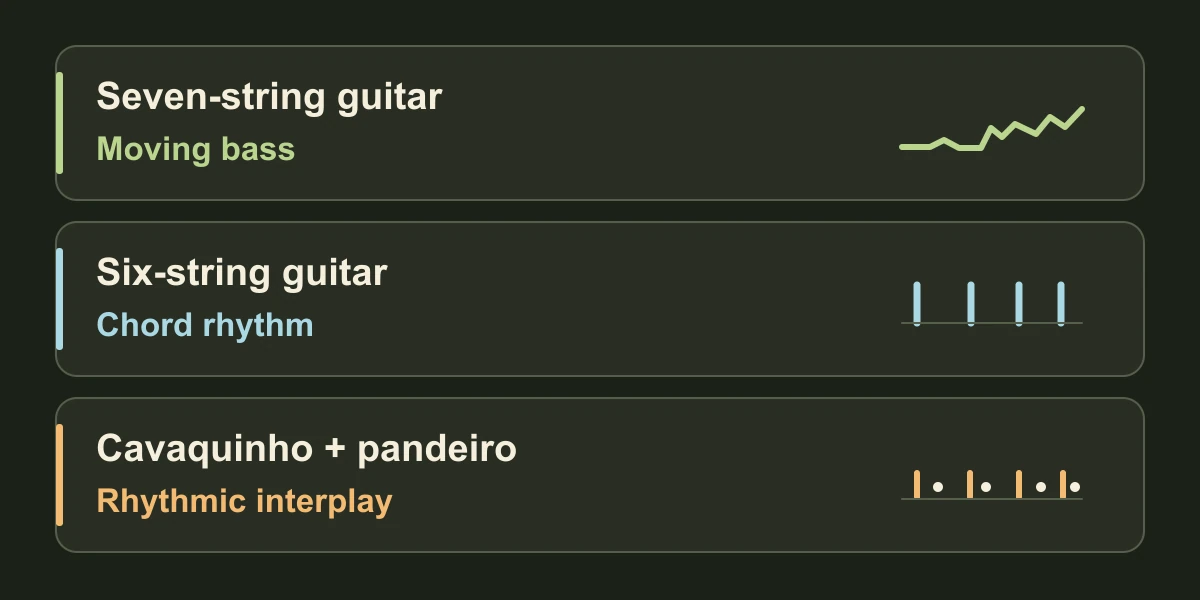
In Jacob do Bandolim’s 1957 recording of Cochichando, start with the moving bass line of the seven-string guitar. Next listen for the six-string guitar’s chord rhythm. On a third pass, follow how the cavaquinho’s chord attacks fit with the pandeiro. The Brazilian heritage institute IPHAN identifies these layers in its analysis. Parts can overlap when you listen to the full mix.
Start with the recording and its ensemble
Open the archive entry for Cochichando. It identifies Jacob do Bandolim, the 1957 RCA Victor disc 80-1845 and the matrix 13-H2PB-0166. That identifies which performance to use, since the same tune appears on other recordings.
McGowan and Pessanha describe an early choro lineup in chapter 8 of The Brazilian Sound: flute, guitars and cavaquinho. The roles developed across later ensembles. For this specific recording, IPHAN identifies Dino on seven-string guitar, Meira on six-string guitar, Canhoto on cavaquinho and Jorginho on pandeiro in its analysis of the accompaniment.
Sources: McGowan & Pessanha, The Brazilian Sound, chapter 8, pp. 171–172; IPHAN technical dossier, pp. 118; IMS catalog entry for the RCA Victor 1957 recording
Listen in three passes
First follow the low moving line underneath the main tune. In the IPHAN analysis, the seven-string guitar plays baixarias, bass figures that can answer the melody and connect one chord to the next.
On the second pass, listen for the six-string guitar’s chord rhythm. On the third, follow the cavaquinho’s chord attacks and how they line up with or leave room for the pandeiro. Keep counting the pulse when two parts are hard to separate. The recording is an ensemble mix and the instruments share some of the same rhythmic space.
Sources: IPHAN technical dossier, pp. 118; IMS audio of the 1957 matrix
Try the roles with a partner
Choose two chords you already know. Have one person try a short moving bass line between them. The other plays brief chords without covering every bass note. Swap roles, then listen to the recording again and attend to where the accompaniment leaves space for the melody. This exercise illustrates the division of work without reproducing this arrangement.
The Mariachi listening guide lets you try a related listening task with a different ensemble and tradition.
How this guide was prepared
We read McGowan and Pessanha’s The Brazilian Sound, chapter 8, pp. 171–172, and the IPHAN technical dossier, p. 118. We matched the 1957 RCA Victor matrix 13-H2PB-0166 to the Instituto Moreira Salles archive and verified that its recording loads. The listening prompts are based on the dossier’s analysis of the accompaniment.
Documentation checked .