
The decision in brief
Compare two exact sets for the same instrument, complete gauges, material and tuning. Check what is coated or treated, then record feel, acceptable sound, replacement reason and usable playing hours. Coating may address a maintenance need, but manufacturer life claims are product-specific. Use current pack prices and your actual replacement pattern to judge value; neither label sets a universal lifespan, sound or price ranking.
What matters most
- Match gauge and alloy before comparing coating.
- Check which parts of the specific set are coated or treated.
- Judge value by your replacement routine and usable playing time.
First define what “coated” means
For this comparison, “uncoated” means a set without the protective coating or treatment being compared in the maker’s product description. It does not mean every metal surface is bare or unplated. Identify the instrument type, complete gauges, core/wrap material and exact protection method.
D’Addario’s October 2021 answer distinguishes XT treated wrap wire from XS film coating. Its longer-life and feel descriptions are the maker’s claims about those lines, not independent measurements by this site. Its July 2023 XS Electric components graphic separately identifies treated plain steels. That named example does not establish the treatment of every acoustic, electric or classical set.
Ask which wound and plain strings are protected. A photograph cannot verify an invisible layer, and a diagram cannot supply its thickness or acoustic effect. Coating does not establish waterproofing, immunity to mechanical wear or a fixed replacement interval.
Sources: D’Addario Support (2021): XT treated wrap wire and XS film coating; D’Addario Support (2023): XS Electric components diagram, including treated plain steels
Coated and uncoated strings at a glance
| Question | Check on either named set |
|---|---|
| Protection | Method and which strings are treated |
| Feel | Your response to the actual surface |
| Sound | Matched guitar, gauge, tuning and signal chain |
| Life | Logged hours and the same replacement endpoint |
| Price | Current price and paid installation, if used |
This is a comparison framework, not a test result. A category name does not establish today’s price or a universal lifespan multiplier. The gauge, alloy, winding, construction and player’s conditions can differ even when both packs say “coated”.
Why life varies more than a package slogan suggests
Decide what ends a useful period: unacceptable response, roughness, unstable pitch, damage or breakage. Those endpoints answer different questions. Log installed date, approximate playing hours, storage and care, and the actual reason for replacement. Keep unused storage time separate from hours played.
Protection does not remove fret or saddle wear. If a failure may involve damaged hardware, investigate the instrument before treating it as a coating result. Follow the exact set and instrument’s care guidance; stop using a damaged set. A single cycle is a personal observation, not a controlled lifespan trial.
Compare feel and sound without confusing the variables
Match complete gauges and material as closely as the catalogue permits. Record any unmatched construction or age. Use the same passages and comparable touch; keep microphone position or pickup selection, amplifier/interface settings and playback level consistent.
Write down the texture and sound you actually notice. A preference for smoother slides is a player judgment. D’Addario attributes natural and smooth feels to its different methods; these descriptions justify trying the named sets, not a claim that all coated strings share a feel or sound.
Sources: D’Addario Support (2021): XT treated wrap wire and XS film coating
Calculate value from replacement habits, not list price alone
Use current prices for the products and market you would actually buy. For your own record: cost per acceptable playing hour = (pack price + paid installation cost) / logged acceptable playing hours. Keep currency, installation basis and replacement endpoint consistent.
A higher purchase price is worthwhile only under your actual use and preferences. Do not insert claimed hours into the denominator as if you observed them. If hours are unknown, compare clearly labelled calendar periods with similar use, or leave the value result unresolved. This is an accounting aid, not a measured saving or price recommendation.
Use a fair practical comparison
Use one identified guitar and two named sets. Match the instrument type, complete gauges, alloy and tuning; record remaining differences. Follow installation and setup instructions, and repeat the same passages under comparable conditions.
| Personal comparison log | Record |
|---|---|
| Set and guitar | Exact set, complete gauges, material, protection scope and instrument |
| Conditions | Tuning, setup, touch, signal chain, care and storage |
| Immediate result | Your observed feel and matched listening notes |
| Use period | Date, approximate hours, interruptions and reason for replacement |
| Value and limits | Current price, installation cost, endpoint and unmatched variables |
Alternate full use cycles if useful; one afternoon cannot establish long-term life. The gauge guide explains why changing diameter at the same time confounds the comparison. Our record is proposed, not a test we performed.
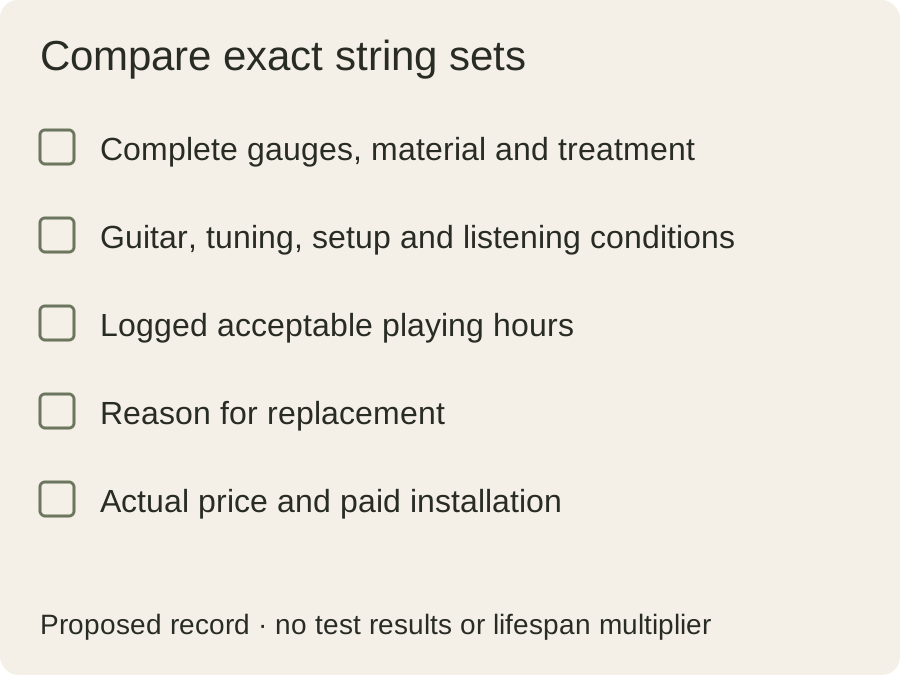
Which use cases favor each choice?
Choose the question that matches your routine. Frequent gigging calls for a response you continue to accept across the schedule. Occasional practice requires both storage and playing-time notes. A recording project may prioritize a familiar fresh-set response. None of these situations automatically chooses a coated or uncoated product.
Compare the exact set you can obtain and keep using. If feel, tone or a compatible gauge remains unresolved, settle that before extrapolating a cost or lifespan result.
Read the exact pack and care information
Before buying, confirm the maker, exact set, instrument type, complete gauges, wrap material and treatment coverage. Check current care information and whether a third string is plain or wound where that matters to the instrument. A “premium” label supplies no replacement interval.
Treat manufacturer benefits as attributed claims. The comparison card records your observations and supplies no microscopic construction or measured result. The hero is an editorial illustration and supplies no coating evidence.
Conclusion: compare exact sets in a real use case
Start with compatible named sets and comparable specifications. Record the surface you prefer, the response you continue to accept and why the set is replaced. Judge value with your actual prices and usable period. Keep the result tied to the instrument, conditions and player.
Frequently asked questions
Do coated guitar strings always last longer?
They are designed to resist some contamination or corrosion, but actual acceptable life depends on the product, playing hours, sweat, climate, storage and what the player considers worn. No universal number applies.
Do coated strings sound duller than uncoated strings?
Not as a universal rule. Coating type, string material, gauge, age, guitar and listening conditions all affect the result. Compare named fresh sets at a matched level and then track how their sound changes.
Are treated strings the same as film-coated strings?
No. Makers use different processes. For example, D’Addario describes treated wrap wire for XT and a film coating for XS. Read the exact product specification.
Are coated strings worth the extra cost?
They can be if the player enjoys their feel and gets a longer acceptable service period. Compare the pack price and actual change interval rather than assuming a fixed saving.
Can I tell whether a string is coated from a guitar photograph?
Usually not reliably. Use the maker’s current packaging or specification for the exact string set; editorial photos should not be treated as material proof.
Should I change gauge when trying coated strings?
Keep gauge, material and tuning as similar as possible during a first comparison. Changing gauge at the same time changes tension and feel, making the coating effect harder to judge.
How this guide was prepared
We checked D’Addario’s dated XT/XS explanation and visually read its XS Electric components graphic, including the separate treated-plain-steel description. Manufacturer longevity and feel claims remain attributed; no life ordering is adopted as an independent result. The comparison log and purchase/installation-cost-per-acceptable-hour equation are editorial aids. We did not test strings, prices, corrosion, film thickness, tone or replacement hours. A personal observation with unmatched construction does not isolate a coating effect.
Documentation checked .
Clarified treatment scope and manufacturer claims, replaced the generic film illustration with a practical log, removed unverified category price ranking and store framing, and added a conditional cost calculation.