The decision in brief
String gauge is the diameter of a guitar string, usually stated in thousandths of an inch. A “9–42” set typically runs from a .009-inch first string to a .042-inch sixth string, but the middle strings and construction still matter. At the same pitch, scale and construction, a heavier gauge generally increases tension and resistance. When choosing a set, compare the complete gauges, tuning, scale length, playing touch and the guitar maker’s limits; a large change may require setup work.
What matters most
- Read the complete set of gauges rather than only the first-string nickname.
- Consider scale length and tuning alongside gauge.
- Recheck relief, action and intonation after a significant gauge change.
Read the whole set, not only “nines” or “tens”
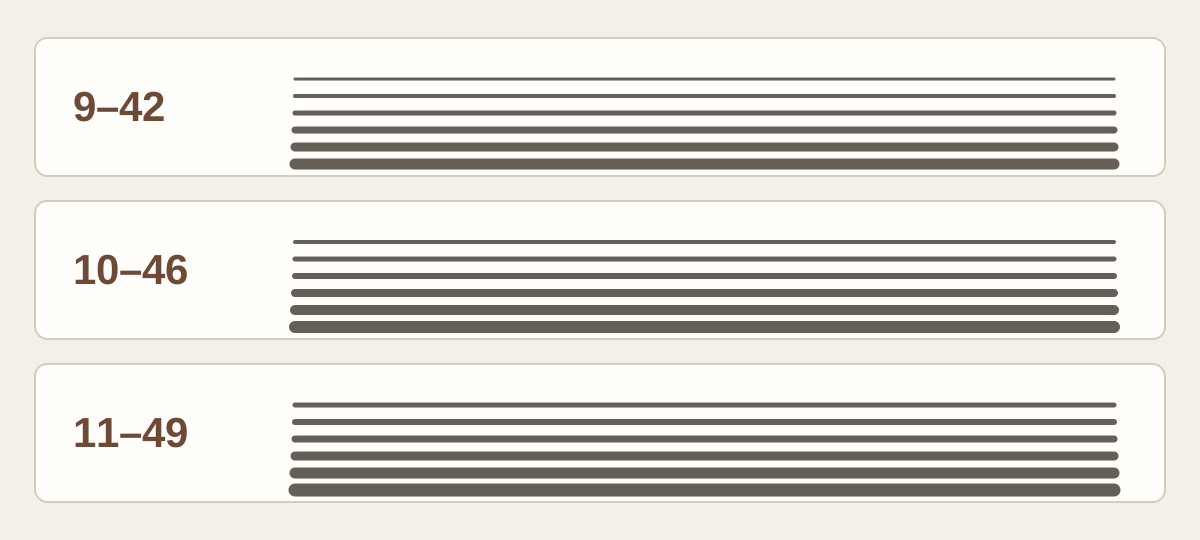
Gauge is string diameter. On steel-string electric and acoustic packs, values such as .009, .010 or .012 inches describe the first string, and a shorthand such as 9–42 names the thinnest and thickest strings in thousandths of an inch. The four middle gauges are not fixed by that shorthand. Two 10–46 sets can differ in their G, D or A strings, core-to-wrap construction and material.
That is why “light” and “medium” are poor universal measurements. A maker may call a 10–46 electric set regular light, while a steel-string acoustic brand uses a different range. The instrument type matters too: classical nylon-string sets are commonly sold by tension category rather than the same steel-string gauge convention. Never replace nylon strings on a classical guitar with steel strings simply because the package looks like a guitar set. Check the maker’s specification for the actual instrument.
Record the complete six-string set, winding material, plain or wound third string, intended instrument and tuning. A retail listing that only says “10s” leaves important questions unanswered. D’Addario’s electric-gauge guidance shows that mixed sets such as a light treble with a heavier bass are deliberate products, not errors in the shorthand.
The international inch is exactly 25.4 mm. Multiply the diameter in inches by 25.4: .009 inch is 0.2286 mm, .010 is 0.2540 mm, .042 is 1.0668 mm and .046 is 1.1684 mm. These are unit conversions of nominal package values, not measurements of individual strings or nut-slot dimensions.
Sources: D’Addario: electric-string gauge notation and mixed sets; NIST: the exact 25.4 mm international inch
Common example sets and their limits
| Example label | Where it is often considered | Check before deciding |
|---|---|---|
| 9–42 electric | Lighter fretting and bending feel at standard tuning | Full gauges, scale, attack and current setup |
| 10–46 electric | A common comparison baseline | Whether its resistance suits the player |
| 11–49 electric | Greater resistance at the same scale and pitch | Nut slots, bridge range and hand preference |
| 11–52 acoustic | A lighter steel-string acoustic example | Maker limits, projection needs and construction |
| 12–53 acoustic | A common steel-string acoustic example | Exact set and guitar recommendations |
These set labels illustrate different comparison ranges; they are not prescriptions for every guitar or verified rankings of popularity. Read the complete package, the guitar’s permitted string system and the intended tuning. Avoid promising that a particular gauge will cure finger pain, improve technique or produce objectively better sound.
Gauge numbers are diameters, not tension ratings. The same diameter can yield a different playing response when the core, wrap, material or tuning differs. Compare exact products at the intended pitch and scale length rather than turning a set label into a single “hard” or “soft” score.
Sources: D’Addario: electric-string gauge notation and mixed sets
Why gauge changes tension and feel
In an ideal vibrating-string model, tension depends on mass per unit length, vibrating length and pitch. A thicker string of comparable construction usually has greater mass per unit length and requires more tension at the same pitch and scale. D’Addario’s tension explanation gives those variables and its unit-weight formula. A diameter label alone cannot determine tension for every wound-string design.
“Tension” is not identical to “stiffness under the fingers.” Core design, winding, bridge break angle, fret height and the length of string beyond the nut and saddle can change perceived compliance. A player might call two sets at similar calculated tension different in feel. Treat the calculator as a controlled comparison tool, then confirm with the instrument.
Changing gauge can also alter the guitar’s balance. On a floating vibrato, different total string tension can move the bridge against its springs. A thicker string may bind in a nut slot that was cut for a smaller diameter. Intonation and action can shift. Those changes are setup questions, not proof that one gauge is faulty.
Sources: D’Addario: unit weight, vibrating length, pitch and tension formula
Choose for the music, not for a slogan
For a player who bends frequently in standard tuning, a lighter treble side may reduce resistance. A hard strummer or a player using a lower tuning may prefer more resistance on the bass side. A hybrid set can address those different demands without forcing every string into the same light-or-heavy label. But a thicker set does not guarantee better tone or longer sustain on every guitar; pickup, amplification, attack and setup all matter.
Use a short playing test: tune to the intended pitch, play a sustained chord, a repeated low-string rhythm pattern and a controlled high-string bend. Note whether the strings return to pitch and whether notes buzz under the player’s normal attack. Repeat after the guitar has settled and been checked for setup. Comparing a fresh set with an old, corroded set can exaggerate differences that are not caused by gauge.
Name the problem you want to change. “These strings feel too stiff for the bends I play” gives a useful starting point. Write down tuning, nominal scale, bridge type and the complete current set before choosing another compatible set. That record helps you compare the change and explain it to a technician.
Account for scale length and tuning
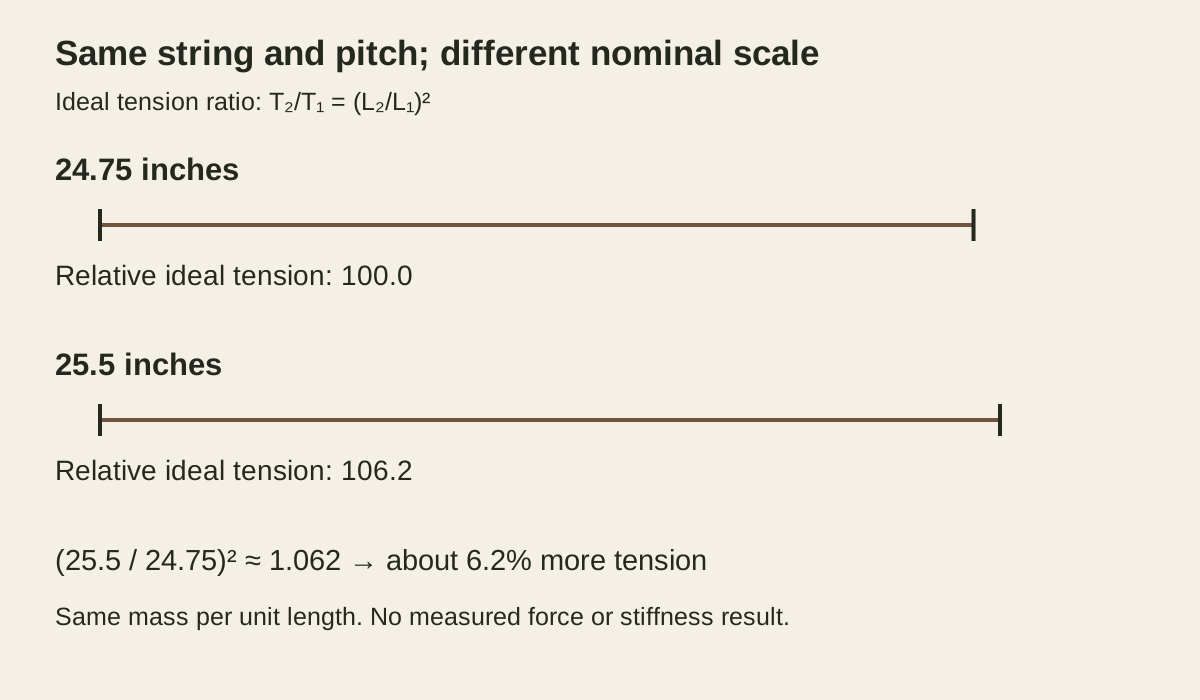
On otherwise comparable strings, a longer scale at the same pitch generally requires greater tension. Lowering pitch without changing strings generally reduces tension. Those effects explain why a set that works on one guitar may feel loose or rigid on another. A 24.75-inch and a 25.5-inch guitar can both use a 10–46 pack, yet their feel need not be identical. Read the scale-length guide alongside gauge rather than treating the two specifications separately.
For alternate tunings, calculate or compare string-by-string tension rather than choosing a thickest-string number alone. A low sixth string may need a different gauge while the higher strings remain comfortable. For extended-range instruments, confirm the maker’s bridge, tuner and nut compatibility. When the goal is a specific pitch and feel, name both in the comparison record.
Do not infer the safe maximum string gauge from a generic online chart. Acoustic and classical instruments differ in construction, and the manufacturer’s current instructions take priority. Martin’s care guidance, for example, cautions that classical instruments are built for nylon strings and that steel strings can cause damage.
Holding the same string’s mass per unit length and pitch constant, the ideal tension ratio is T₂/T₁ = (L₂/L₁)². Comparing nominal lengths of 24.75 and 25.5 inches gives (25.5/24.75)² ≈ 1.062, or about 6.2% more ideal tension for the longer scale. This is a calculated comparison, not a measured guitar result or a 6.2% change in perceived stiffness. Different setup and string construction can change the playing comparison.
Sources: D’Addario: unit weight, vibrating length, pitch and tension formula; Martin: care, string compatibility and string installation (2022), pp. 5–7, 11
What to check after changing gauge
Install the correct instrument-specific set, tune to the intended pitch and allow it to settle. Check neck relief, nut-slot fit, open-string clarity, action, bridge position and intonation. A significant gauge change can call for a professional setup. Fender’s factory setup guidance explicitly notes that its published values assume the standard factory string gauge and may need compensation when the gauge changes.
Do not widen a nut slot with an improvised tool or force a large string into it. Excess friction can cause tuning problems, and a slot cut too deep cannot be fixed by simply changing back to lighter strings. A floating bridge can also require spring adjustment. If the truss rod meets strong resistance or the instrument is structurally unusual, refer the work to a qualified technician.
- Record the old and new complete string gauges.
- Keep the intended pitch and scale length with the record.
- Inspect nut-slot fit and bridge travel.
- Check relief and action using stated reference points.
- Recheck intonation after the new set stabilizes.
- Note the player’s actual bending and rhythm response.
Use a before-and-after gauge log
Write the reason for changing before buying another set: easier treble bends, a firmer low string in a named tuning, or a different response under your normal attack. Record all strings, not just “nines” or “tens.” Keep construction and condition comparable if you want to investigate gauge rather than coating or wear.
For a conventional electric at standard tuning, comparing a compatible 9–42 product with a compatible 10–46 product can be a useful personal trial; it is not a recommendation for every guitar. Ask for the maker’s permitted range and assess the nut and bridge before changing. A floating bridge can move when total tension changes, so compare after the setup has been checked.
| Before changing | After the set settles |
|---|---|
| Exact product and all gauges | Exact new product and all gauges |
| Tuning and nominal scale | Use the intended tuning and same scale |
| Relief, action and bridge position | Remeasure using the same reference points |
| Bending and rhythm observations | Repeat the same passages and attack |
| Pitch return and intonation | Recheck stability and fretted notes |
If a larger string binds, do not force it or file the nut without the appropriate assessment. If new buzzing appears, consult the action guide and buzz diagnosis before changing several parts at once. Keep both packages so reverting or asking a technician is based on the actual products, not a remembered nickname.
Sources: D’Addario: String Tension Pro calculator and variables
Do not transfer one instrument rule to another
Electric and steel-string acoustic guitars can use very different typical sets. An acoustic top and bridge respond as a system under string load; select from gauges the maker permits and pay attention to the model’s age and condition. A vulnerable vintage instrument warrants individual professional assessment. The fact that a set is sold for “acoustic guitar” is not a safety approval for every acoustic.
Classical and flamenco guitars use their own nylon or suitable composite string systems. Packages may use low, normal or high tension rather than steel-string diameter shorthand. Bass, baritone and extended-range instruments have separate scale and attachment requirements. Match the exact instrument category before comparing products.
Sound descriptions should stay conditional. A fresh heavier acoustic set can change how one guitar responds to a particular attack, but the outcome depends on the top, bracing, setup and player. A clear product page says what the strings are; it does not promise a universal tonal result.
Keep a string specification you can use
For your own guitar, record the exact installed string product where known, all gauges or the nylon tension category, tuning and nominal scale. If a previous owner’s set is unknown, state that uncertainty and check compatibility before using it as a baseline.
Separate diameter, core and wrap construction, material and coating. A coated and an uncoated 10–46 set differ in more than their shared outer-gauge label. The coated-versus-uncoated guide helps plan a maintenance and feel comparison. Record your own use rather than adopting an unverified promise of playing hours.
Keep your tuning, scale, bridge, current set and reason for changing with the comparison notes. Record any setup work as another changed variable. A technician can then work from actual specifications instead of a remembered “light” or “professional” label.
Conclusion: start with the instrument and the task
String gauge is a measurable diameter, but the set label does not encode the whole playing experience. At a fixed pitch and scale, heavier comparable strings generally raise tension; changes in scale, tuning, construction and setup can alter the result. Choose the complete set for the guitar’s design and the player’s actual music.
If a change is modest, compare it with notes on feel and tuning stability. If the change is substantial, budget for a setup and check the maker’s limits. The right set is the one that supports the desired pitch and technique while keeping the instrument in a healthy, playable state.
Frequently asked questions
What does a 9–42 guitar string set mean?
It usually means the first string is .009 inch and the sixth string is .042 inch in diameter. The four middle gauges vary by set, so read the complete package specification.
Do heavier strings always have more tension?
At the same scale length, pitch and comparable construction, a heavier string generally requires more tension. Tuning, scale, core, wrap and material can change the comparison.
Are 9s or 10s better for a beginner?
Neither is universally better. Both are common electric-guitar starting points. Check the guitar, setup, hand comfort and music, then choose a set that lets the player fret and bend without excessive effort.
Do I need a setup when changing string gauge?
A meaningful gauge change can alter relief, action, nut-slot fit, bridge position and intonation. Check those items; consult a qualified technician if the change is large or the instrument is difficult to adjust.
Can steel strings go on a classical guitar?
No, unless the instrument maker explicitly designed that exact model for steel strings. Conventional classical guitars are built for nylon-string tension and construction; steel strings can damage them.
Why can the same 10–46 set feel different on two guitars?
Scale length, bridge geometry, setup, fret size, tuning and instrument condition can all affect playing feel even when the string pack is identical.
How this guide was prepared
D’Addario documents gauge notation and the tension variables; NIST provides the inch definition, while Fender and Martin supply scoped compatibility and setup guidance. The diameter conversions and same-string scale ratio are editorial calculations for an ideal string model. The before-and-after log is a suggested personal method. No string set was installed or tested, and no playing-force, tone or durability result is claimed.
Documentation checked .
The update adds exact unit conversions and a conditional scale/tension calculation, replaces the misleading scale image, attaches relevant sources and turns retail instructions into a player’s own record.