
The decision in brief
For a steel-string acoustic guitar, begin with a complete set that matches the maker's approved string type and gauge. Then compare wrap alloy, coating and feel within that compatible range. Phosphor bronze and 80/20 bronze are common choices, but their labels do not guarantee one sound on every guitar. Keep gauge and setup constant when testing alloy, check the whole gauge sequence, and use a technician when a string change exposes structural or setup problems.
What matters most
- Confirm a steel-string acoustic model and its approved string system.
- Write down the current tuning and complete gauge sequence.
- Choose one change with a clear playing goal.
Confirm the guitar's string system before choosing a set
This guide covers conventional steel-string acoustic guitars. A classical guitar needs its own approved nylon or composite string system; an acoustic bass, twelve-string, baritone or specialist instrument needs a set designed for that format. A package saying acoustic is not enough to establish compatibility. Identify the guitar model, number of strings, intended tuning, attachment and current set before buying a replacement.
Find the maker's current specification or care guidance and keep it with the instrument record. If the original set is known and the guitar plays well, replacing it with the same approved type and gauge gives a useful baseline. If the strings were changed by a previous owner, do not assume that their choice establishes what the instrument can safely carry. Ask the maker or a qualified technician when the model or condition is uncertain.
The general guitar-strings guide explains instrument-family compatibility. Here the question is narrower: once a steel-string acoustic system is confirmed, which replacement features deserve attention? Start with a musical or practical goal, such as a less stiff feel, a different attack or fewer changes between rehearsals.
Sources: Martin: care, string compatibility and string installation (2022), pp. 5–7, 11
Read the complete gauge sequence
Terms such as extra light, light and medium are product labels. Read the actual diameters of all six strings and the product's intended tuning. Two sets with the same first-string diameter may use different middle or bass strings. A mixed or custom set can feel different across the hand even when the top string matches the old one.
Gauge interacts with string construction, scale length and pitch. A thicker set is not simply a louder version of a thin set, and diameter alone does not predict tension across every construction. Use the gauge guide for that relationship. Manufacturer guidance determines a sensible range for the guitar; personal preference determines which compatible option serves the playing task.
Do not jump to a heavier set to fix weak projection before checking technique, setup and the instrument's condition. A lighter set may make bends or fretting more manageable, but it can also respond differently to a strong attack. Record the old set and its tuning before a change so any new buzzing, relief movement or intonation problem has a reference.
Compare wrap alloy separately from gauge and coating
Many acoustic sets have plain steel treble strings and wound lower strings. The package alloy name mainly describes the wrap of the wound strings, rather than a promise that every string has identical construction. D'Addario's alloy guide separates core wire from wrap wire and describes phosphor bronze and 80/20 bronze as different acoustic families.
| Feature | What to verify | Useful comparison |
|---|---|---|
| Wrap alloy | Exact product and material | Attack and balance at the same gauge |
| Gauge | All string diameters | Fretting, picking and setup response |
| Coating | Which components are treated | Feel, residue and service interval |
| Construction | Core, winding and attachment | Compatibility and tactile response |
D'Addario describes its 80/20 line as bright and its phosphor bronze line as balanced, with corrosion resistance part of the latter's design history. Those descriptions apply to the maker's products; they do not establish a universal audible ranking. Compare complete sets on your guitar after they settle, at similar playing level, with the same pick or fingerstyle passage.
Choose coating for your own care and playing routine
A coating or treatment can change the surface the player encounters and the way contamination reaches parts of the string. Products use different methods, so the word coated is not a single specification. Read the set's description and distinguish a coating on the wrap from a treatment on other components. Avoid assuming that every coated string will feel slippery or that every untreated set will deteriorate at the same speed.
Compare a coated and an uncoated option with the same intended instrument, gauge and alloy where possible. Note initial feel, sliding noise, picking response and the reason you later replace each set. The coated-versus-uncoated comparison provides a broader framework. A player's real service interval is more useful than an unsupported promise of a particular number of months.
Keep the cost calculation simple: record purchase cost and the amount of acceptable use in your own routine. Sweat, hand cleanliness, storage and musical preference vary. A set that lasts longer but feels wrong can still be a poor fit, while a frequently changed uncoated set may suit recording work or a specific attack.
Match the change to a specific playing complaint
If fretting feels difficult, compare action, nut height and technique before assuming gauge is the only cause. If bass notes feel unstable under a strong pick, compare the current gauge and tuning with the maker's approved options. If a recording sounds too sharp at the attack, check microphone placement, pick and playing level as well as the set. One complaint can have several causes.
Write a goal that can be tested: preserve the current gauge but compare wound-string attack; keep the alloy and compare coating feel; or try a lighter approved set and note the setup response. Changing alloy, gauge, coating and pick together makes it difficult to explain the result. A preference is still valid, but the cause becomes uncertain.
A guitar can also sound different to the player than to a listener across the room. Use the context that matters. For solo playing, judge the unamplified instrument. For performance with an onboard pickup, test the amplified path too. A string choice that works acoustically may reveal a balance issue through a particular pickup system, and the electronics may need their own assessment.
Install the set and evaluate it after it stabilizes
Follow the maker's string-change instructions for the bridge, tuners and any unusual attachment. Keep the old package or record the exact set before removing it. Seat bridge pins and ball ends correctly without forcing parts. Do not copy a string path from an unrelated guitar. If a pin, saddle, tuner or bridge appears damaged, resolve that condition before loading another set.
Tune gradually to the approved pitch, recheck each string after ordinary playing, and inspect the string path if the pitch jumps or settles poorly. A gauge change can alter relief, action or intonation. The action guide and intonation guide help describe those symptoms without prescribing a universal adjustment.
Compare after the set is stable enough for normal playing. A fresh set versus a dirty, worn set is mostly a condition comparison. To investigate alloy, use similarly fresh compatible sets and record the time since installation. Keep the guitar, room, microphone placement and playing passage as similar as practical, and label any recording with the actual product rather than a generic material name.
Sources: Martin: care, string compatibility and string installation (2022), pp. 5–7, 11
Check symptoms before buying a different set
A repeated break at the same bridge or tuner contact can indicate a burr or sharp edge. A single note that buzzes may relate to a fret or setup issue. A new set that slips at the tuner may have been installed poorly. Replacing strings again may temporarily change the symptom while leaving its cause unresolved. Record the location and timing of the problem and inspect the exact string path.
If all wound strings seem dull immediately, confirm the product and package condition, then compare through the same acoustic or amplified path. If only the amplified sound changes, check the pickup and signal chain. If tuning is right on open strings but chords sound sharp, compare fretting pressure and intonation. Avoid adjusting a truss rod as a general response to every string complaint.
When corrosion or residue is the reason for replacement, review wiping, storage and the products used around the instrument. A clean dry cloth and the maker's care guidance are useful starting points. Do not put household cleaners or an unfamiliar treatment on strings where it may reach wood, finish or hardware. Keep persistent damage or unusual structural movement for a technician.
Use a simple string comparison record
A useful record fits on one page. Write guitar model, scale, tuning, full set name, gauge sequence, installation date and any setup work. Add three observations at normal playing level: how first-position chords feel, how the bass strings respond to your usual attack, and how the sound serves the actual room or recording. Revisit the note when you change the set.
For example, imagine a player who likes the current feel but finds slides noisy in close microphone recordings. The first test can preserve gauge and compare one coating option, using the same recording position and passage. If the player instead changes gauge, alloy and microphone, the result may be pleasing but will not isolate surface treatment. This is an illustrative method, not a report of a test we performed.
Record the reason for the next change: broken string, corrosion, lost response, feel or planned session. That history gradually tells you which product serves your own use. It also prevents an arbitrary calendar schedule from replacing inspection. A harmless color change is different from a damaged or rough string that interferes with playing.
Keep a short change record: the feature you changed, the features you held constant, the observation and any setup work. For an alloy comparison, hold the complete gauges, coating, tuning and playing passage as close as practical. For a gauge comparison, hold alloy and coating where possible and record the setup response. If several variables change, describe a preference for the complete set without assigning the result to one feature.
When this advice changes
A twelve-string, baritone, short-scale specialist or vintage acoustic may have requirements that differ from a conventional six-string. Confirm total set design, string length, attachment and approved pitch. Taylor’s June 2023 string FAQ provides a dated example of model-specific recommendations. It does not establish a permitted gauge for another maker’s instrument or every later Taylor model. Check current guidance for the exact guitar.
A guitar with bridge lifting, cracks or abnormal top movement needs assessment before a tension increase. A low-tuned setup may need different strings or adjustments. An unusual magnetic, piezo or other pickup system may react differently to wrap construction. If the player's concern involves persistent pain, stop and seek appropriate guidance; a package label cannot diagnose a physical problem.
The baseline rule remains useful in these cases: identify the exact instrument and its condition, then consult the relevant maker or technician. Generic online advice is least reliable where important model information is missing.
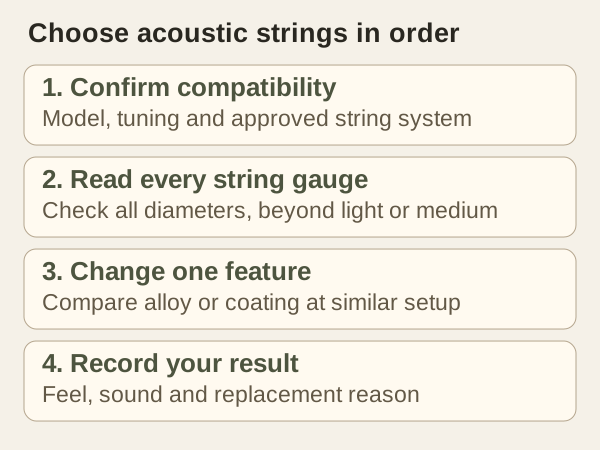
The acoustic string replacement checklist
- Confirm a steel-string acoustic model and its approved string system.
- Write down the current tuning and complete gauge sequence.
- Choose one change with a clear playing goal.
- Read alloy, coating and construction as separate features.
- Install according to the guitar maker's method.
- Recheck tuning, action and intonation after the set settles.
- Record the useful result and the eventual replacement reason.
Choose the compatible set that gives the response and upkeep you prefer on your own guitar. Bronze labels and gauge names are useful starting information, but a fair trial and a sound setup make the choice dependable. If you are satisfied with the existing approved set, repeating it is a valid decision.
Frequently asked questions
Should I choose phosphor bronze or 80/20 bronze?
Compare compatible sets at the same gauge and similar age. Makers describe different tendencies, but the useful choice depends on the actual guitar and playing task.
Are light acoustic strings the same gauge for every brand?
No. Read all six diameters. The label alone does not reveal the full gauge sequence or tension.
Can I put steel acoustic strings on a classical guitar?
Use only the string system approved for the exact instrument. A conventional classical guitar is designed for nylon or suitable composite strings.
Do coated acoustic strings last a fixed number of months?
No universal interval applies. Inspect the set and record your own playing time, storage, feel and reason for replacement.
Do new strings require a setup?
An equivalent replacement may need little change, while a gauge or tuning change can alter the setup. Have abnormal movement or persistent problems assessed.
How this guide was prepared
This guide uses D’Addario’s alloy descriptions, Taylor’s dated model-specific guidance and Martin’s care instructions to separate compatibility, gauge, alloy and maintenance. The comparison record and playing checks are editorial suggestions. No strings were installed, recorded or followed for service life for this update; manufacturer tone descriptions are not our listening results. The instrument image is an editorial illustration.
Documentation checked .
The update adds a traceable installation source, dates the model-specific example and explains which variables to hold constant in a personal string comparison.