Start with the task
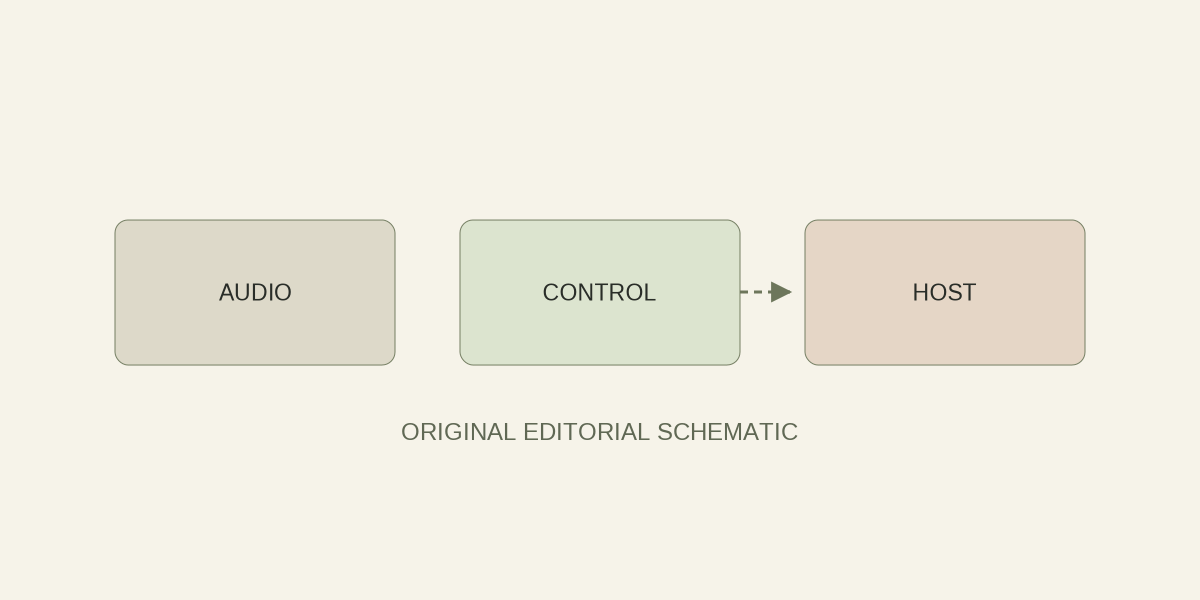
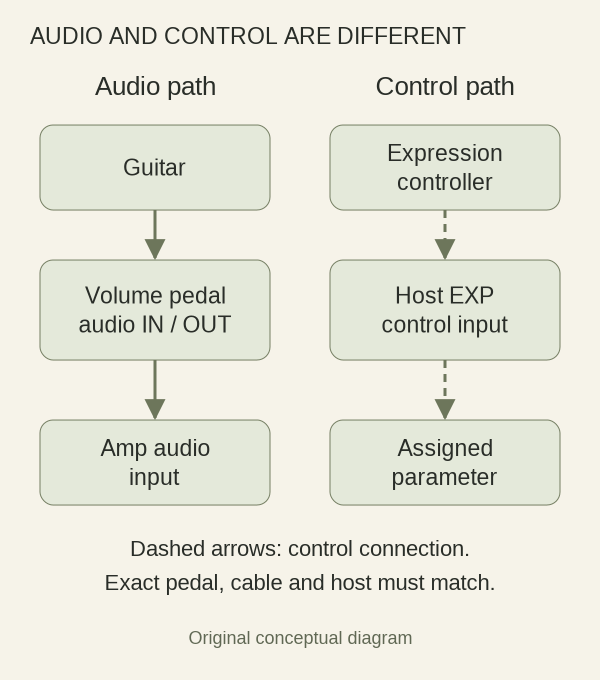
An audio volume pedal changes a signal passing through its audio connections. An expression pedal controls a parameter in a compatible host through a control connection. Some units provide both functions on separate jacks. Match the exact pedal, cable and host input; a similar treadle or TRS plug does not establish compatibility.
Identify the job of the destination socket
Begin at the device you want to control. An audio input receives the guitar or another supported audio source. A socket labelled EXP may instead read a control pedal. Moving that pedal can change volume, wah position or another assigned parameter inside the host without sending guitar audio through the pedal itself.
| Question | Audio volume route | Expression route |
|---|---|---|
| What travels through the connection? | Supported audio signal | A control connection read by the host |
| Where is the sound changed? | In the documented audio path | At the parameter assigned inside the host |
| What must match? | Source, pedal input and destination | Pedal, host control requirements and cable |
A pedal can control volume through expression while still being an expression controller. Name both the physical connection and the assigned function so that “volume pedal” does not hide which route you mean.
Read dual-function and dual-output examples carefully
BOSS lists separate INPUT, OUTPUT and EXP connections on the FV-500H. Its FV-500L has two audio input/output channels and an EXP connection. These named units show why the statement “a volume pedal can never act as an expression pedal” is too broad. The appropriate jack and the receiving device still have to match.
The EV-30 is an expression controller with two expression outputs and separate minimum controls. Its specification assigns the polarity switch to EXP 2. Do not infer the same switching feature on both outputs, or interpret two control outputs as left and right guitar audio.
These examples identify functions, not interchangeable parts. If you already own one of them, use the documented role that solves your task; neither this comparison nor a matching brand name approves every possible host.
Sources: BOSS: FV-500H/FV-500L audio and expression connections; BOSS: EV-30 outputs, minimum controls and EXP 2 polarity
Check the pedal, cable and host as a set
- Record the exact model and version of both devices.
- Find the host’s expression-input instructions and any compatible-pedal list.
- Confirm the specified cable and contact assignment, polarity options and any published controller requirements. If resistance or another required detail is unclear, ask the maker rather than substituting a guessed value.
- Check whether the intended pedal jack is audio, expression, a switch connection or another control interface.
- Resolve the required power and connection procedure before plugging in.
TRS describes tip, ring and sleeve contacts. It does not by itself establish the control circuit or guarantee that a cable suitable for stereo headphones is the documented controller lead. The TS/TRS and signal-role guide explains why connector appearance is insufficient.
Separate connection from assignment and calibration
Once the connection is supported, follow the host’s setup procedure at a low listening level. Check the parameter assignment and whether the host requires calibration. Move through the travel and observe the displayed endpoint values where the device provides them.
Test the actual task. A controller assigned to a limited parameter range may move normally while leaving some sound at heel-down. A nonzero minimum setting can also be intentional. An inverted response, a jump or a dead area is a reason to revisit the model-specific connection and setup; it does not establish which component has failed.
Do not change the cable, polarity, assignment and calibration together while trying to find the cause. Record one supported change and the resulting display or sound before moving on.
Choose audio placement only after identifying an audio pedal
If your task requires an audio volume pedal, its source and destination requirements matter as well as its position. The FV-500H and FV-500L are documented with different audio roles; a shared shape does not make those roles identical.
Then decide whether you want to change drive input, fade into delay or reduce the output of the full effects route. Our volume-pedal placement guide handles that next decision. An expression assignment may achieve a similar musical fade inside a processor, but its location is the host parameter’s place in the processing chain.
Sources: BOSS: FV-500H/FV-500L audio and expression connections
Keep the evidence behind the working connection
| Record | Useful detail |
|---|---|
| Identity | Exact pedal, host and versions |
| Connection | Jack names, cable and documented requirements |
| Control | Assignment, minimum, endpoints and calibration |
| Result | Task achieved, remaining symptom and next question |
Keep the manual pages or support confirmation with the record. “It fits the socket” and “it worked on another unit” leave important questions open. When compatibility remains uncertain, choose a documented combination before purchasing or modifying a cable. No soldering or rewiring procedure is supplied here.
Download the blank record (English CSV). The fields are empty; the sheet contains no site test results.
How this guide was prepared
AI-assisted review of the current BOSS EV-30 and FV-500H/FV-500L product specifications on 26 November 2026. Output roles and the EXP 2 polarity limitation were read separately. The connection checklist and host-configuration sequence are editorial guidance, not a completed hardware test. No human technical review is claimed.
Documentation checked .