Start here
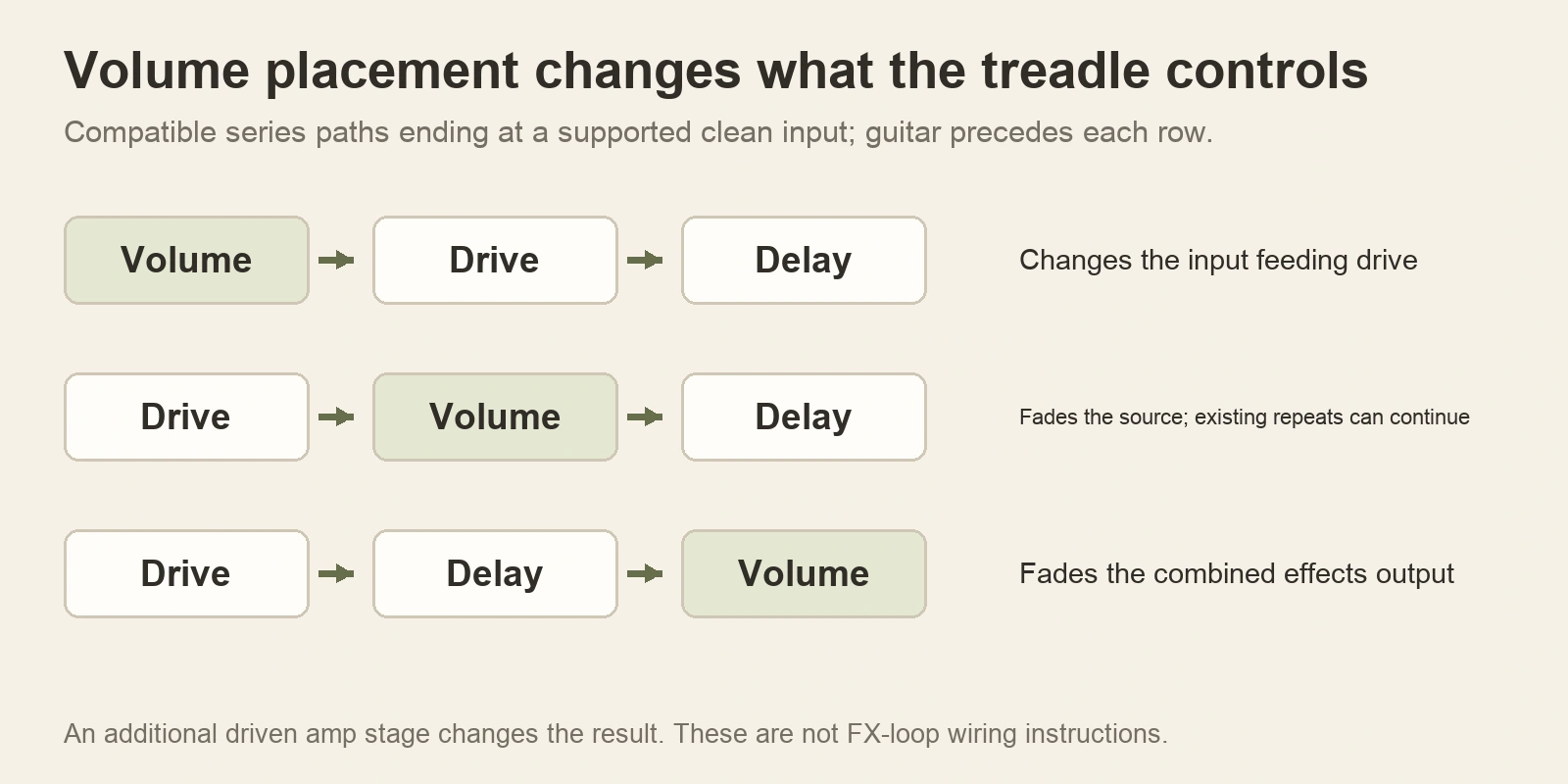
Place a compatible volume pedal before an input-sensitive drive stage when you want its input to fall with the treadle. Place it after the chosen drive stage but before delay and reverb when you want to fade the driven signal while leaving their existing tails. After those effects, it also fades their output. A later driven amp stage can change all three results.
Define what your foot should change
Choose one task: reduce the signal feeding a drive, fade into an effect, or lower the whole board’s output. Write the task before deciding where a treadle belongs. A control that produces a useful swell may be inconvenient as an immediate complete mute.
Confirm that this is an audio volume pedal. An expression pedal controls a supported host parameter and belongs in its specified control socket; it does not automatically pass guitar audio. Verify the exact pedal’s wiring, source requirements, power where applicable and available travel.
Open the full-size diagram in a new tab.
If the task is to control a processor parameter, first check the expression-versus-volume connection guide.
Sources: Lehle: volume-pedal placement
Compare the position relative to drive and delay
| Position | Proposed purpose | Listen separately |
|---|---|---|
| Before drive | Change drive input with the treadle | Amount of breakup and output level |
| After drive, before delay/reverb | Fade the source feeding ambience | New attacks and existing effect tails |
| After delay/reverb | Fade the combined effects output | Tails and any remaining downstream noise |
Lehle explains the first and last placements; BOSS gives volume after drive and before ambience as one arrangement. These are conditional signal-path examples. Keep the final amp input clean enough for the intended comparison, or explicitly record its additional drive stage.
Sources: Lehle: volume-pedal placement; BOSS: Is There a Perfect Pedal Order?
Include the amplifier in the map
Putting volume after a distortion pedal still leaves it before the amplifier’s preamp. If that preamp is driven, lowering the signal reaching it can change its distortion as well as level. Draw the route through the amp instead of ending the map at the last floor pedal.
Lehle discusses effects-loop placement after a preamp. Before attempting that route, verify loop type, send level, pedal limits and return requirements. A parallel dry path can prevent the treadle from controlling the whole sound. Keep required amp loads connected. Read the FX-loop checks when the route is unclear.
Sources: Lehle: volume-pedal placement
Try the musical change at a controlled level
| Passage | Observation |
|---|---|
| Short chord with a slow fade | Does breakup change with the treadle? |
| Picked note followed by a swell | Does the attack disappear as intended? |
| Note followed by heel-down | Do wanted delay or reverb tails remain? |
| Pause at the desired minimum | Is there downstream sound you expected to mute? |
Keep guitar controls, drive settings, effect mix and final listening level recorded. Mute before reconnecting as instructed. Start with one approved position; move only after checking the next position’s requirements.
This is a proposed playing comparison, not a trial we performed. Do not report a measured loudness match from a subjective listening impression.
Save the route with the useful setting
Record the exact position, amp channel, relevant loop mode, treadle minimum and the part you played. Note both the intended change and the unwanted side effect. If the next song changes amp channels or effects routing, check the result again.
Use the pedal-order guide to keep the complete map, and the delay guide when the unresolved problem is repeat level or feedback. Placement cannot replace the receiving device’s connection specifications.
Download the blank comparison record (English CSV). The sheet starts blank; it contains no measured results.
How this guide was prepared
We checked Lehle’s placement examples and BOSS’s discussion of volume after drive and before ambience. We mapped what lies before and after the control and designed a three-position listening record. No pedal was connected or auditioned.
Documentation checked .