
Start here
A conventional guitar lead normally carries unbalanced mono audio. A balanced mono connection needs supported source and receiver circuitry as well as suitable wiring. TRS describes the contacts, not the signal: the same plug format can carry balanced mono or unbalanced stereo. Read both sockets before choosing a cable.
Read the source and receiving socket first
Write down the exact output and input names. Include whether the output is a pickup, a processor line output, a DI mic output or a headphone output. Read the connection instructions for both devices before changing the lead.
Our Hi-Z versus line guide handles signal level and input mode. Balanced wiring is a different question: a balanced mic connection and a balanced line connection do not become interchangeable because both use XLR.
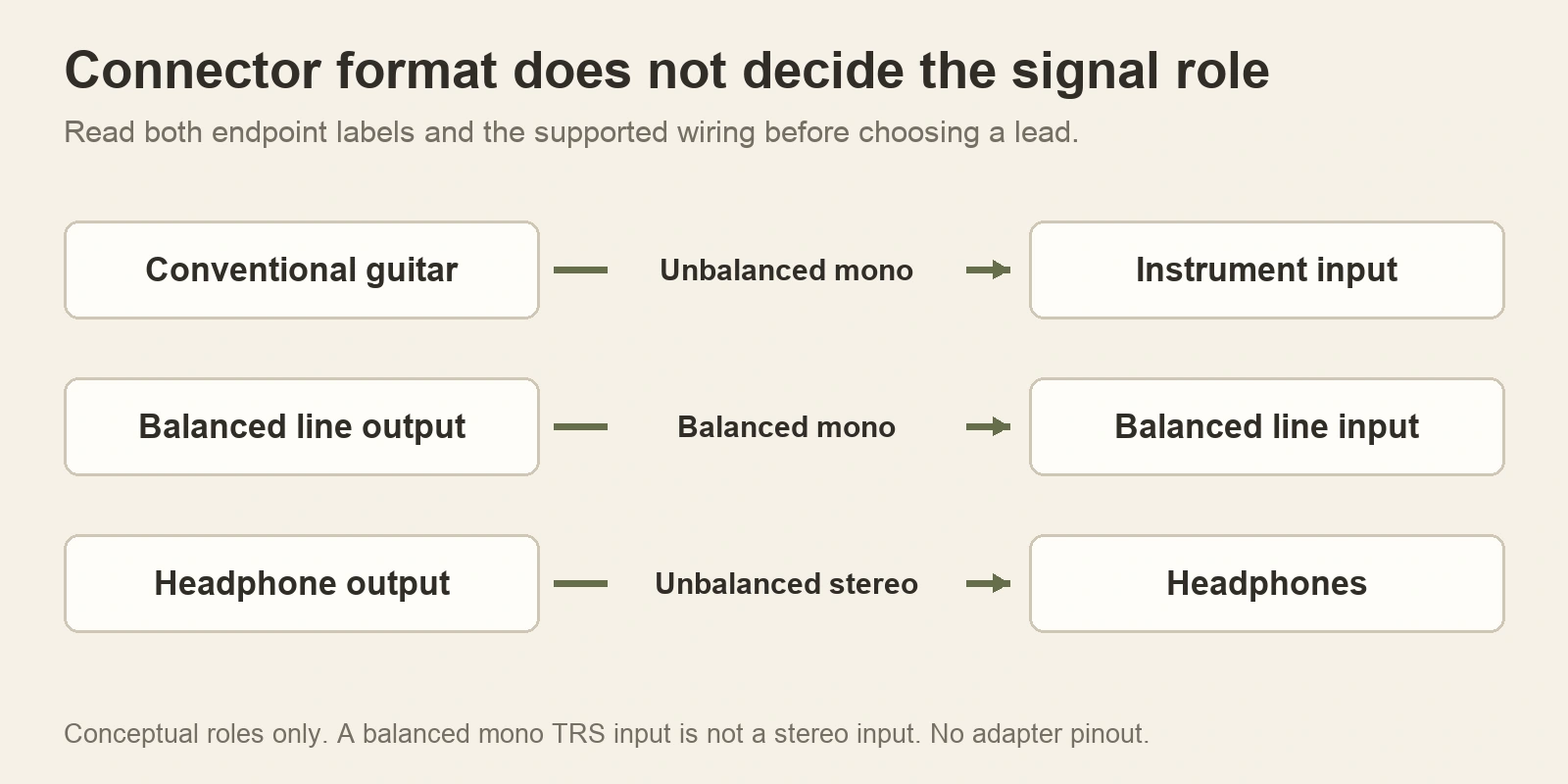
Separate three common routes
| Documented route | Signal role | What to verify |
|---|---|---|
| Conventional guitar to instrument input | Unbalanced mono | Specified instrument lead and input mode |
| Balanced processor line out to balanced line in | Balanced mono | Supported level and pin assignment |
| Headphone output to headphones | Usually unbalanced stereo | Headphone wiring and correct destination |
Focusrite describes balanced connections as a way to reject picked-up interference, and unbalanced connections as the ordinary route for pickup-equipped guitars. Those descriptions do not establish that every pedal output or guitar socket has the same wiring.
A balanced cable connected to an unbalanced endpoint does not create a balanced output circuit. Check the permitted connection, including any adapter, rather than buying from a connector photograph.
TRS names contacts, not an audio mode
TS means tip and sleeve; TRS adds a ring. Focusrite distinguishes balanced mono TRS from unbalanced stereo TRS. They use the same contact count for different jobs. A headphone output is not an ordinary balanced line output.
For stereo processor outputs labelled Left and Right, record each supported output separately. Two balanced mono channels need their own documented routes; one balanced mono input does not receive left and right as two independent channels. Use the maker’s breakout arrangement when converting a stereo connection.
For stereo guitar built from recorded layers, distinguish performances from copied signals with the double-tracking guide.
Do not use an adapter as proof of compatibility
| Check | Record |
|---|---|
| Source | Model, socket label and output role |
| Receiver | Model, supported input level and wiring |
| Lead | Contact arrangement and end-to-end assignment |
| Unknown item | Ask the maker before connecting |
Keep amplifier speaker connections outside these signal-level examples. The speaker-cable comparison explains that separate job. Preserve protective electrical grounds; an audio connection problem is not permission to remove a mains safety connection.
Where a DI is appropriate, follow its documented input, power and output requirements. The DI guide explains that conversion without treating a box as a cure for every noise.
Keep the connection record useful
Sketch one route with both endpoint names, the lead and the selected modes. Mark unknown specifications as unknown. This is a proposed documentation exercise; it is not an electrical verification procedure.
If you are investigating noise, start with one known supported connection at a low listening level. Record the symptom and each change separately. A quieter result in one arrangement does not measure interference rejection or establish that all remaining hum came from the cable.
Download the blank comparison record (English CSV). The sheet starts blank; it contains no measured results.
How this guide was prepared
We read Focusrite’s balanced/unbalanced explanation and TS/TRS/TRRS connector guide. We separated connector contacts, channel count and supported input level, then designed a socket-to-socket checklist. We did not measure interference rejection or test adapters.
Documentation checked .