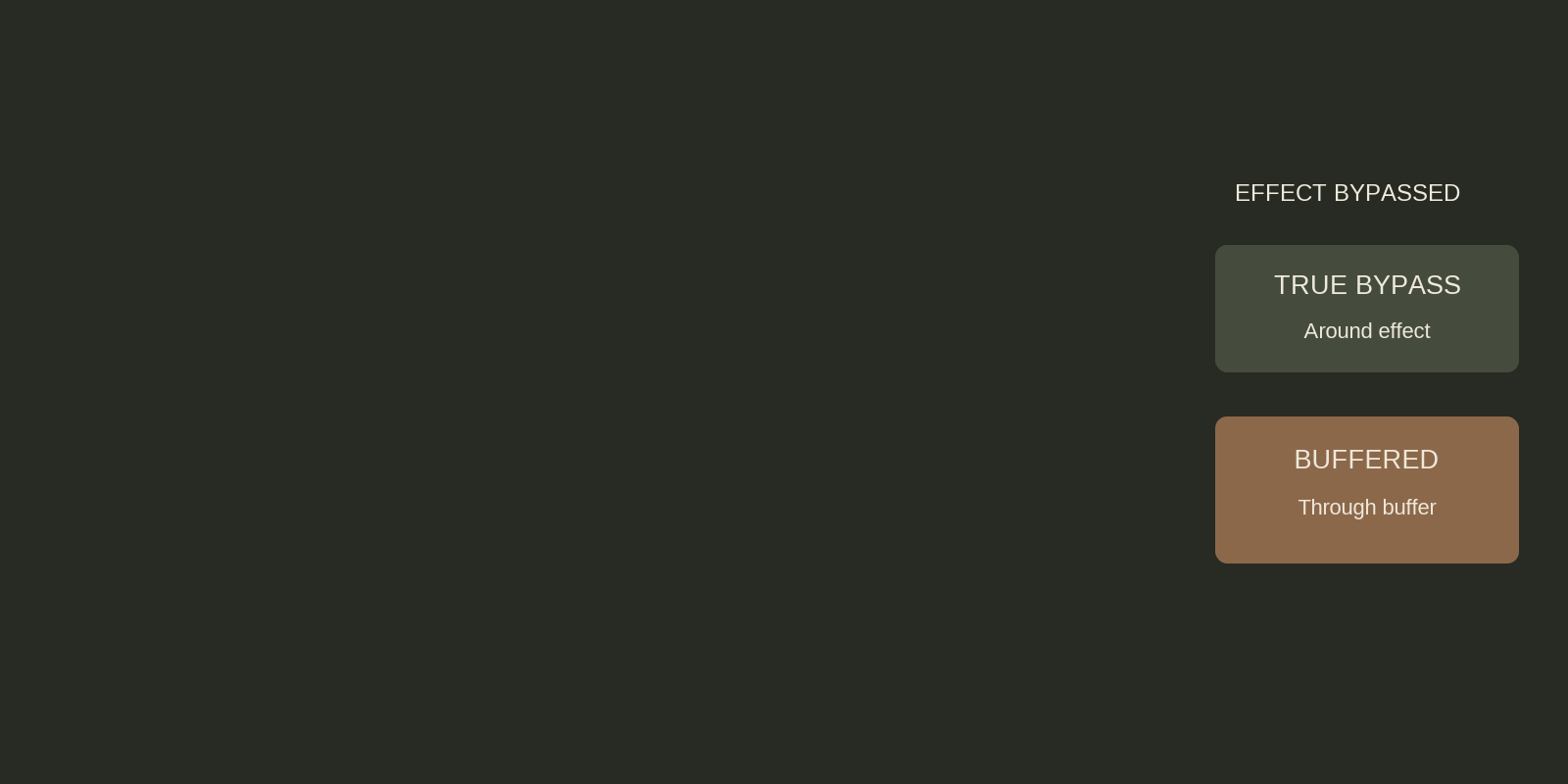
The decision in brief
True bypass routes the signal around a pedal’s effect electronics when bypassed; buffered bypass keeps a powered buffer in that path. For a conventional passive guitar, a suitable buffer can reduce the influence of cable that follows it, while cable before it still matters. Choose for the whole rig, including input-sensitive effects and documented power behavior. Neither label guarantees a preferred sound, silent switching or operation without power.
Compare the bypassed state before judging the label
Bypass means that the selected effect is disengaged. It does not mean that every electronic stage in the device is absent. True bypass provides a route around the effect electronics; buffered bypass retains a buffer while the effect is off. When the effect is engaged, its own input and processing stages belong to the comparison.
A buffer presents an input to the preceding source and a lower-impedance output to the next section. BOSS explains that this can reduce the loading effect of subsequent cable on a conventional passive guitar. Its article promotes buffered equipment; that mechanism does not establish a need to buy a particular pedal or prove which sound you will prefer.
Describe the whole route rather than counting pedals. A short board with long connecting leads and a large board with a suitable early active stage are different loading situations. The cable-capacitance guide handles length and unit calculations; the question here is which stages are present when you bypass the effects.
Sources: BOSS: buffers, passive-pickup loading and input-sensitive effects
Locate the first active stage in each state
| State | What to confirm in the manual | What belongs in your route map |
|---|---|---|
| Effect engaged | Input, output and any selectable mode | The active device and cables before and after it |
| Effect bypassed | True, buffered or another documented arrangement | Whether an active buffer remains in the path |
| Device unpowered | Specified bypass or failure behavior | A separate condition, not inferred from the bypass label |
| Preset or mode changed | Whether bypass, tails or routing also changes | The settings used for the song |
Start at the guitar and trace the route until the first suitable powered stage. Include patch cables through pedals that leave the signal unbuffered in that state. Mark the cable before that stage separately from the cable it drives. A buffer later in the chain cannot remove the loading already presented by earlier cable.
Then repeat the map for the states you actually use. If your first active effect is bypassed by true bypass during a quiet verse, the passive path may extend farther than when that effect is engaged. A photograph of the board does not establish either state.
Check the guitar’s output system as well. An active pickup system, onboard preamp or wireless receiver may already change what drives the pedalboard. Identify the actual output; do not infer it merely from a battery compartment. See active and passive pickup systems for that separate distinction.
Read what a buffer switch actually changes
The TU-3W manual identifies an OUTPUT BUF/THRU switch for selecting buffered or true bypass. That is an explicit bypass-mode choice on a named device. It is useful evidence for that model, not a rule for every tuner.
A switch labelled Buffer can have a different job. Dunlop’s M173 Classic 108 Fuzz manual specifies true bypass and separately describes a BUFFER switch for interaction with a preceding wah. That switch should not be assumed to select buffered bypass. Read the bypass specification and the switch description together.
For an input-sensitive effect, follow its maker’s placement guidance and compare the guitar-volume response in the arrangement you use. The M173 example also shows why “all fuzz pedals must reject buffers” is too broad: the documented circuit and its available controls matter. Do not treat a buffer as an automatic repair for an oscillating or noisy rig.
Sources: BOSS TU-3W owner’s manual: OUTPUT BUF/THRU switch; Dunlop M173 Classic 108 Fuzz manual: true bypass and separate BUFFER function
Check power and effect tails as separate requirements
Write down what you need when the effect is disengaged: dry signal, continuing delay or reverb tails, tuner muting, or a particular preset transition. Confirm each function in the exact manual. The words true bypass and buffered bypass do not, by themselves, specify all those behaviors.
Treat power loss as a separate operating condition. Do not assume that an unpowered pedal will pass signal, or that it will fail silently. If uninterrupted performance matters, resolve the model’s documented behavior and your recovery plan before relying on it. Switch modes only using the maker’s procedure, with the listening path muted as appropriate.
Avoid changing power, bypass mode and the signal route together while trying to judge one tonal difference. If a configuration requires several changes, record the whole configuration. You can compare two useful setups without claiming that one isolated circuit feature caused every difference.
Compare the actual route before buying another device
If a pedal already offers a documented bypass-mode choice, it can provide a useful comparison without adding another product. Otherwise, compare only supported arrangements and keep track of the extra connections. The routine below proposes observations; it reports no listening results.
- Record the guitar, pickup selection, guitar-volume setting, leads, pedal order, bypass modes and first active stage. Choose a phrase that includes high notes, decay and the guitar-volume changes you use.
- Establish the complete board with effects bypassed at a comfortable level. Keep that as the working baseline.
- Following the manual’s procedure, change one available bypass mode or one supported buffer arrangement. Keep the cable route and other settings the same where possible.
- Return to the original configuration and repeat. Record an audible difference only if you can identify it reliably in that session; record a preference separately.
- Engage the effects you use, especially input-sensitive ones, and check their response as a second task. A preferred bypass sound is insufficient if an essential effect no longer behaves as needed.
| Reference | What it can answer | What it cannot establish |
|---|---|---|
| Short direct cable to the amp | How that simpler route sounds | A difference caused only by bypass electronics |
| Complete board with effects bypassed | The actual between-effects sound | The response of every engaged effect |
| Same route with one documented mode changed | Preference between those recorded conditions | A universal ranking of bypass designs |
Use the result to keep or change a documented arrangement. If neither condition gives a repeatable useful improvement, the comparison supplies no reason to buy a buffer solely for the label. Keep fault symptoms such as crackles or dropouts in a separate connection check. For the order of the engaged effects, continue with the pedal-order guide.
How this guide was prepared
We checked BOSS’s buffer explanation, the TU-3W owner’s manual and Dunlop’s M173 Classic 108 Fuzz manual on November 9, 2026. These establish the bypass distinction and two named examples of switches with different functions. The signal-state map and comparison routine are editorial analysis. We measured no impedance, capacitance, frequency response, noise or switching behavior and performed no listening test.
Documentation checked .