A starting order, with a reason to change it
A useful starting point is guitar → tuner → input-sensitive effects or wah → drive → modulation → delay → reverb → a clean amplifier input. Use only the stages you need. For a driven amp, include its preamp in the routing decision: effects after the drive pedals can still feed amp distortion. Choose a looper position by what you want recorded, then check levels and the receiving input before comparing orders.
AI-generated editorial hero; the still life does not show a working signal chain.
Start with a musical question such as “should the repeats stay distinct when the amp is driven?” A pedalboard layout becomes easier to evaluate when you can name the signal entering each device. Physical left-to-right placement on the board does not establish electrical order; trace the cables from output to input.
What matters most
- Include amplifier gain when deciding what comes before or after distortion.
- An effects loop needs both routing and level checks; a speaker output must never feed an ordinary pedal input.
- A looper captures earlier processing; later processing remains able to change its playback.
- Compare one pair of positions at a time, with settings and listening level recorded.
Find the gain stages and the receiving input
Write the path all the way to the listening system. Include the guitar, any active effects, the amp input and the channel you use. A pedal labeled delay does not tell you whether the next amplifier stage is clean. If that stage is driven, both the direct notes and repeats entering it are processed there.
For a conventional mono front-input setup, the final pedal feeds the amplifier’s instrument input. An effects-loop arrangement instead sends the amplifier’s FX SEND to compatible processing and returns its output to FX RETURN. Check the actual amp’s routing diagram: the location and behavior of its loop are model-specific.
Keep speaker connections separate. Never connect an amplifier’s speaker output to an ordinary effects-pedal input. Maintain any load the amplifier requires, and leave internal wiring alone. Our speaker and instrument cable guide explains why a matching quarter-inch plug does not establish signal or power compatibility.
Sources: Orange: effects-loop connections and separate speaker-output duty
Use a short starting chain, then choose the exceptions
BOSS’s order guide offers a conventional progression from a relatively clean source through drive and then modulation, delay and reverb. It also acknowledges alternative positions. Treat that sequence as a first arrangement to hear. You do not need a pedal from every category.
| Stage or choice | Useful first question | Reason to change the position |
|---|---|---|
| Tuner and input-sensitive effects | Does the device need a relatively clean source? | Its manual specifies a different front-end or buffer arrangement |
| Wah and drive | Should the filter shape what enters the drive? | You want to filter the already-driven sound |
| Modulation | What signal should move or change? | You prefer its interaction with a later gain stage |
| Delay and reverb | Should repeats and ambience enter more distortion? | You want that processed texture rather than separated repeats |
| Looper | Which processing should become part of the recording? | You want to change playback with later effects |
Do not turn “tuner first” into a rule that overrides a particular fuzz or other input-sensitive device’s documentation. A multi-effects processor may also route its internal blocks differently from the order of external boxes. The Whammy and wah comparison separates pitch processing from filtering before you decide where those functions belong.
Compare what enters the drive, not just the pedal names
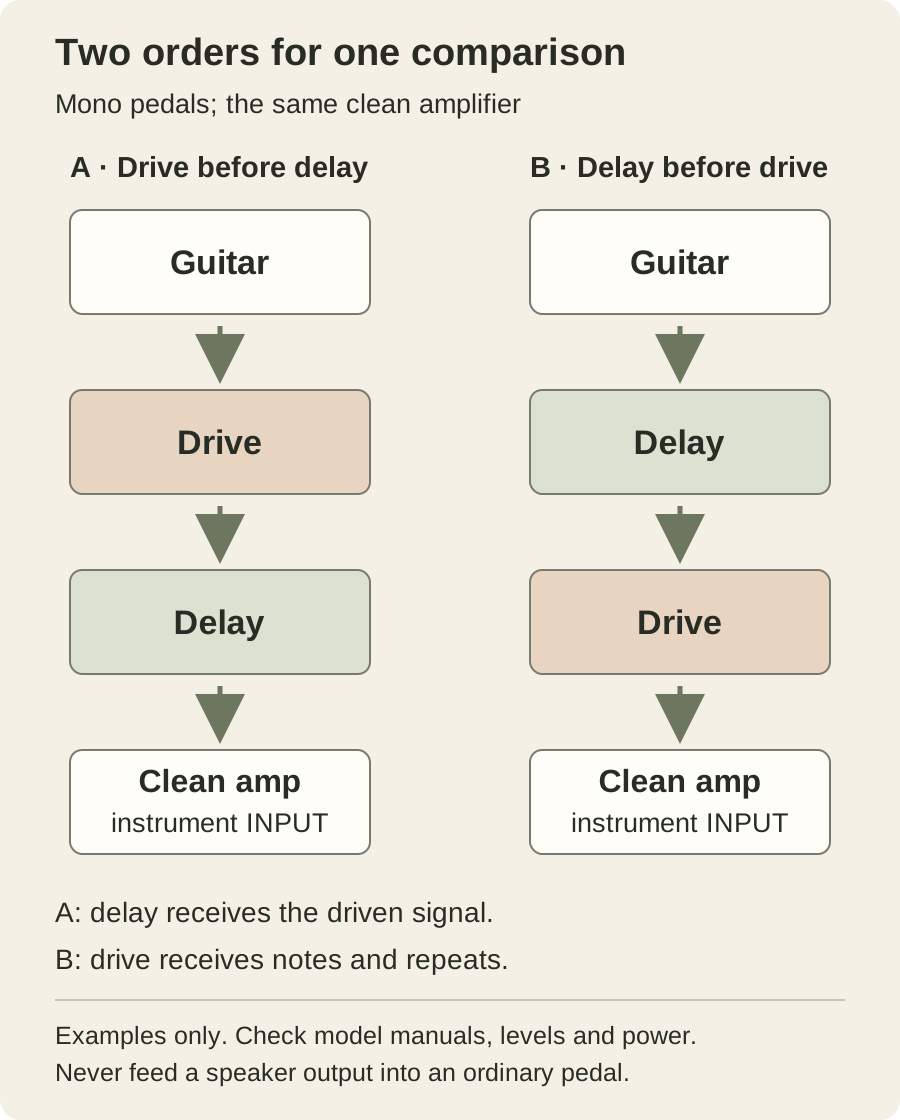
Try drive → delay when you want the delay to repeat a sound already shaped by that drive. Try delay → drive when you want the direct phrase and its repeats to enter the drive together. The latter can make the gain stage respond to their combined signal. Neither arrow diagram predicts the exact result for every circuit, setting or performance.
Keep the amplifier clean for that first two-pedal comparison. Otherwise, moving delay after the drive pedal still leaves it before the amplifier’s distortion. Begin with modest feedback and effect level so you can hear the note attacks and repeat decay separately.
A boost raises another question: are you seeking more drive, more level or both? BOSS describes boosting into an overdrive as a way to change its drive texture. A boost later in the path can still overdrive the next input. More audible output depends on spare headroom, meaning how much additional signal that stage can accept before it clips. “After the drive pedal” does not guarantee a clean solo-volume lift.
For two drive pedals, compare both directions with the same guitar part. Record each pedal’s gain, tone and output settings. There is little value in naming a winning order if the louder version simply had a higher output setting.
Sources: BOSS: pedal order as a starting point; BOSS: boost placement and drive; BOSS BP-1W: level control drives downstream inputs
Decide what the amp’s effects loop changes
If the amplifier’s documented FX loop sits after its preamp, compatible delay or reverb there can receive the preamp-shaped signal. That can keep their output from being driven again by that preamp. It does not promise a completely clean result: later stages, level settings and the receiving equipment still matter. With a clean amp, front-input effects may already deliver the result you need.
Read whether the loop is series or parallel. A series loop inserts the connected processing into the signal path. A parallel loop retains another path and blends the return with it. Dry means the signal without that added effect; in an amp loop, “dry” can already contain the amp’s preamp tone.
For a parallel loop, check whether the returned signal includes another copy of the dry sound. A documented wet-only or kill-dry route may be needed for the intended blend. Check bypass as well as the active sound. A pedal set to maximum wet mix may restore dry signal when bypassed, while a documented kill-dry mode can keep dry signal absent. The DD-8’s specific Direct Mute connection, for example, removes direct sound at output A whether the effect is on or off; follow its manual rather than copying that wiring to another pedal.
A delayed copy of the dry signal, for example from conversion in an external processor, can interact with the amp’s dry path when they are mixed. Neunaber’s explanation describes the resulting comb filtering. With several effects in the return path, changing every Mix control to maximum is not a general solution. Use the exact loop and processor instructions, or a documented simpler series arrangement, before treating a thin or uneven sound as a faulty pedal.
Sources: Brian Neunaber via Quilter: kill dry and series/parallel loops; Brian Neunaber via Quilter: parallel-loop interactions; BOSS DD-8 reference manual, pages 15–17: mono, stereo and direct mute
Put the looper where the recording needs it
Place an effect before a looper when you want that processing captured into the recorded layer. Put it after the looper when you want it to keep processing playback. In a simple chain, a drive after the looper receives both the loop and any live signal passing through; changing that drive can therefore change the accompaniment too.
A looper after delay records the repeated audio that reaches its input. A looper before delay lets the delay continue to process loop playback. The capture boundary and the delay’s continuing repeats can produce different musical results. Neither position removes the need to practise starting and closing the phrase.
BOSS’s beginner guide favors a chain-end looper for capturing earlier effects; its pedal-order article also discusses a looper before delay. These are different recording aims. Decide which sound should stay in the saved layer, then check the actual connections and levels. The looper guide covers record, overdub, stop and storage, which are separate from this routing decision.
Sources: BOSS: looper placement and capture; BOSS: pedal order as a starting point
Check level, power and the complete mono or stereo path
Before a new connection, lower volume, power down and follow the devices’ connection and power-up instructions. The DD-8 manual, for example, specifies turning the amp on last and off first. Confirm each pedal’s required supply, polarity, connector and current capacity. A shared plug shape or voltage label alone cannot approve a power supply.
For an FX loop, compare the send specification and any level switch with the receiving device’s documented input range; check its output against the return requirements too. A nominal level is a reference operating figure, not a maximum permissible input or proof of headroom. If those documents do not establish compatibility, ask the manufacturers before connecting. Turning down playback or a control after an overloaded input cannot establish that the input is safe or clean.
Keep left and right paths explicit. The DD-8 reference manual distinguishes A input/A output for normal mono delay, A input/A-and-B outputs for mono-in/stereo-out, and A-and-B inputs/outputs for stereo-in/stereo-out. It also assigns other behavior to other combinations. Two output sockets therefore do not establish how your chosen wiring works.
Use the documented mono output when feeding one mono input. Do not join two outputs with an unapproved Y cable or assume an adapter preserves stereo. A final pedal also needs a supported receiver: an amplifier input, or the documented input of a suitable processor or monitoring system. Use a dedicated headphone output for headphones where provided; an ordinary signal output is not automatically a headphone driver or a passive-speaker power output.
If wireless or digital monitoring is part of this route, use the guitar wireless latency guide to distinguish one device’s figure from the complete listening path.
Sources: BOSS DD-8 owner’s manual: connections and controls; BOSS DD-8 reference manual, pages 15–17: mono, stereo and direct mute; Orange: effects-loop connections and separate speaker-output duty
Make one comparison you can repeat
This is a proposed listening exercise, not a test we performed. Choose one question and one pair of positions. For example: do you prefer delay before or after a drive pedal for a short chord-and-melody part through a clean amp? Establish supported connections and power first.
- Write down the guitar, pickup setting, amp channel and gain settings, plus the exact cable path.
- Start with low effect level and feedback. Enable only the stages needed for this question.
- Play a short part containing both clear attacks and held notes. Keep the playing and settings as consistent as practical.
- Power down as instructed, move only the pair being compared and repeat the phrase.
- Note repeat definition, attack, decay, noise and unintended clipping. Also record any level difference. Where supported, make a separate comparison at similar perceived loudness using a control after the stages under study; changing the level feeding a drive changes the experiment. If you cannot do that without changing the result, keep the loudness difference in your notes.
- Restore the full arrangement and confirm the result still helps the actual part. Recheck any newly added stage’s levels and routing.
A useful note reads: “For this part, pickup and amp setting, order A gave the repeat decay I preferred; order B sounded denser.” It records a conditional preference. It does not rank the pedals, prove a measured performance advantage or establish the best chain for another player.
Frequently asked questions
Does the physical order of pedals on the board matter?
Electrical order follows the cables and any programmed routing. A pedal on the left can feed one on the right or vice versa. Leave enough physical space to operate the controls and trace the actual output-to-input path.
Do delay and reverb always need to go in an amp effects loop?
No. Their position depends on the desired interaction with gain and the amp’s supported routing. A clean front-input setup may work for the part; an overdriven preamp can make a compatible post-preamp loop useful. Verify levels and whether that loop is series or parallel.
Can I use only one output of a stereo pedal?
Use the exact model’s documented mono connection and mode. A single output may not contain the same material as both outputs together. Do not assume a spare socket is redundant or combine outputs with an unapproved adapter.
How this guide was prepared
We read BOSS’s current pedal-order, boost and beginner-looper articles, the BP-1W’s level/buffer documentation, the DD-8 owner’s manual (DD-8_eng03_W) and reference manual (DD-8_Reference_eng01_W), including visually checking the output diagrams on printed pages 15–16. We compared Brian Neunaber’s series/parallel and kill-dry explanations, now hosted by Quilter, with Orange’s external connection guidance. The three related GuitarInsightGuide articles were read in full and their source bodies matched to current public pages. The examples, signal-flow SVG and comparison worksheet are editorial analysis of those documents. We did not connect, listen to, measure or performance-test a pedal rig, and no human technical reviewer is claimed. Sources checked October 19, 2026; AI assistance was used for research comparison and language review.
Documentation checked .
Sources and further reading
- BOSS: pedal order as a starting point
- BOSS: boost placement and drive
- BOSS BP-1W: level control drives downstream inputs
- BOSS: looper placement and capture
- BOSS DD-8 owner’s manual: connections and controls
- BOSS DD-8 reference manual, pages 15–17: mono, stereo and direct mute
- Brian Neunaber via Quilter: kill dry and series/parallel loops
- Brian Neunaber via Quilter: parallel-loop interactions
- Orange: effects-loop connections and separate speaker-output duty