
Start with the question
Alternate picking uses successive downstrokes and upstrokes for picked notes. Begin on one string at a comfortable pulse, then retain that direction sequence while changing strings. Keep rhythm, pitch and stroke direction visible in the exercise. A relaxed, repeatable motion is a more useful starting goal than a promised BPM target; stop if the movement hurts.
What matters most
- Count picked events separately from musical pitches.
- Keep D–U through the string change if practising strict alternation.
- Record timing and comfort before increasing the challenge.
Define directions and rhythm separately
Fender describes alternate picking as alternating downward and upward strokes. Here D means a stroke toward the floor in the usual playing orientation, and U means the return stroke toward the ceiling. The letters describe pick travel; they do not mean lower or higher musical pitch.
The examples start with D and continue D–U. Starting a phrase on U is also possible, but choose one starting direction while learning to read the record. If a chart requires repeated downstrokes, it is describing a different picking sequence.
Keep the pick grip comfortable and the stroke small enough that you can find the intended string. Do not force a rigid wrist angle from a drawing. If tension or pain develops, pause and ask a teacher to observe your motion rather than pushing through to finish a tempo target.
Sources: Fender: alternate picking definition
Start with four open-string notes
Use six-string E standard, no capo. String numbers run from 6, the lowest-pitched string, to 1, the highest. The open sixth string is E2. If your tuning differs, confirm the notes using the tuning guide before transferring the example.
For exercise A, play four quarter notes in one bar of 4/4: one picked note per numbered beat. Choose any steady pulse at which you can hear each attack and keep the other strings quiet. Sound the note for the written beat, then prepare the next one. There are no rests in this first bar.
| Beat | String / fret | Pitch | Stroke |
|---|---|---|---|
| 1 | 6 / 0 | E2 | D |
| 2 | 6 / 0 | E2 | U |
| 3 | 6 / 0 | E2 | D |
| 4 | 6 / 0 | E2 | U |
Repeat the bar without resetting to an extra downstroke at the end: the U on beat 4 is followed by the next bar’s D. Listen for an unintended accent on one direction, a missed attack or a neighbouring string. A recording can help you review the sequence, but this page contains no recorded performance or expected practice result.
Change strings while keeping the sequence
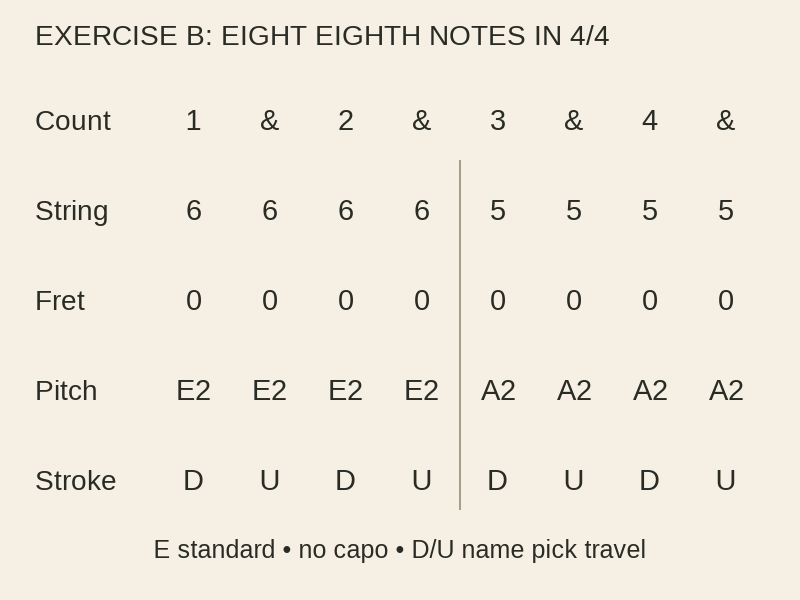
Exercise B uses eight eighth notes in 4/4, counted “1 and 2 and 3 and 4 and.” Play string 6 open for the first four events, then string 5 open for the next four. Those open pitches are E2 and A2. This is a movement exercise, not a chord progression.
Retain D–U through the change. The fourth event is U on string 6; the fifth is D on string 5. Move to the intended string without adding an extra picked event. Keep the strings you are no longer playing under control so the new note is easy to identify.
| Count | String / fret | Pitch | Stroke |
|---|---|---|---|
| 1 | 6 / 0 | E2 | D |
| 1 and | 6 / 0 | E2 | U |
| 2 | 6 / 0 | E2 | D |
| 2 and | 6 / 0 | E2 | U |
| 3 | 5 / 0 | A2 | D |
| 3 and | 5 / 0 | A2 | U |
| 4 | 5 / 0 | A2 | D |
| 4 and | 5 / 0 | A2 | U |
Loop the written bar and check the return to string 6 at the next beat 1. If the change disrupts timing, use a slower comfortable pulse or return to exercise A. Avoid changing pick thickness, muting contact and speed at the same moment; you need to hear which part of the task remains difficult.
Notice what changes with an odd-note group
Now keep the same eight eighth-note counts but move to string 5 after only three notes on string 6. The third event is D; event four, on “2 and,” must therefore be U on the new string if you retain strict alternation. The remaining events continue D–U.
This small change explains why you cannot decide the first stroke on every new string from the string number alone. Count the picked events that precede it. Economy picking and other approaches can use different rules; they are outside this exercise’s D–U constraint.
Try the original four-note change again before comparing the three-note change. Write down where the motion becomes uncertain rather than labelling one version good or bad. You can practise each at a different comfortable pulse without treating the difference as a fixed speed limit.
Separate timing from tone and muting
Picking direction, picking position and palm contact are different variables. The picking-position guide concerns where along the sounding string you pick. Palm muting changes the string’s contact and ending; it does not replace the direction sequence.
Once the picked attacks are clear, add one further task deliberately. If you use hammer-ons or pull-offs, label which notes are picked before writing the stroke pattern. A sounded note produced by the fretting hand is not automatically another picked event.
Keep a practice note with tuning, exercise version, pulse, starting stroke and the specific observation: a rushed string change, a missed upstroke or an unwanted ringing string. Use tab notation to keep fret numbers separate from rhythm. Increase the challenge only when the current movement remains comfortable and repeatable; there is no promised rate of improvement.
Download the blank English record (CSV). The sheet contains no completed observations or site test results.
How this guide was prepared
Fender’s definition of alternate picking was checked. The exercises were composed for this article and their pitches derived from E A D G B E with no capo. Count and stroke sequences were independently validated, including the difference between even and odd numbers of notes before changing strings. No published song tab or performance claim is used.
Documentation checked .