
The decision in brief
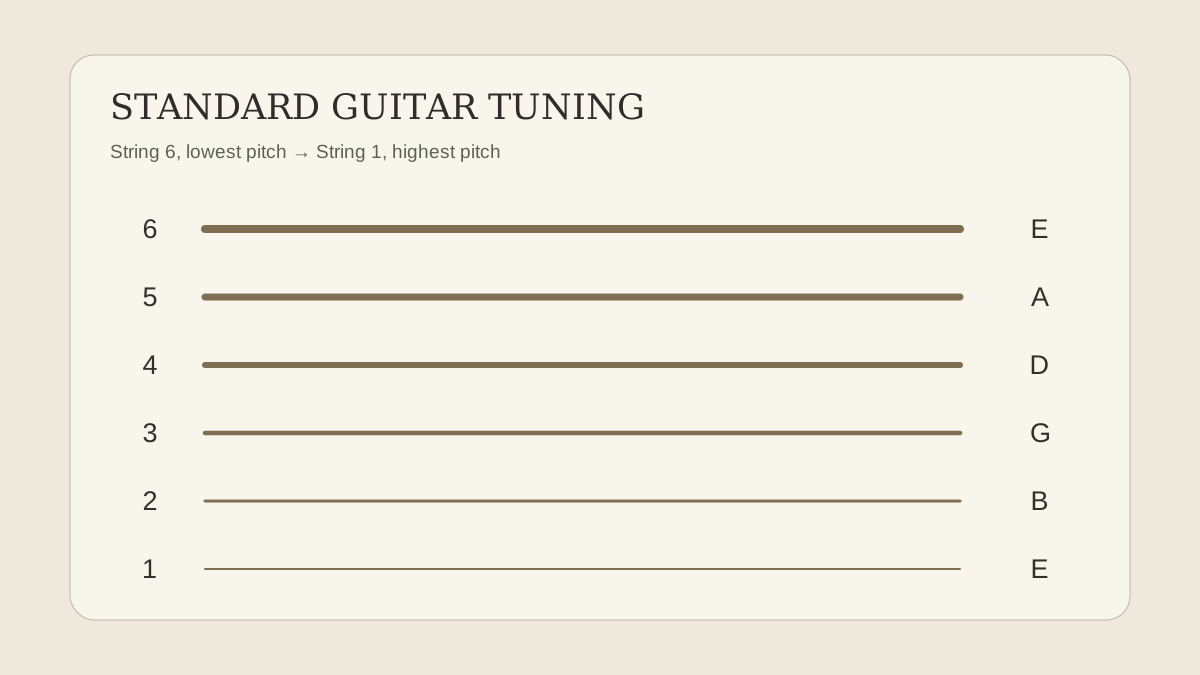
On a conventional six-string guitar, standard tuning is E2–A2–D3–G3–B3–E4 from string 6 (low E) to string 1 (high E). The two E strings are two octaves apart. Confirm the actual string, intended octave and your session’s reference pitch before turning its tuning machine. Tune one sustained open string at a time with the other strings muted, then repeat the six-string pass. A4 = 440 Hz is a common reference, not the frequency of every open string or a requirement for every ensemble.
The six open strings and the direction to read them
String numbers run from the high first string to the low sixth string. Read the sounding open pitches in the opposite numbered direction: 6 to 1. This is independent of whether the instrument is right- or left-handed. On a normal set, low E is the thickest and high E the thinnest; identify by the actual string path rather than “top” or “bottom” alone.
| String number | Standard open note | Calculated frequency at A4 = 440 Hz |
|---|---|---|
| 6 | E2 | 82.41 Hz |
| 5 | A2 | 110.00 Hz |
| 4 | D3 | 146.83 Hz |
| 3 | G3 | 196.00 Hz |
| 2 | B3 | 246.94 Hz |
| 1 | E4 | 329.63 Hz |
The frequencies assume twelve-tone equal temperament with A4 = 440 Hz and are rounded to 0.01 Hz. They are calculated targets, not measurements or required tuning tolerances. A4 is a reference note; the fifth string is A2 at 110 Hz under that reference.
Fender gives the EADGBE low-to-high order. The octave names and frequency values use the convention and equation explained by UNSW Physics. Guitar tab commonly places high E on the top printed line, while the body figure here reads from low to high. Read its labels before interpreting its page position.
Sources: Fender: standard string order and sustained-note tuning tips; UNSW Physics: equal-tempered note frequencies and cents
Why the pattern is E A D G B E
Ascending from low E, the adjacent semitone counts are 5, 5, 5, 4 and 5. These correspond to perfect fourths except for the major third from G3 to B3. The total is 24 semitones, so E4 is two octaves above E2. The G-to-B exception affects familiar chord and scale fingerings; a copied shape can need adjustment when crossing that pair.
These are standard-tuning relationships, not a claim that this is the only useful tuning or the best fit for every hand. Drop D changes the sixth string to D2 while leaving the other standard notes unchanged. A larger pitch change needs the instrument’s string and setup guidance; the string-gauge guide explains that separate choice.
For the frequency table, f = 440 × 2(m − 69)/12 Hz, using MIDI note numbers 40, 45, 50, 55, 59 and 64 for E2 through E4. This is arithmetic under the stated reference and temperament, not evidence that your guitar is carrying the correct set or is safe to raise to those pitches.
Sources: Fender: EADGBE and the fourth/major-third interval pattern; UNSW Physics: equal-tempered note frequencies and cents
A repeatable tuning sequence
- Identify the instrument, fitted strings and approved tuning. If its history, string identity or condition is uncertain, resolve that before raising tension substantially.
- Remove a capo for this uncapoed standard-tuning check. Set the required reference A and a mode that will identify the intended notes and octaves without an unintended offset or transposition.
- Trace the low-E string to its own tuning machine. Mute the other strings, pluck once normally and let the note sustain.
- Use small corrections under the actual hardware instructions. Confirm the pitch direction after a small movement instead of applying a universal clockwise rule. Stop for binding or unexpected resistance.
- Repeat for A2, D3, G3, B3 and E4. Make another complete pass, then play a familiar passage.
Fender’s online guidance supports the low-to-high sequence and sustained-note check. Its generic toward/away peg-direction shortcut should not be copied across every machine layout. Use the guitar-tuner guide when the input, reference or display mode is unclear.
Sources: Fender: standard string order and sustained-note tuning tips
Understand flat, sharp and unstable readings
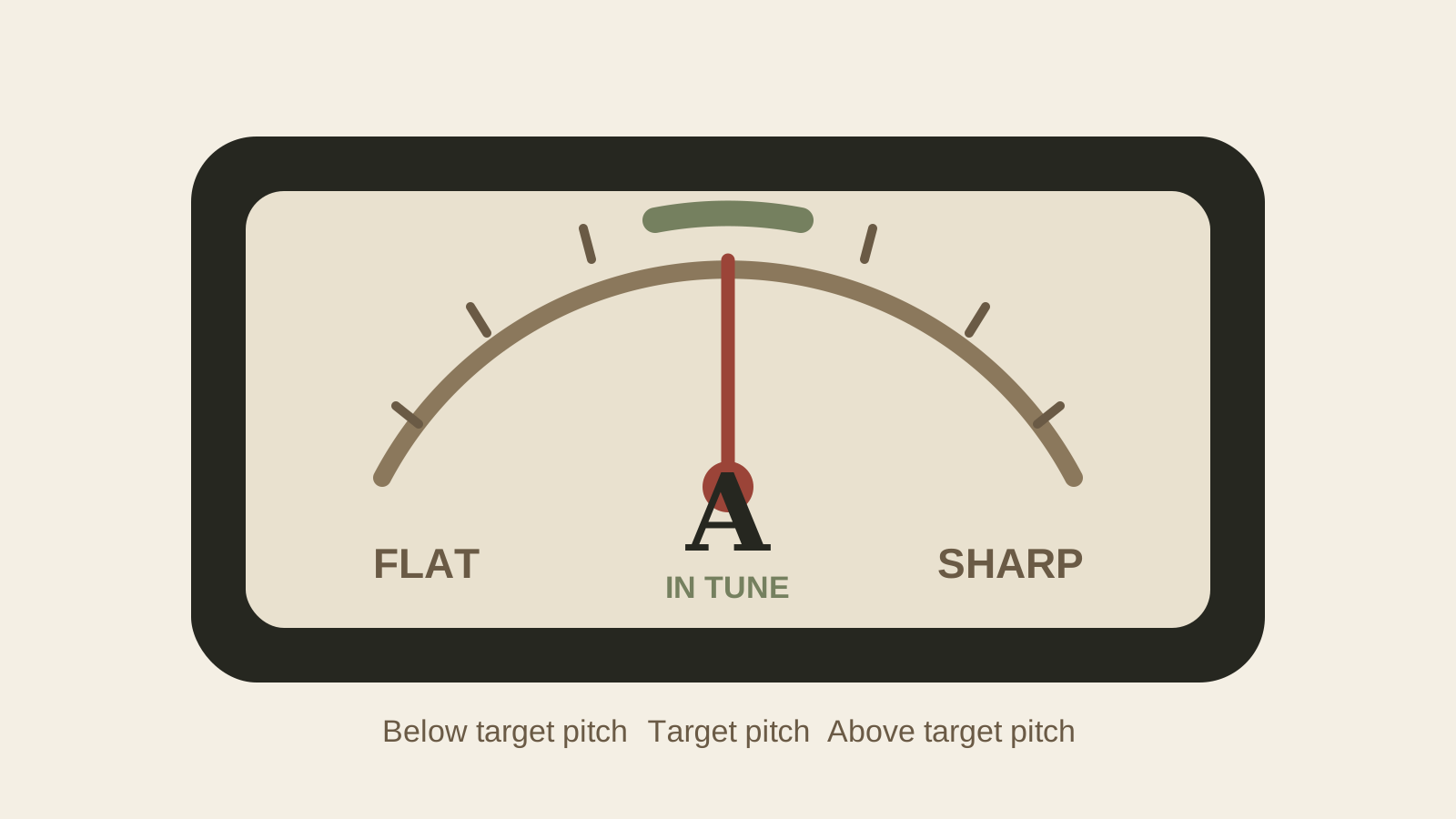
Flat means below the selected target; sharp means above it. Confirm the displayed note and intended octave before moving the pitch. A letter-only E cannot show whether you reached E2, E3 or E4. If the target is far away or uncertain, stop and use an octave-aware reference or competent help rather than winding upward until E appears.
Mute unused strings and repeat a controlled sustained note if the display jumps. A centre reading is useful only for the target and reference actually selected. A device stuck on the wrong mode and a string physically drifting are different problems; the tuner guide covers the input checks.
A relative fretted-note check is fifth fret of E2 against open A2, fifth fret of A2 against D3, fifth fret of D3 against G3, fourth fret of G3 against B3, and fifth fret of B3 against E4. This follows the 5/5/5/4/5 intervals in a conventional equal-tempered layout. It carries forward error from the starting string and adds fretting/intonation error, so it cannot establish an absolute reference by itself.
Sources: Fender: EADGBE and the fourth/major-third interval pattern; UNSW Physics: equal-tempered note frequencies and cents
When a tuned guitar goes out again
Recheck after ordinary playing and record the affected string, when the pitch moves and whether the change repeats. New-string seating, the string path, bridge return and instrument condition may need inspection. A single reading does not show that a nut slot or tuning machine is at fault.
Fender’s Stratocaster instructions discuss stringing, new-string settling and the balance of a floating bridge. Those are model-qualified examples, not permission to copy its dimensions, lubrication or adjustment method onto every guitar. A floating bridge can couple changes between strings, so use gradual passes and the exact setup guidance.
A matched open-string reading does not prove fretted chords correct. Record the note, fret and normal pressure before changing parts. Read the locking-versus-standard tuners guide for post retention, and the intonation guide for fretted-pitch questions. A damaged part or uncertain structural condition needs assessment.
Sources: Fender Support: model-qualified stringing, bridge balance and tuning
What changes on other instruments and tunings
String count and a guitar-shaped body do not authorize this six-string pitch map. Seven-string, twelve-string, baritone, bass and specialist designs require their own targets and approved set. A conventional six-string classical can also use E2 through E4, but its nylon/composite string system and instructions remain separate from a steel-string system.
A full capo changes the sounding open targets above its fret, and clamping can also disturb tuning. In standard tuning with a full capo at fret 2, the low-E target becomes F♯2; do not turn it back to E2 merely because a guitar-only mode expects the uncapped string. Follow the capo guide for fit, pressure and checks before, with and after use.
When the session uses another reference A, the note names can remain standard while their frequencies shift. At the same temperament, multiply every frequency in the table by the new reference divided by 440. Record a changed tuning or capo state with the song instead of assuming that a familiar shape names its sounding chord.
Sources: Fender: capo installation can disturb tuning; UNSW Physics: equal-tempered note frequencies and cents
Standard-tuning checklist
| Personal tuning record | Write down |
|---|---|
| Instrument | Model, exact fitted set if known, tuning and capo state |
| Target system | String numbers/notes/octaves, reference A and tuner mode |
| Observation | Sustained readings, repeated pass and the passage checked |
| Unresolved change | String affected, event before drift and next instrument-specific check |
This is a proposed player record, not a tuning test we performed. The useful result is a correctly identified target and a repeatable observation under the conditions you actually play. If target, string choice or condition remains uncertain, keep that uncertainty visible and obtain the missing guidance.
Frequently asked questions
What are the six notes in standard guitar tuning?
From string 6 to string 1, E2, A2, D3, G3, B3 and E4 on a conventional six-string guitar. Read from low to high pitch, independently of the way a diagram or the instrument is oriented.
Are the two E strings the same pitch?
No. Low E2 and high E4 share a note name but are two octaves apart. A letter-only tuner display does not establish which octave you reached.
Does A = 440 mean that the fifth string should be 440 Hz?
No. A4 = 440 Hz defines a common reference. In twelve-tone equal temperament under that reference, the open fifth string is A2 = 110 Hz. Another ensemble reference changes the frequencies, not necessarily the standard note names.
Why should I repeat all six strings?
The instrument can respond as strings settle or a floating bridge rebalances. Recheck under the actual model’s guidance and record persistent drift; one completed pass is not proof of stability.
Does the standard pitch table apply with a capo?
It describes the uncapoed conventional tuning. A full capo raises the sounding open targets; check the intended notes, fitting and pressure rather than tuning every capoed string back to its uncapped target.
How this guide was prepared
This AI-assisted documentation review read Fender’s standard note/interval and tuning guidance, its model-qualified Stratocaster stringing/bridge discussion and capo-tuning explanation, plus UNSW’s note-number and frequency equations. The six frequency targets are our twelve-tone equal-tempered calculations at A4 = 440 Hz, rounded to 0.01 Hz; they are not measured notes or tolerances. The relative-fret sequence follows the stated intervals, and the personal record is proposed guidance. We played, tuned, measured or adjusted no instrument, verified no tuner calibration and performed no human expert review. Maker-specific peg directions, hardware values and promotional claims are not universal instructions. The existing guitar illustration and body charts document no actual instrument test.
Documentation checked .
Made string numbers, octaves and reference-dependent frequencies explicit; separated A4 from open A2; corrected the capo tension/target explanation; added a bounded relative-tuning and observation record; moved the pitch map into the readable body.