
Start here
A treble-bleed circuit connects across the input and output of a guitar’s volume control to carry more high-frequency signal as the volume is reduced. It can help a conventional passive guitar stay clearer at lower settings. Choose by both the sound and the volume-knob response in your rig. Some players prefer the existing darker sound when they turn down.
Decide what you want from the volume knob
Play a part at your usual full-volume setting, then reduce the guitar volume to the position you actually use for rhythm or cleaner passages. Describe the problem precisely. Is the sound too dark, is the level changing too suddenly, or is the amplifier staying more distorted than you want?
Those are separate observations. A bypass network changes the signal reaching the next stage as the knob moves. It also can alter how useful the knob’s travel feels. The desired result might be a clearer quiet part, a smoother transition, or keeping the stock response because it already suits the music.
Start with a conventional passive pickup and volume circuit identified from its diagram. Active preamps and unfamiliar switching need model-specific advice. The potentiometer guide explains resistance and taper as separate choices.
Sources: Seymour Duncan on capacitor-only, parallel and series treble-bleed arrangements
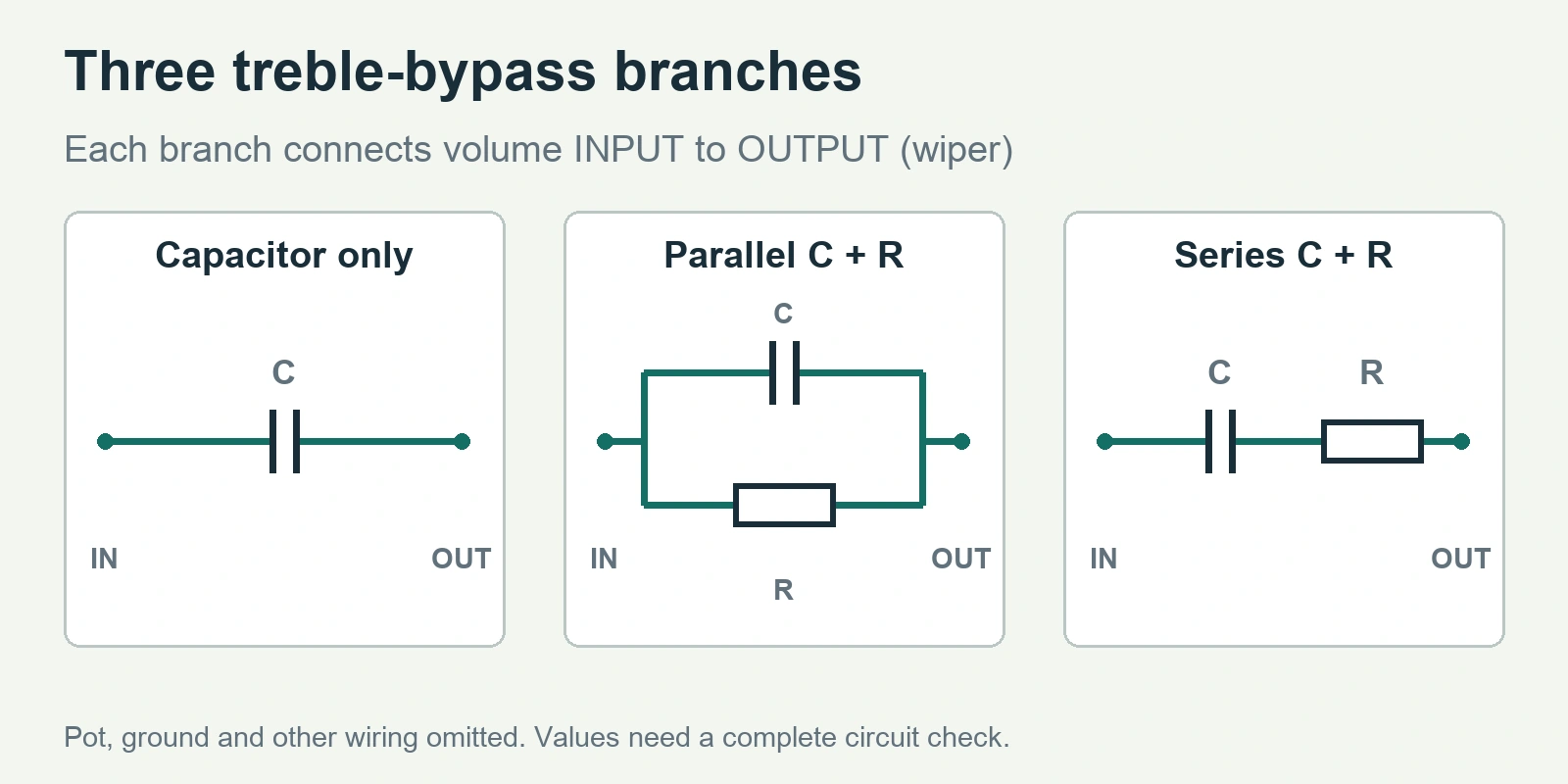
Identify the bypass connection
StewMac describes a treble-bypass capacitor bridging the volume pot’s input and output connections. In the common circuit, the output is the wiper. At reduced volume, the added branch provides a frequency-dependent route around part of the volume control.
A tone capacitor has a different connection and purpose. In a conventional tone control it works in a branch toward ground. Check the actual wiring before calling any small capacitor a treble bleed. The tone-capacitor guide covers that distinction and value units.
Reading that conventional connection as a simplified circuit, input and wiper are effectively connected together at full volume. The bypass branch then has essentially no voltage difference across it. This is a deduction from the connection arrangement. The intended comparison is the response as the knob comes down. Unusual wiring and additional controls require a separate circuit check.
Sources: StewMac: How a tone control works, including a treble-bypass connection
Compare the three common arrangements
| Branch | What to compare | Question for the technician |
|---|---|---|
| Capacitor only | How much clarity remains and whether reduced settings sound thin | Does the capacitance suit this pickup and load? |
| Capacitor and resistor in parallel | Brightness alongside the change in volume sweep | How does the resistor affect the useful knob range? |
| Capacitor and resistor in series | Brightness and sweep across the positions you use | Which paired values suit this complete circuit? |
Seymour Duncan describes all three arrangements and notes that their results depend on the guitar and signal chain. Its examples are starting points for those circuits. They do not establish a single correct pair of values for every guitar.
Ask for the complete proposed wiring and both component values. A resistor alongside a capacitor can mean two different connection arrangements. A parts list without the connection drawing does not identify which one is intended.
Keep the original pot’s value and taper in the record. Replacing the pot and adding a bypass network together makes it harder to identify which change produced the new sweep. Check shaft fit, cavity clearance and the exact terminal assignment before any work.
Sources: Seymour Duncan on capacitor-only, parallel and series treble-bleed arrangements; StewMac: How a tone control works, including a treble-bypass connection
Keep the load and amplifier conditions in the comparison
Use the cable run and first pedal or amplifier input you normally play through. The passive guitar interacts with what it drives. Changing that route while comparing bypass choices introduces another variable. The guitar-cable guide explains the path up to the first buffer.
For a first pass, keep amplifier input gain and controls fixed. Play the same chord, picked line and sustained note at full volume and at two lower knob positions you use. Record level, brightness and amplifier breakup separately. The lower signal level itself can change an overdriven stage’s response.
For a second pass, compare the recorded excerpts at similar playback loudness. Use this pass to describe tonal balance. Keep the original level-changing recordings as the evidence for the playing transition. Adjusting the amp’s input gain during a take would create a different comparison.
If you frequently switch between a clean amp and a drive or fuzz setup, repeat the short record with each actual route. A setting that helps one playing situation may be less useful in another.
Keep a control-response record
| Record | What to keep |
|---|---|
| Circuit identity | Pickup, pot value and taper, wiring diagram and bypass arrangement |
| Component identity | Capacitance, resistance where present and actual connection |
| Rig | Cable run, first input or pedal and amplifier settings |
| Knob positions | Full and the two reduced positions used for the part |
| Fixed-input comparison | Loudness, brightness, breakup and usable sweep |
| Playback comparison | Preference at similar listening volume and remaining uncertainty |
Download the blank treble-bleed comparison record (English CSV). A useful finding names the position and musical task: for example, a rhythm setting that keeps the desired note definition. It does not require every knob position to sound identical.
Have a technician verify the diagram and installation when the wiring is unfamiliar. Keep the original wiring record so that a change can be evaluated against a known starting point.
How this guide was prepared
We checked StewMac’s distinction between a tone-capacitor path and a volume-control treble bypass, plus Seymour Duncan’s three circuit arrangements. We created a connection diagram without component values, deduced the conventional full-volume node relationship, and designed a proposed two-pass listening comparison. The guide concerns conventional passive volume wiring and does not specify a universal modification.
Documentation checked .