The decision in brief
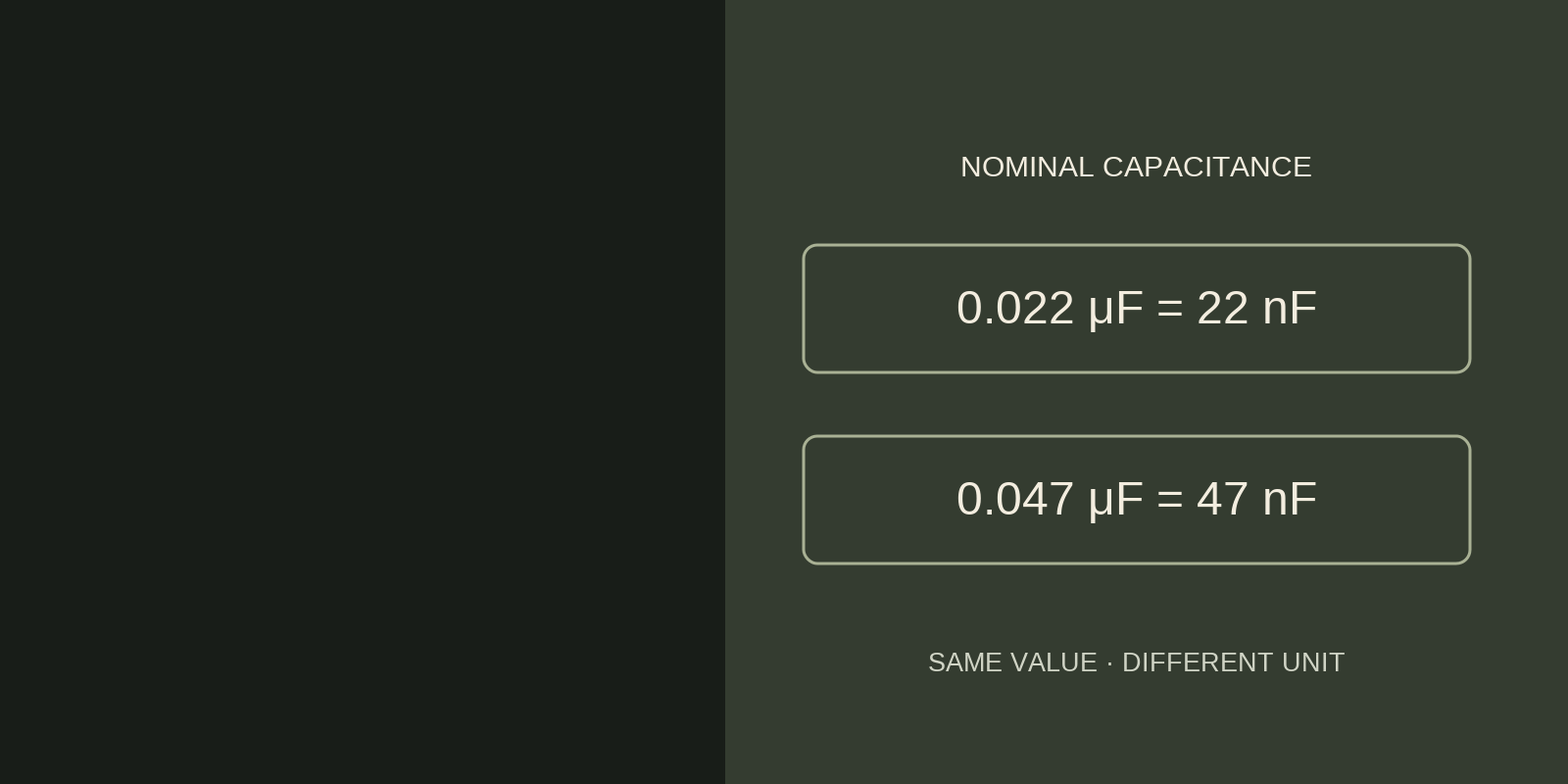
For a conventional passive guitar tone circuit, compare capacitor values in the same unit: 0.022 μF equals 22 nF, while 0.047 μF equals 47 nF. A larger value generally lets the turned-down tone control reach a darker range, but the actual wiring, controls and pickup remain part of the result. Identify the capacitor’s job first; a treble-bypass capacitor at the volume control serves a different purpose. Start with the documented circuit and the control range you want to change.
Identify the capacitor’s job before comparing its value
In a conventional tone circuit, a capacitor and control pot form a branch between the guitar signal and ground. The capacitor passes higher frequencies more readily than lower ones, and the control changes the branch’s effect on what reaches the output. The useful question is how the tone control behaves through the settings you play.
A treble-bypass, often called treble-bleed, capacitor instead connects across part of the volume control to help higher frequencies reach its output as volume is reduced. StewMac describes both arrangements. A small component beside a pot does not identify its job, and a tone-cap value should not be substituted into a bypass circuit by appearance.
Find the exact wiring diagram or ask a technician to identify the connection. Record which pickups and selector modes the tone control affects. The pickup-system overview helps describe the installed system before choosing controls.
Sources: StewMac: tone capacitors and treble-bypass connections
Convert the units before calling two values different
Capacitance is measured in farads (F). NIST defines micro (μ) as 10−6, nano (n) as 10−9 and pico (p) as 10−12. Therefore 1 μF equals 1,000 nF and 1,000,000 pF. To convert a value in μF to nF, multiply by 1,000.
| Microfarads (μF) | Nanofarads (nF) | Picofarads (pF) |
|---|---|---|
| 0.015 | 15 | 15,000 |
| 0.022 | 22 | 22,000 |
| 0.033 | 33 | 33,000 |
| 0.047 | 47 | 47,000 |
For example, 0.022 × 1,000 = 22, so 0.022 μF and 22 nF are the same nominal value. In contrast, 0.022 nF is 1,000 times smaller than 0.022 μF. Keep the decimal point and unit together when copying a listing or ordering a part.
A printed number without an unambiguous unit is an incomplete specification. Identify the manufacturer and part marking from its data sheet rather than guessing from colour or body shape. The table converts stated values; it does not decode every marking system or replace a capacitance measurement.
Sources: NIST SP 811: capacitance and decimal prefixes, Tables 3 and 5
Compare the tone-control range you actually need
Seymour Duncan’s Strat-control support guidance recommends 0.047 μF in its stated pickup and standard-harness context, while offering smaller values for less treble roll-off, including 0.022 μF and 0.033 μF. This is a useful scoped example of changing the available range; it does not assign one compulsory value to every single coil or humbucker.
If a functioning tone control becomes darker than you want as you turn it down, a smaller value can be worth discussing for that circuit. If the darkest available setting does not reach the sound you want, a larger value is a possible comparison. First state the desired result in a passage you play, such as retaining chord definition at a frequently used tone setting.
The pot’s resistance and taper, its wiring and the rest of the connected system remain relevant. A capacitance number by itself cannot supply the complete guitar’s cutoff frequency. The 250k and 500k pot guide handles the separate resistance and control-travel questions.
Sources: Seymour Duncan support: capacitor options for its Strat-style pickup systems
Keep the instrument’s wiring and part specifications attached
A tone control can be part of a larger pickup system or a small circuit board. EMG’s B124 manual, for example, distinguishes tone-control versions for active EMG and passive HZ pickups. Its label “passive tone control” does not mean that the guitar necessarily has passive pickups. Use the instructions for the actual system rather than treating every battery-powered guitar alike.
For a replacement, record the nominal capacitance, specified tolerance, voltage rating, dimensions and connection requirements from the actual part documentation. Tolerance describes the permitted variation around nominal; a matching printed value does not show what either individual sample measures. Check the available space and the required installation method before ordering.
This guide does not rank capacitor materials, vintage labels or prices by sound. A claim of a preferred material needs its own comparison with actual values and other conditions accounted for. An intermittent control or unknown connection should be assessed separately before treating the problem as a value preference. For the separate power distinction, see active and passive pickups.
Sources: EMG B124 instructions: tone-control versions and circuit scope (pp. 1–2)
Record a proposed change without changing several variables
Use the following record with a competent installation plan. These are proposed owner observations, with no site test results filled in.
| Record | What to keep explicit |
|---|---|
| Circuit identity | Guitar, pickup, selector mode, wiring revision and tone-control function |
| Component identity | Original and trial capacitance with units; actual part specification and any measured value supplied by the technician |
| Playing conditions | Same passage, guitar volume, cable, effects and amplifier input settings |
| Control positions | Fully up, the setting you use in the passage, and the turned-down endpoint |
| Decision | Preferred usable range, any unwanted change, and what remains unknown |
- Describe the present control’s behaviour and the change you want. Keep an unfamiliar fault out of a preference comparison.
- Confirm the original circuit and a suitable trial part. Preserve the original details and arrange a return to the documented setup if practical.
- After installation, play the same passage at the recorded settings. Check each selector mode the control affects, including the fully-up setting.
- Record whether the available range and useful knob positions improved for your task. Note any extra adjustment rather than attributing the whole result to the capacitor.
Keep the cable and first receiving input consistent. The cable-capacitance guide explains why that connection is another part of a passive pickup’s load. If the existing control already serves the part, the record may give you a reason to leave it as it is.
How this guide was prepared
We checked NIST’s SI unit and prefix tables, StewMac’s capacitor explanation, Seymour Duncan’s model-scoped Strat-control guidance and EMG’s B124 instructions on November 6, 2026. We derived the unit-equivalence table from the decimal prefixes and developed the comparison record as an editorial aid. We installed, measured and auditioned no capacitors. This guide concerns identifying and comparing conventional guitar tone controls; it supplies no measured frequency response, universal cutoff frequency or material ranking. The exact instrument and component documentation governs any replacement.
Documentation checked .