
The decision in brief
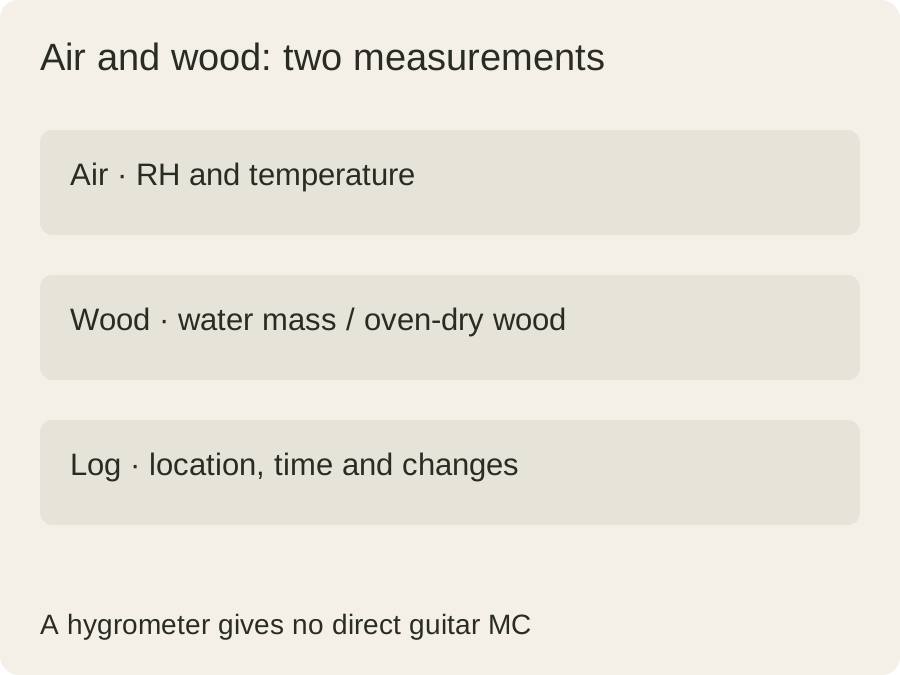
A hygrometer measures air relative humidity (RH); it does not measure the guitar’s wood moisture content (MC). RH depends on water-vapour pressure and temperature. Wood MC uses the mass of water relative to oven-dry wood, so its percentage has a different denominator. Monitor room/case conditions and physical changes, follow confirmed guidance for the actual instrument and involve a repair professional for structural signs. A maker’s RH range is not a universal wood-MC target; conflicting care figures need clarification rather than a wider assumed limit.
Give the two percentages their correct denominators
The Hong Kong Observatory defines relative humidity as actual water-vapour pressure divided by saturation vapour pressure at the same temperature, expressed as a percentage. RH can change with temperature without adding water. Record temperature with RH; a room reading and a case reading describe their respective sensor locations.
The USDA Wood Handbook defines wood MC as water mass divided by oven-dry wood mass, multiplied by 100. Equivalently: MC (%) = (current specimen mass − oven-dry specimen mass) / oven-dry specimen mass × 100. For a hypothetical wood specimen of 110 g with an oven-dry mass of 100 g, (110 − 100) / 100 × 100 = 10% MC. This is arithmetic, not a guitar measurement or care target.
A guitar’s strings, hardware, glue and finish prevent a whole-instrument weight from becoming this specimen calculation. Do not oven-dry, drill, probe or disassemble a finished guitar to obtain MC. A direct wood assessment belongs to a qualified person using an appropriate method.
Sources: Hong Kong Observatory: relative humidity definition, May 2024; USDA Forest Products Laboratory, 2021: wood moisture definition and equilibrium, pp. 4–1 and 4–3
Confirm the reference for the actual instrument
Taylor’s humidifier guidance states 45–55% RH for its guitars. It is a maker care reference, not a direct MC measurement or a universal threshold at which every guitar becomes damaged. Keep the source, model applicability and date with the target you use.
During our October 14, 2026 check, Córdoba’s FAQ stated 45–65% RH. Its care page also stated 45–65% in the accessories paragraph but 45–55% in the displayed humidity list. These passages conflict. They illustrate why an owner should request clarification for the actual model; they do not authorize selecting the wider band. No general Córdoba target is prescribed here.
If the manual, warranty information and a general web page disagree, retain the passages and ask the manufacturer which applies. Record the answer. No universal MC target, damage threshold or recovery deadline can be derived from these care pages.
Sources: Taylor: maker-specific humidity range and case monitoring; Córdoba FAQ: nylon-string compatibility and stated humidity range; Córdoba care page: differing humidity figures on the same page
Create readings you can interpret
Choose a sensor whose instructions state its measurement range, accuracy and checking procedure. A digital display with extra decimal places does not establish accuracy. Agreement between two unverified devices is a comparison, not a calibration. Follow the sensor instructions for a reference check and stabilization after moving it.
Log date/time, sensor identity, location, RH, temperature, case-open/closed state, conditioning device and any change. Keep room sensors away from direct output of climate-control equipment so the reading addresses the storage location. Place a case sensor without pressure or contact that could damage the instrument.
Use a frequency suited to the actual variation: after moving the guitar, opening a transported case, changing a device or entering a heating/cooling season, more observations may be useful. A fixed monthly check cannot reveal every intervening excursion. Keep a same-condition baseline and preserve unknown values rather than estimating them.
Treat physical signs as observations, not a diagnosis
Taylor describes combinations such as a sinking acoustic top, altered action, projecting fret ends and cracking in dry instruments. Its wet-guitar page describes high action and distorted geometry, while warning that some body curvature is normal. These are possible signs in the described instruments, not proof of cause on every guitar.
Record the observed change, its location and the storage history. String condition, relief, fretwork, setup or damage may also affect playability. A sound difference or one action measurement alone cannot establish excess moisture or dryness. A stable RH reading does not prove that an earlier exposure caused no damage.
For a new crack, lifting bridge, open joint, severe change or unexplained movement, stop the comparison and obtain qualified advice before further playing, conditioning or adjustments. This guide supplies no generic detuning, bridge-pressure or repair procedure.
Sources: Taylor: possible dry-guitar symptoms; Taylor: possible wet-guitar symptoms and normal body curvature
Separate environmental care from repair
Follow confirmed guitar and device instructions when conditions need correction. Avoid spraying the guitar, wet contact, direct heating and aggressive drying. Do not add moisture simply because a guitar buzzes. If the reading or target is disputed, resolve that first.
The Wood Handbook explains that exchange responds to both temperature and RH; coatings can slow changes without preventing them. A present reading therefore does not show that every wooden component has equilibrated. We do not calculate a finished guitar’s internal MC or promise stabilization within a set number of hours.
Preserve the before/after record. Have a technician assess persistent geometry or playability concerns rather than chasing them with immediate rod or saddle changes. Environmental correction cannot be assumed to repair a crack, failed joint or an unrelated setup issue.
Sources: USDA Forest Products Laboratory, 2021: wood moisture definition and equilibrium, pp. 4–1 and 4–3
Check the actual room, case and route
A closed case, bag or room is not evidence of a safe climate. Record the enclosure, closures, opening frequency and actual conditions. An enclosure can contain a damp item or an incorrectly used conditioning device; its category name does not establish how quickly conditions change.
Keep the instrument away from direct sun, heaters, damp storage and uncontrolled vehicles. After a temperature-changing journey, follow the actual maker’s arrival instructions. There is no universal waiting period in this guide. Document visible delivery condition and unresolved concerns before requesting setup changes.
For several instruments or locations, use readings from the places they actually occupy. A sensor beside a humidifier does not represent a distant shelf. The case and gig-bag guide explains how fit and the handling route add separate questions.
Sources: Taylor: maker-specific humidity range and case monitoring; Taylor: possible wet-guitar symptoms and normal body curvature
Keep a care record with clear limits
| Record | Include |
|---|---|
| Identity | Model/unit, date/time, sensor and location |
| Environment | RH, temperature, case state and known exposure |
| Observation | Named physical change; comparable photo or playing condition |
| Action | Confirmed maker/device guidance and change made |
| Follow-up | Trend, unresolved question and qualified assessment |
Monitor the air you can measure and describe the instrument you can observe. Keep RH and MC distinct, verify the applicable target and avoid diagnosing from one symptom. The record is an editorial aid; no guitar, sensor, humidity-control device or repair outcome was tested for this article.
Frequently asked questions
Does 50% RH mean that a guitar is 50% water?
No. RH compares water-vapour pressures in air at a temperature. Wood MC compares water mass with oven-dry wood mass. A hygrometer does not provide a direct guitar MC value.
Is 45–55% RH a universal requirement?
It is Taylor’s stated care reference, not a specification for every guitar. Confirm actual model guidance. Our check also found differing figures within Córdoba care materials, so those need clarification rather than a wider assumed limit.
How long does a guitar need to stabilize?
This guide gives no universal interval. Follow the maker’s instructions and retain comparable condition records. A current room or case reading does not prove every component is at equilibrium.
Does a closed case guarantee correct humidity?
No. Check actual conditions, enclosure use and any conditioning device. A case may protect the guitar physically without establishing the required environmental conditions.
Should I adjust the action after a humidity change?
First verify conditions and investigate the change. Obtain a qualified assessment for structural signs or persistent problems; do not assume a rod or saddle adjustment repairs an environmental or structural issue.
How this guide was prepared
We checked the Hong Kong Observatory’s May 2024 RH definition, the USDA 2021 Wood Handbook formula and equilibrium discussion on printed pp. 4–1 and 4–3, and Taylor’s care/symptom pages. Córdoba’s FAQ and care page gave differing RH figures; we preserve that conflict and prescribe no general Córdoba limit. The 110 g/100 g specimen example is hypothetical arithmetic. The care log is proposed. We did not measure a guitar’s MC, calibrate a sensor, test an enclosure, diagnose damage or establish stabilization times. The handbook describes wood, not a validated test of a finished instrument.
Documentation checked .
Added the MC denominator and hypothetical calculation, documented conflicting maker care figures, replaced decorative images with a measurement-context diagram and added a condition log without fixed check or recovery intervals.
Sources and further reading
- Hong Kong Observatory: relative humidity definition, May 2024
- USDA Forest Products Laboratory, 2021: wood moisture definition and equilibrium, pp. 4–1 and 4–3
- Taylor: maker-specific humidity range and case monitoring
- Taylor: possible dry-guitar symptoms
- Taylor: possible wet-guitar symptoms and normal body curvature
- Córdoba FAQ: nylon-string compatibility and stated humidity range
- Córdoba care page: differing humidity figures on the same page