
The decision in brief
Choose protection around the actual guitar’s fit and the most demanding part of its route. When stacking or uncontrolled loading is plausible, inspect a suitable rigid case and its stated limits; for controlled local carrying, compare a structured bag’s padding, support, closures and loaded comfort. A thin bag mainly addresses dust and abrasion. Neither the category name nor a closed enclosure proves impact performance, safe humidity or airline acceptance.
Hard cases, structured gig bags and light bags are different categories
A rigid case uses a shell and an interior that must fit the instrument. A structured bag uses padding and sometimes panels or reinforcement. A thin cover has little supporting structure. Inspect the actual design; the names do not specify a drop test, load rating or waterproof standard.
A rigid shell is a sensible starting point to investigate when equipment might be stacked around the instrument. A structured bag may be convenient for walking with the instrument under your control. Confirm loaded weight and carry points rather than assuming every hard case is heavier or every bag is easier to carry. We have no comparative impact or crush-test data for named enclosures.
Start with the most severe part of the route
| Journey | Question to resolve | Useful starting inspection |
|---|---|---|
| Home storage | Room conditions and accidental contact | Fit, closures and a separate climate plan |
| Walking or public transport | Loaded comfort, crowding and exposure | Bag support, straps, handles and stated weather limits |
| Controlled car loading | Movement and nearby equipment | Fit and secure placement; avoid heat exposure |
| Shared vehicle/equipment | Possible stacking and uncontrolled loads | Suitable rigid structure and explicit limits |
| Air travel | Actual carrier, route and handling arrangement | Confirm requirements and a fitted travel solution |
Describe the complete route, including stairs, crowded doors and periods out of your control. Do not put an instrument under equipment just because its enclosure looks rigid. A protective shell cannot make a hot parked vehicle an appropriate storage place.
Sources: Martin Care & Feeding Guide (2020), pp. 2–3 and 8: support, climate and travel limits
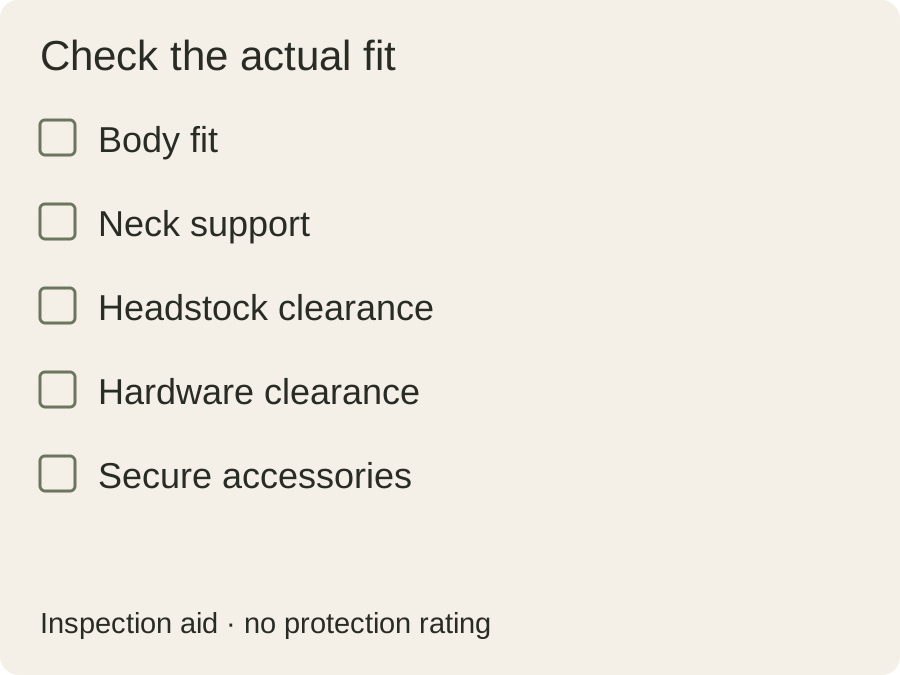
Fit is the first protection specification
Use a stable surface and the actual guitar where possible. Follow the enclosure’s intended fitting and closing method. Do not force the lid or zip to close over the instrument. Check every dimension and projecting part, not only advertised lower-bout width.
Martin’s 2020 guide describes neck/body support and warns against placing objects under the headstock. This is a maker’s care instruction, not a universal interior drawing. Confirm the exact support design for an angled headstock, offset body, archtop or unusual instrument.
- Check that the body does not move excessively without squeezing it into unsuitable padding.
- Confirm neck support and clearance around the headstock and tuning keys.
- Check bridge, controls, strap buttons and any fitted arm against the interior and lid.
- Confirm that compartments restrain accessories; keep heavy or sharp loose objects out of the guitar cavity.
- Check closure, handle and strap condition, then try a careful normal carry with the loaded enclosure.
Stop if the instrument binds, the lid presses on hardware or the support is uncertain. Do not shake, drop or load the enclosure as an improvised protection test.
Sources: Martin Care & Feeding Guide (2020), pp. 2–3 and 8: support, climate and travel limits
Compare the features that must be verified
| Feature | Check on a rigid case | Check on a structured bag |
|---|---|---|
| Support | Interior shape, contact points and secure fit | Neck support, padding distribution and secure fit |
| Closure/carry | Latch, hinge, handle and loaded balance | Zip, seams, straps, handle and loaded balance |
| External loads | Maker’s actual limits and placement instructions | Reinforcement and limits; do not infer a load rating |
| Weather | Stated sealing or water-resistance conditions | Fabric, seams, zip and cover conditions |
| Storage | Actual internal climate and liner condition | Actual internal climate and padding condition |
Water resistance and waterproofing are different claims. Read the maker’s actual wording and conditions. A wet liner can affect the instrument even if the outer shell is dry. Inspect and dry the enclosure as instructed before storage. Carry height matters too: allow clearance at doors and in crowds.
A case does not create a safe climate by itself
Taylor’s case-support answer, drawn from its 2022 discussion and updated in March 2026, says its wooden hardshell case is not a sealed vapor barrier. It also discusses the liner’s moisture condition. Martin’s 2020 care guide recommends monitoring the instrument’s surroundings and suitable in-case storage. These are specific care accounts, not a measured humidity-exchange ranking for all bags and cases.
Measure the relevant environment with a suitable hygrometer and follow current guidance for the exact instrument and humidity device. Excess moisture and prolonged heat exposure also need attention. No universal air-exchange rate, device maintenance interval or case humidity guarantee is supplied here.
Martin advises allowing a cold instrument to warm gradually in its case. Follow the actual maker’s acclimatization method; this guide does not set a universal waiting time. Choose and maintain the climate plan separately from the shell’s handling role.
Sources: Taylor Support: wooden case is not a sealed vapor barrier; updated March 2026; Martin Care & Feeding Guide (2020), pp. 2–3 and 8: support, climate and travel limits
Make handling and documentation part of the plan
Record the instrument and enclosure condition before a demanding trip, secure permitted accessories and check closures. Use placement and restraint methods appropriate to the enclosure; a handle is not automatically a tie-down anchor.
Martin’s travel section says even a hard case may not prevent carrier mishandling and recommends discussing an appropriate flight case and carrier requirements. It is a 2020 instrument-care guide, not a current airline policy. Confirm the actual booking, route, dimensions, handling arrangement and current carrier terms; we have not verified any reader’s journey or guarantee of cabin space.
For unfamiliar finishes, valuable or fragile instruments, unusual dimensions or any uncertain support, seek model-specific guidance before travel. Do not copy another guitar’s detuning, packing or humidity-device arrangement. At arrival, inspect the enclosure, follow the maker’s climate instructions and record the instrument’s condition before adjustments.
| Journey record | Write down |
|---|---|
| Instrument and enclosure | Exact models, fit checks and any unknown compatibility |
| Handling | Route, loaded carrying, possible loads and who controls the guitar |
| Climate | Relevant conditions, measurement and maker/device instructions |
| Travel arrangement | Carrier terms checked for the actual trip; agreed handling and contingencies |
| Condition | Dated observations before and after; unresolved problems |
Sources: Martin Care & Feeding Guide (2020), pp. 2–3 and 8: support, climate and travel limits
Choose for the route, then verify fit and care
Start with the demanding part of your route, inspect a suitable enclosure and try its loaded carry. Record fit, support, closures and limits you can verify. Plan humidity and travel arrangements separately. The useful choice is one you can use correctly for this instrument and journey, with remaining risks visible.
Frequently asked questions
Is a hard case always better than a structured bag?
The actual fit, construction, handling and loaded comfort decide. Inspect a suitable rigid case for potential external loads, but do not infer a tested rating from its category.
Can a guitar be stored in a gig bag?
Confirm the maker’s storage guidance for the instrument and bag, monitor the relevant climate and maintain any appropriate humidity system. A bag label alone neither proves safe conditions nor establishes an air-exchange rate.
How should the case fit?
The instrument needs the intended body/neck support without excessive movement, forced closure or loading the headstock and hardware. Secure accessories and confirm uncertain fit with the makers.
Does a hard case guarantee safe air travel or humidity?
No. Confirm the exact trip and current carrier requirements, suitable enclosure limits and a separate climate plan. This guide supplies no universal flight approval, humidity guarantee or waiting time.
How this guide was prepared
We checked Martin’s 2020 Care & Feeding Guide (printed pages 2–3 and 8) for support, temperature, storage and travel limits, and Taylor’s case/liner explanation from its 2022 discussion updated in March 2026. Manufacturer care instructions remain model-specific; older device details and general shipping anecdotes were not adopted. The route tables and carry record are proposed inspections, not measured impact, crush, weight, sealing or humidity-exchange tests. We did not inspect a real enclosure, confirm airline rules for a booked journey or establish a medical carrying benefit. The drawings are inspection concepts, not rated products or interior specifications.
Documentation checked .
Removed category-wide humidity and weight/protection rankings, clarified model-specific care and travel limits, replaced misleading/decorative images and added a fitted-carry checklist, journey record and specific method.