
The decision in brief
A steel-string acoustic guitar is built for its intended steel-string system: strings excite the bridge and soundboard, while the braced body radiates sound into the room. Fitting metal strings to a different guitar does not make that guitar compatible. Identify the exact model and approved string set first, then assess fit, playability and condition. Ordinary steel strings must not be fitted to a nylon-string classical guitar.
What makes it a steel-string acoustic guitar?
“Steel-string” identifies the string system the instrument was designed to carry. The neck, bridge, top and internal structure must work with that load. “Acoustic” describes sound produced by the vibrating instrument and surrounding air without an external amplifier. These terms describe a design, not permission to fit any metal-string set.
Many familiar flat-top examples have six strings. Twelve-string, baritone and specialist designs need their own specifications. A pickup adds an amplified signal path; it does not remove the underlying acoustic guitar’s string requirements. Our acoustic vs electric guide covers that decision.
For a classical guitar designed for nylon-family strings, ordinary steel strings are an incompatible substitution. Martin’s steel-versus-nylon explanation warns of damage from this change. An unusual hybrid must be identified by its exact model instructions, rather than by appearance.
Sources: Martin: Are Strings Interchangeable?
Follow the string-to-sound path
| Part or contact | Role in the system | What a player can establish |
|---|---|---|
| Nut and frets | On a guitar without a zero fret, the nut defines the headstock end of an open string’s speaking length; a fretted note ends at the selected fret. | Check open and fretted notes separately. |
| Saddle and bridge | The saddle provides the body-end contact; the bridge couples string forces to the top. Attachment details vary. | Look for damaged contact points or visible separation; do not pry or load the bridge. |
| Top and internal bracing | The soundboard vibrates; bracing supports the loaded structure and influences its movement. | Use maker documentation for the brace design. An exterior image cannot verify it. |
| Body and enclosed air | The body surfaces and air contribute to the radiated sound. | Listen at the player’s position and from in front, under comparable playing conditions. |
| Neck and frets | Their geometry helps determine playable string clearance. | Keep relief, action and fret condition as separate observations. |
This is a functional map. It does not rank parts or let one visible feature predict the whole instrument. Taylor’s bracing explanation describes the support and vibration roles of the internal braces; it is a manufacturer’s account of construction, not a listening test by this site.
Why top and bracing matter together
X-bracing is common in steel-string acoustics, but it is not the only approach. Taylor also describes its alternative bracing designs. A pattern name alone leaves out brace dimensions, placement, top thickness and the rest of the guitar. Do not turn a maker’s comparison of its own designs into a guarantee of louder sound, longer sustain or better intonation on every instrument.
Likewise, “solid” and “laminate” identify construction. Neither label tells you the setup, condition or response of the guitar in front of you. Verify the exact model’s top specification, then use the solid-top vs laminate comparison for the separate buying tradeoffs.
For a useful listening comparison, play the same passage with a similar attack and note each guitar’s strings and tuning. If another person plays while you listen from in front, record that change of position. This is a proposed comparison method, not a test we have performed.
Use strings approved for the instrument
Check the approved string family, gauge or tension limits, scale and attachment for the exact guitar. The word “acoustic” on a packet is insufficient. Martin’s care guide supplies string limits for its own instruments; those limits do not approve the same gauge for every other maker or model.
Gauge, tuning and construction can change the load together. Before a substantial change, consult the maker or a technician familiar with the instrument, particularly if its history or condition is uncertain. Do not assume a heavier set will give more usable volume.
Nylon-family strings are not a simple reverse conversion either: their attachment and setup requirements may differ. The guitar strings guide covers compatibility before materials; the gauge guide explains the scale–pitch–string relationship. For choosing between instrument families, read steel vs nylon.
Sources: Martin: model-family string guidance and classical-guitar warning
Read playability as a connected setup
Test body reach, balance and fretting effort with the passages you expect to play. Record the string set and tuning so that a stiff-feeling sample is not automatically blamed on its wood or body style.
Relief is neck curvature under the specified measurement conditions; action is string clearance at a named fret. Nut slots, saddle height, fret condition and neck-to-body geometry also matter. The truss rod is not a substitute for correcting every high-action complaint. The truss-rod guide and action guide separate these checks.
An inspection may reveal a setup question or a repair question. Do not assume that a routine setup can resolve a lifting bridge, opening joint or changing neck angle. Follow the service requirements for the exact model before any adjustment.
Humidity, storage and routine care
Wood changes with its environment. Taylor’s humidity support page describes swelling and possible joint or geometry problems with excessive humidity, and recommends monitoring the storage environment. Follow the exact maker’s storage and environmental guidance; a room relative-humidity reading is not a measurement of moisture inside the wood.
Keep the guitar away from direct heat and rapid environmental changes. Use its recommended case and humidity-control method where required. Follow finish-specific cleaning instructions and keep uncontrolled liquid away from the instrument. One room reading does not establish what caused a change in action.
A top may have an intentional arch; any visible curve is not automatically damage. A new change, visible bridge separation or a crack deserves assessment rather than an online diagnosis or an attempt to press the top flat. Record the condition and consult a technician. The wood and humidity guide explains the two moisture measures.
Sources: Taylor: humidity-related changes and normal top bellying; Martin: environmental care and intentional top arch
A short inspection before buying or restringing
| Record | Observe without disassembly | Leave unresolved until verified |
|---|---|---|
| Model, strings and tuning | Maker-approved specification and the actual fitted set, if known. | An unknown set is not evidence of compatibility. |
| Exterior condition | Visible bridge, saddle, top, joints and seams; dated photos of any concern. | No prying, pressing, brace tapping or tension increase to test a suspected fault. |
| Playing result | Open strings and several fretted notes with ordinary attack; location of buzz or discomfort. | A symptom does not identify its cause. |
| Sound and electronics | Unplugged response; a separate amplified check if electronics are fitted. | Keep string, room, playing-position and amplifier differences in the record. |
This is a proposed player’s record, not a certified structural inspection. Do not infer a loose brace from an exterior photograph or declare a guitar structurally sound after one short recording. Ask for a qualified inspection when condition could change the purchase or restringing decision.
When this advice changes
Twelve-string, baritone, resonator, travel and hybrid instruments can have different construction, tuning and string requirements. Previous repairs or damage can also change what is appropriate. This overview cannot approve a string change or diagnose an individual instrument. Follow its maker’s instructions and resolve structural uncertainty before altering the load.
The useful way to understand a steel-string acoustic
Start with the documented string system, then check the individual guitar’s condition and playing fit. Use construction terms to ask better questions; verify sound and feel on the actual instrument under recorded conditions. For a personal purchase, continue to the acoustic buying guide.
Compatibility and condition questions
Can an acoustic-electric use any acoustic string set?
No. Its acoustic construction still determines string compatibility. Check the exact model’s approved string family, gauge or tension limit and attachment; the pickup does not approve a different load.
Can I identify bracing or a solid top from the cover image?
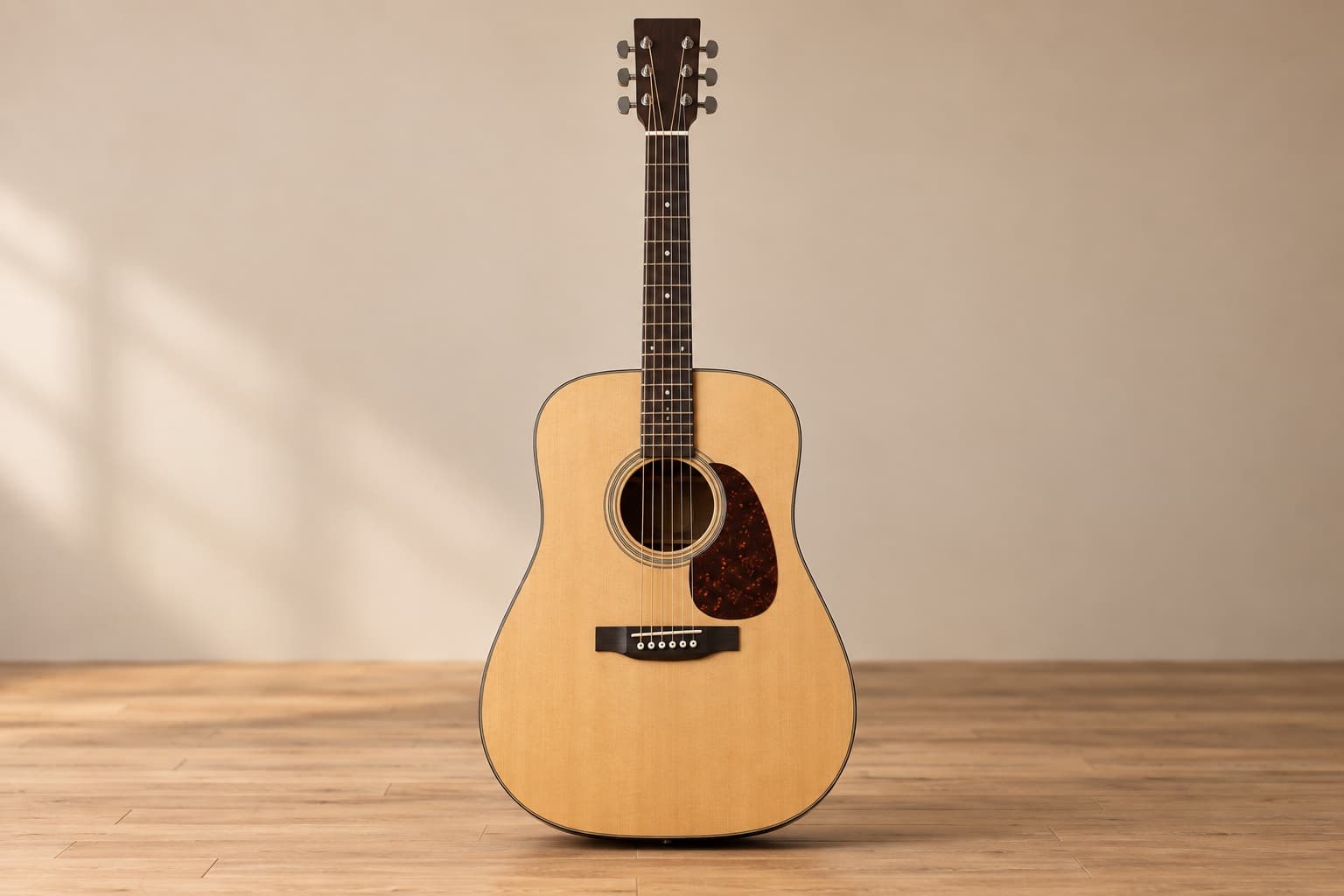
No. The illustrations here show exterior context. Use the model’s construction documentation; they do not establish internal bracing, top construction or the condition of a real guitar.
Does a curved top mean the guitar is damaged?
Not necessarily. Some tops have an intentional arch. A new change, separation or crack needs individual assessment; do not press the top or increase tension to test it.
How this guide was prepared
This documentation-based revision used Taylor’s 2018 bracing explanation and humidity support page, Martin’s 2024 string-interchangeability explanation, and its 2022 Care & Feeding guide for string limits and care context. The existing string, action, fret-buzz, solid/laminate and bracing articles were read to keep this overview distinct. The inspection and listening records are editorial proposals; no guitar, humidity history, brace, string change or listening comparison was tested for this article. Existing images were visually checked and described as illustrations, not product or inspection evidence. The work used AI-assisted research, drafting and editorial checks; it does not claim a named human technical review.
Documentation checked .
Clarified string-system compatibility and the nut/fret/saddle roles; added a non-invasive observation record, model-specific care and service limits, contextual source links and accurate illustration captions; repaired the existing acoustic/electric link markup.