The decision in brief
An active bass uses powered onboard electronics, often a preamp with EQ; a fully passive bass produces and controls its signal without a battery-powered onboard circuit. An active bass can still use passive pickups, so the instrument label does not identify the pickup construction. Choose by the controls you need, how the bass works through your rig and whether you can maintain its power supply. Verify any passive bypass and dead-battery behavior on the exact model. Neither circuit category guarantees a particular genre, output level or better sound.
What matters most
- Identify the pickups and preamp separately; active bass does not automatically mean active pickups.
- Learn the documented neutral EQ position rather than assuming every knob belongs at noon.
- A bypass switch does not establish that every powered component works without a battery.
- Compare at a similar listening level and include power, service and live control in the decision.
Identify what active and passive describe on this bass
Start with the wiring description or owner's manual, not the number of knobs. Ask two separate questions: do the pickups themselves require power, and is there a powered preamp or other circuit after them? A battery compartment establishes that some component needs power; it does not tell you which component or whether a usable signal remains when power is unavailable.
A fully passive bass commonly uses pickup selection or blending, volume and a passive tone control. An active design may add onboard frequency controls, buffering or other functions. The exact control map is the evidence you need. A manufacturer can use the word active for the instrument's electronics even when the pickups are passive. Keep those descriptions separate in your comparison notes.
Our active versus passive pickup guide focuses on the pickup component. This article addresses the complete bass: where you shape the sound, how you operate it and what can interrupt the signal. Those questions remain relevant even if two basses use similar pickup layouts. A familiar body shape does not prove that the controls behave like another instrument you have played.
Sources: EMG FAQ: powered pickups, passive pickups and buffered accessories
Compare the architecture before comparing the tone
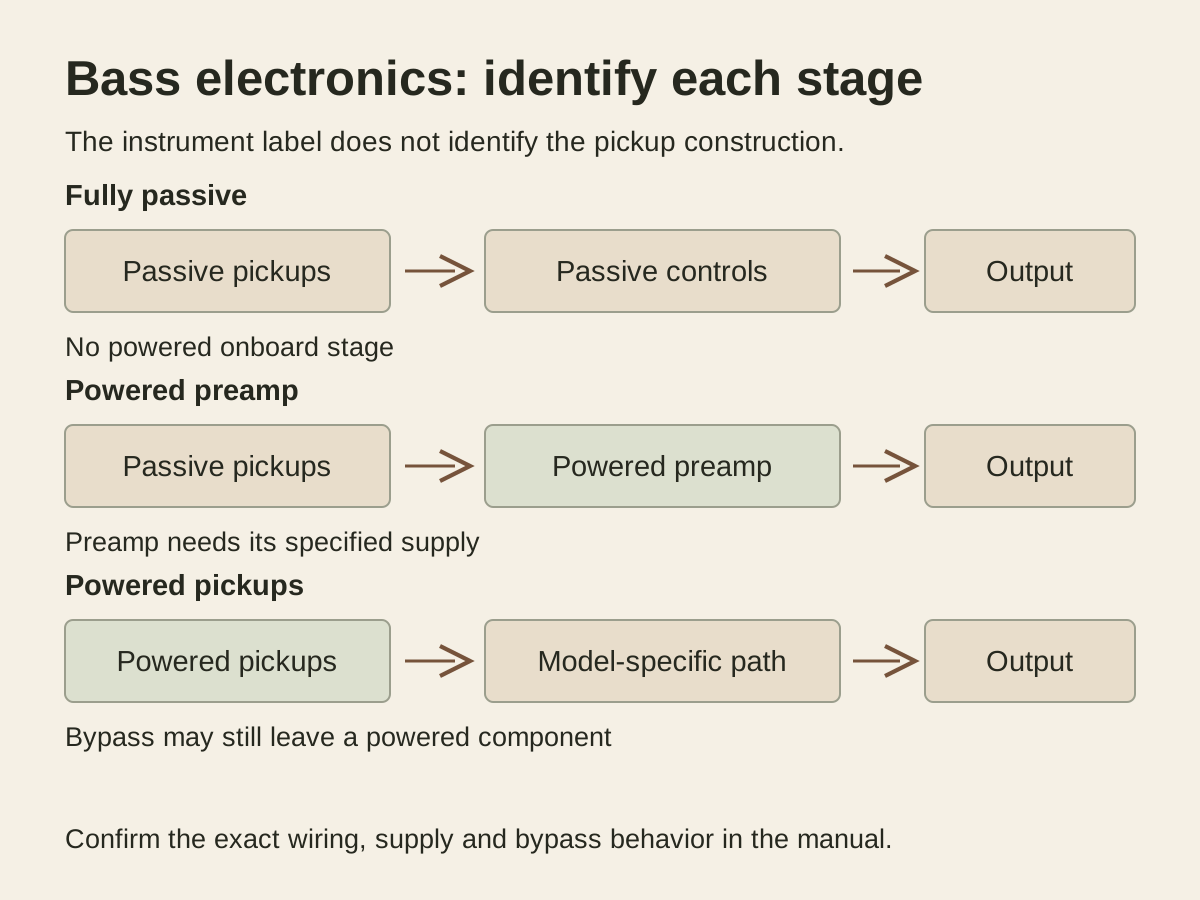
| Architecture | Power requirement | Useful question | Assumption to avoid |
|---|---|---|---|
| Passive pickups and passive controls | No powered onboard circuit in this description | Can these controls and the external rig shape the part? | Passive means electrically or musically inferior |
| Passive pickups with a powered preamp | Preamp needs its specified supply | Which EQ, buffer and bypass functions are provided? | The pickups must be active |
| Powered pickups, with or without another preamp | Powered components need their specified supply | What remains functional if the preamp is bypassed? | A bypass necessarily removes all power dependence |
Use the table to ask for missing information, not to rank instruments. Ernie Ball Music Man documents buffering and onboard EQ as active-electronics functions. Sadowsky's control document separately describes a preamp bypass and passive tone control. Such examples show why a complete signal path is more informative than a single active/passive label.
Write your candidate's architecture in one sentence. If you cannot establish it from the available documentation, ask the maker or dealer for the model-specific explanation. Keep an unanswered power question visible rather than filling it with an assumption based on a promotional description.
Sources: Ernie Ball Music Man: Passive and active bass electronics; Sadowsky: Bass control layout and operating instructions
Find the real neutral position and surviving controls
List the function of every knob, switch and stacked control. Separate pickup balance from overall volume, passive tone filtering from powered EQ, and preamp bypass from any other switching. Some controls change their behavior between modes; others become inactive. Learn that map before deciding that a mode sounds unexpectedly thin or bright.
Do not assume that an EQ is neutral with all knobs halfway. Sadowsky's documented boost-only bass and treble controls use their minimum settings for the flat starting position, with its vintage tone control fully open. Other circuits use different arrangements. A center detent may be useful, but the exact manual establishes its meaning. Two basses with matching knob positions may therefore be applying very different processing.
For the tryout, prepare a written starting state: selected pickup balance, tone position, EQ settings and mode. Return to it between experiments. Then test one control at a time with a short repeated phrase. If you cannot reliably identify what a control changes, spend time on that task before treating a dramatic setting as evidence that one whole circuit category is better.
Sources: Sadowsky: Bass control layout and operating instructions
Compare at a similar listening level
Use the same amplifier or interface, cabinet or headphones, cable and basic playing passages. Begin with documented neutral settings and keep downstream EQ and effects consistent. Keep amplifier input settings fixed when comparing how each bass drives the rig. If input clipping requires a gain change, record it as a changed condition. For tone preference, compare recordings at a similar playback volume rather than changing bass volume before the amplifier. A louder demonstration can seem more impressive while answering a different question from the one you intended.
If a single bass offers a documented active/passive switch, it can help you explore that instrument's preamp contribution. The comparison still includes any controls or loading that change with the mode. If you compare two different basses, the pickups, strings, setup and physical construction can also differ. Describe the result as a comparison of those instruments rather than attributing every difference to active versus passive electronics.
Try a sustained note, a quiet phrase and the strongest attack you normally use. Listen within a musical context as well as alone. Note whether the line remains clear, whether controls are easy to repeat and whether the instrument encourages the touch you want. Without a measurement process, report observations instead of assigning an invented dynamic-range, noise or performance score.
Check input gain, distortion and useful EQ range
Active does not guarantee a higher output than every passive bass. Pickups, controls and the particular preamp determine the delivered signal. Use the receiving device's instructions to choose its input and gain settings; do not select an active pad only because the instrument has a battery. A pad can be helpful when the signal warrants it, but unnecessary attenuation can create a different problem.
When adding onboard EQ, listen for the musical result and watch any available input meter. A setting that sounds stronger can also increase the burden on the next stage. If an unwanted roughness appears, reduce the processing and isolate where it enters the chain before blaming a pickup, amplifier or battery. Test the actual loudest phrase you expect to play, including any effects that change level.
More supply voltage is not automatically an upgrade. Use only the battery type and voltage specified for the circuit. Sadowsky's FAQ explicitly warns against applying 18 volts to its documented 9-volt electronics. Treat that as a model boundary, not a specification for other makers. Any modification should be evaluated with the component documentation and a technician who understands the complete wiring.
Include the cable and external rig in the choice
A passive pickup signal interacts with the controls, cable and receiving input. A powered output stage can change that interaction. Ernie Ball Music Man describes buffering as one reason its active designs can behave differently through longer cable runs. The exact result depends on the circuit and connected equipment; do not translate that explanation into a promise that any cable or input is harmless.
Test the route you will actually use. A short shop cable directly into an amplifier may not represent your pedalboard, wireless system or recording input. If the shop cannot reproduce your rig, write down that limitation and arrange a relevant check. An external preamp or buffered device can also become part of a passive bass's signal path. The practical choice may be where you want the control and power requirement to live.
For recording, decide whether to capture a repeatable starting sound or commit a particular onboard EQ setting. Record that setting with the take. For stage use, decide which changes need to happen at the instrument and which can remain at the amplifier or pedalboard. Extra knobs are useful when they solve those tasks and remain manageable during a performance.
Sources: Ernie Ball Music Man: Passive and active bass electronics
Verify battery access and dead-battery behavior
Check the required supply, battery access and the manufacturer's method of switching the circuit off. Sadowsky's control instructions tell users to unplug the cable when the documented circuit is not in use. Apply the operating instructions for your exact bass; turning an amplifier off does not establish that the instrument has stopped drawing power.
Ask what happens when the battery is depleted. Sadowsky's FAQ documents continued passive operation for its described instruments, while other active-only architectures can lose output. Neither example supports a universal promise. An active/passive switch may bypass a preamp while another powered component still needs its supply. Confirm the actual fallback with the owner documentation and a safe dealer demonstration.
Plan a practical power routine: suitable spare supply, accessible compartment, polarity instructions and a pre-session functional check. Do not invent a fixed battery lifespan from another player's experience. If you hear a new fault, check the documented power arrangement along with cables and controls. The ability to diagnose and recover from a problem matters as much as the attractive EQ setting used in a demo.
Sources: Sadowsky: Bass control layout and operating instructions; Sadowsky: Technical questions and battery behavior
Evaluate noise and service without category stereotypes
Active electronics do not establish that a bass is noiseless, and a passive label does not identify its noise behavior. Pickup design, shielding, wiring, nearby interference and gain settings all matter. Compare noise at a relevant listening level, using the pickup selections you will actually play. Changing the balance can reveal a different behavior from the full-both-pickups setting shown in a demonstration.
Distinguish interference, mechanical noise and unwanted distortion. Muting the strings can help separate a playing or hardware sound from an electrical one, but a quiet moment in one room does not certify an instrument for every venue. Document the control positions and environment when investigating a fault. Avoid diagnosing a specific failed component from a general description alone.
For service, ask for the wiring diagram, control functions and replacement-part route. A more complex circuit can introduce more items to identify, but component quality and access are model-specific. If you intend to modify the pickups or preamp, confirm compatibility before purchase. Physical fit, control values and power requirements all need assessment; a matching pickup cover size alone does not establish a safe replacement.
When the advice changes: the stage, studio and learning routine
For a beginner, prioritize physical comfort, a clear sound through the available practice rig and controls that can be understood and repeated. A passive bass can simplify the operating routine; a well-documented active bass can also be approachable. There is no requirement to buy a particular circuit first. A confusing control layout is a reason to seek instruction or compare another model.
For a player changing sounds on stage, accessible onboard EQ may be valuable. Test whether you can make the required change without losing your place or disturbing the volume unexpectedly. If you use a bypass switch during performance, follow its operating instructions. The Sadowsky document warns of switching noise and describes a volume-down procedure for its circuit; other designs may behave differently.
For a studio player or someone using several basses, consider consistency at the input, repeatable settings and service records. You may prefer simple onboard controls with shaping elsewhere, or an onboard preamp that gives a familiar starting point. Choose based on that workflow. If the instrument has powered pickups or another battery-dependent feature, revisit the fallback assumption even when a passive mode is advertised.
Sources: Sadowsky: Bass control layout and operating instructions
Conclusion: choose the controls and reliability you can use
The best comparison ends with an operating specification, not a winner for all players. You should know how the candidate produces its signal, which controls matter for your music and what happens when power is unavailable. Include those answers in the purchase decision alongside the neck, balance, string spacing and setup covered in our bass buying guide.
- Architecture: pickup type, powered stages and the documented bypass path.
- Controls: neutral positions, usable range and behavior in each mode.
- Rig: input gain, cable route, effects and a similar-level listening comparison.
- Power: specified supply, access, shutdown procedure and confirmed fallback.
- Ownership: wiring documentation, service route and a routine you will maintain.
Choose a passive design when its controls and your external rig perform the task you need. Choose an active design when its documented functions earn their place in your playing and maintenance routine. If the evidence is incomplete, ask the specific question before buying. Sound labels such as warm, modern or powerful cannot replace a clear explanation of the circuit and an audition through the intended signal chain.
Frequently asked questions
Does an active bass always have active pickups?
No. Passive pickups can feed a powered onboard preamp. Identify the pickup construction and the preamp separately from the owner's documentation rather than inferring both from an active bass label.
Will an active bass work with a dead battery?
It depends on the exact architecture. Some instruments provide documented passive operation; others lose output. A preamp bypass may leave other powered components in the path. Confirm the fallback for the model you are considering.
Should all active EQ knobs start in the middle?
Only if that is the documented neutral position. Boost-only designs can use minimum settings as the flat starting point, while other controls use different arrangements. Read the specific control map and record your starting state.
Are active basses better for slap or heavy music?
There is no universal circuit requirement for either style. Compare the actual bass's attack, control range, setup and behavior through your rig. The pickup design, strings and playing technique also affect the result.
Can an external preamp make a passive bass more flexible?
It can add supported buffering or shaping after the instrument, depending on the device. Decide where you want controls and power in your signal path, and audition the complete chain. It does not automatically reproduce another bass's pickups or onboard circuit.
How this guide was prepared
We checked Ernie Ball Music Man’s buffer/EQ explanation, EMG’s separate active-pickup and accessory power guidance, and Sadowsky’s control sheet and FAQ for its stated neutral controls, preamp bypass, cable power switching, passive fallback and 9 V limit. These are documented circuit examples, not universal behavior across active basses. The fixed-input drive check and similar-volume playback routine are proposed editorial comparisons. We did not measure output, noise, headroom or battery runtime, inspect wiring or audition basses. The AI-generated hero identifies no tested electronics; the signal diagram is not a wiring plan.
Documentation checked .
Separated fixed-input drive checks from similar-volume playback preference, added nearby pickup/power evidence and recorded the manufacturer-documentation scope and untested conditions.