The decision in brief
Start with the notes and part you need, then compare the complete bass’s reach, balance, string spacing, electronics and setup through your intended rig. Common examples are four-string E–A–D–G and low-B five-string B–E–A–D–G; confirm the actual tuning and muting demands. A shorter nominal scale narrows fret spacing but does not establish the whole fit or replacement-string length. Ask the seller or technician to confirm uncertain adjustments and powered-system behaviour before purchase.
Define the notes and the complete practice system
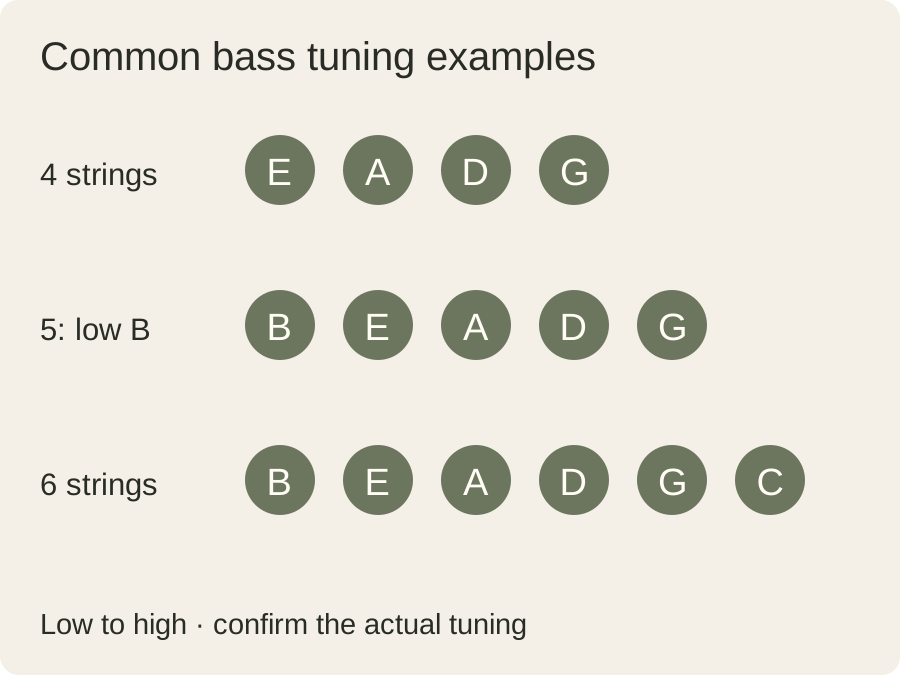
Record the ensemble, repertoire, tuning and required lowest note. Yamaha’s electric-bass manual lists common four-, five- and six-string note columns. Read the examples below from lowest to highest: E–A–D–G, B–E–A–D–G and B–E–A–D–G–C. They are examples, not definitions of every bass with that string count.
Extra strings can change the notes available and the muting task. Test cross-string phrases and rests with the tuning you will use. A four-string is a useful starting comparison, while a clear low-range requirement can justify five strings from the start. A fretless instrument requires accurate stopping pitch; choose according to the musical goal and learning support.
Budget for the instrument and a suitable amplifier or interface/headphone chain, cable, strap, protection and any needed setup. Use the bass-versus-guitar guide if the musical-role decision is still open.
Sources: Yamaha electric-bass manual, printed p. 4: example four/five/six-string tuning columns; Yamaha bass-selection PDF, pp. 5–8: scale examples, string count and powered electronics
Compare nominal scale, reach and balance
The Yamaha selection guide gives 34-inch and approximately 30-inch examples. Nominal scale is a fret-layout reference; individual saddle compensation and replacement-string winding length are separate. Use the exact maker’s method for unusual layouts.
Try your normal posture seated and standing with a secure strap. Compare where the nut and first position sit relative to your body, not only fret spacing. Record neck depth/profile, nut width, actual string spacing, body contact and balance. Hand size or a short-scale label does not determine comfort for every player.
Play familiar low/high-position changes without forcing an uncomfortable reach. Record any unmatched strings, tuning or setup. The short-scale guide covers closer spacing, remaining reach limits and string compatibility.
Sources: Yamaha bass-selection PDF, pp. 5–8: scale examples, string count and powered electronics
Check the exact electronics and output path
Record pickup arrangement, controls and operating modes. “Active” may describe a powered preamp, pickup system or both; confirm the actual circuit rather than choosing from the label. Yamaha’s selection guide distinguishes battery-powered preamp operation from its passive examples.
Follow the exact model’s control and battery instructions. A knob’s midpoint is not automatically neutral. Check pickup combinations, useful EQ settings, jack output and battery access under the seller’s permitted demonstration. Do not assume passive bypass will work with a depleted battery on every model.
Keep the cable, rig and listening level comparable. Check noise, clipping, balance and low-note definition at a comfortable permitted level. Test the intended interface or monitoring path. Body material and appearance do not establish the complete output, weight or feedback performance.
Sources: Yamaha bass-selection PDF, pp. 5–8: scale examples, string count and powered electronics
Screen condition without making an unauthorized adjustment
Fender’s bass setup guide conditions its procedures on factory strings and playing style, and places fine intonation late in the setup. Its measurement targets are model guidance, not universal pass/fail values for every bass.
With the owner’s permission, play the notes and check stable tuning, useful action, clean response, controls and visible condition. Record string age and normal attack when comparing the harmonic and fretted octave. An isolated buzz or tuner reading does not prove a repair diagnosis.
Ask a qualified seller or technician to assess uncertain relief, nut/fret condition, neck structure and remaining adjustment range. Do not turn a truss rod, move saddles, remove hardware or open electronics merely to complete a buying checklist. Separate present condition from work that is only promised.
Sources: Fender Support: bass setup conditions and late fine-intonation step
Confirm replacement strings and maintenance details
D’Addario’s June 2021 length guide measures its string length from the ball-end junction to the taper. It asks the user to check the ball-end seat-to-nut route and choose an appropriate taper position. That is a maker-specific fit method, not the bass’s nominal scale.
Record bridge/top-load or body-through routing, nut and tuner locations, full winding and taper requirements and the exact set. Follow both string and instrument makers where a tapered low string or unusual bridge is involved. A 30- or 34-inch instrument label alone does not prove a particular “short” or “long” set will fit.
Confirm available replacement sets, stated battery type and operating behaviour, case fit, actual or nominal weight basis, care and return/setup arrangements. For a used bass, obtain explanations of repairs or wiring changes before treating them as improvements.
Sources: D’Addario Support (2021): ball-end-to-taper winding length and bass-string fit
Use a personal purchase record
| Record | Write down |
|---|---|
| Musical role | Tuning, notes, passages and intended rig |
| Fit | Seated/standing reach, balance, neck and actual spacing |
| Sound and controls | Signal chain, settings, matched level, noise and lowest-note response |
| Condition | Identified instrument, strings, observations and technician questions |
| Ownership | Winding fit, battery/modes, protection, service and terms |
Repeat the same useful passages, include rests and the lowest required note, and note unmatched variables. Pause if the task is uncomfortable. Record uncertainty instead of assigning a score you cannot justify. This is a proposed personal comparison, not a medical test, controlled sound trial or inspection we performed.
Choose the instrument you can use and support
Confirm the required notes, a workable personal fit and useful response through the real rig. Keep condition observations separate from suggested adjustments. Check winding-length compatibility and electronics behaviour before committing to ownership. A specification becomes useful when its effect is verified in your actual task.
For the broader instrument-family and ownership decision, return to the complete guitar buying guide and keep your required role and practice system in view.
Frequently asked questions
Should a beginner choose four or five strings?
Start with the required notes, reach and muting. Common E–A–D–G four-string material may be enough; a clear low-B requirement can justify a five-string. Confirm the actual tuning.
Does short scale guarantee easier playing?
Closer fret spacing may help some stretches, but first-position location, neck dimensions, balance, strings and setup still affect the complete fit.
Does an active bass always work in passive mode with a dead battery?
No universal behaviour is established. Confirm the exact pickups, preamp and bypass circuit in the model instructions or a permitted seller demonstration.
Can nominal scale select replacement strings?
Not by itself. Confirm the bridge route, ball-end seat-to-nut path, winding/taper position and tuner requirements using the exact instrument and string makers’ instructions.
How this guide was prepared
We checked Yamaha’s selection PDF for scale examples, string counts and powered electronics, its older electric-bass manual’s printedp 4 note columns, Fender’s conditional bass-setup sequence, and D’Addario’s ball-end/taper fit method. The old manual is used for tuning examples only; its numerical adjustment targets and problematic harmonic wording are not adopted. We do not adopt the selection PDF’s automatic hand-size, wood-tone or truss-rod/twist claims. The personal record is proposed. We did not inspect a bass, measure fit, test battery depletion, amplification, comfort or a string set. Exact model instructions govern adjustment and compatibility.
Documentation checked .
Added nearby references and a personal buying record, separated nominal scale from winding fit, clarified tuning and battery-mode limits, qualified condition screening and replaced decorative/mislabelled images.
Sources and further reading
- Yamaha electric-bass manual, printed p. 4: example four/five/six-string tuning columns
- Yamaha bass-selection PDF, pp. 5–8: scale examples, string count and powered electronics
- Fender Support: bass setup conditions and late fine-intonation step
- D’Addario Support (2021): ball-end-to-taper winding length and bass-string fit