
The decision in brief
Choose bass strings in two stages. First confirm the number of strings, intended tuning, end fitting and usable winding length for your exact instrument. Then choose a winding style and gauge for the response and surface feel you prefer. Roundwound and flatwound describe different outer surfaces; neither is a universal winner. A set labeled long scale is not automatically correct for every long-scale bass, because the route from the string anchor to the nut also matters. After a meaningful string change, retune and check the setup before judging the result.
What matters most
- Instrument scale length and the required string winding length are different measurements.
- Check the whole set, including the lowest string and its intended pitch.
- Winding style is a useful starting point, not a guarantee of tone or flexibility.
- Compare strings with a consistent rig and a suitable setup; keep a written replacement specification.
Build a compatibility record before comparing tone
Write down the instrument model and version, string count, tuning, current set and bridge arrangement. If the current strings fit and perform well, retain their package or photograph its complete product code. That gives you a useful reference when a retailer lists several sets with similar names. A photograph of the installed string ends and tuning posts can also reveal a fitting detail that a short product description leaves out.
Separate a replacement from an experiment. A replacement aims to restore a known response with the same specification. An experiment deliberately changes something, such as surface texture or the lowest string's feel. Decide which task you are doing before ordering. Otherwise, an unexpected setup change can be mistaken for an improvement or defect in the string material.
Check every string rather than only the first and last gauge printed on the pack. Two sets sharing those endpoints can distribute the middle gauges differently. For a five- or six-string bass, confirm the tuning of the additional string: a low extension and a high extension serve different purposes. Keep the instrument maker's original specification as a reference, while recognizing that a player may choose a different approved set for a different tuning.
Scale length does not describe the entire fitting path
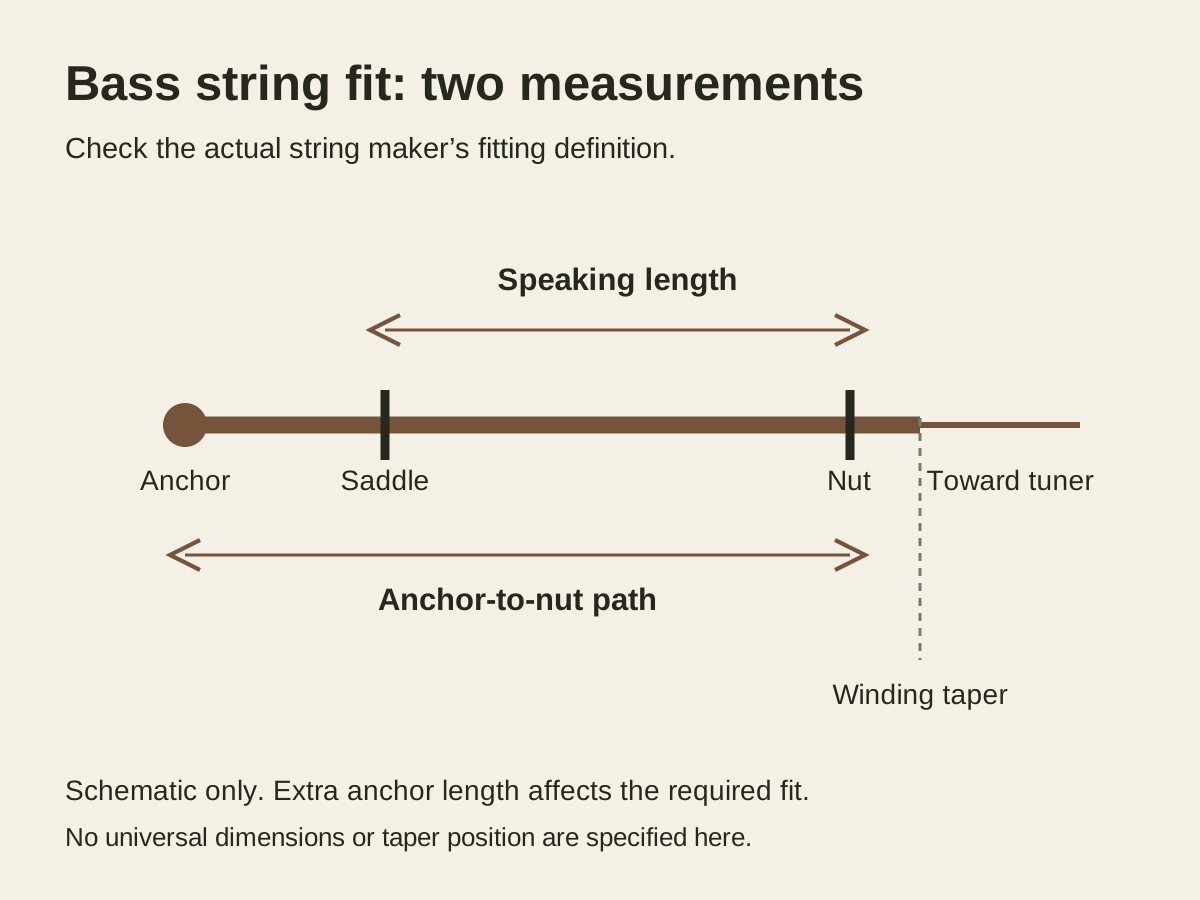
Nominal instrument scale is the fret-layout reference; the actual open-string speaking length runs from the nut to each compensated bridge saddle. Neither measurement describes the whole fitting path. String fit also includes the route from its anchor to the saddle and beyond the nut toward the tuning post. A through-body route or an unusual bridge can add length outside the speaking portion. That extra distance still has to be covered by an appropriate part of the string.
D’Addario's support guidance measures its bass string length from the ball seating point to the taper and asks buyers to check the anchor-to-nut distance. This illustrates why the instrument's scale label alone is insufficient. Use the fitting definition for the particular string maker and product; do not apply one brand's short, medium or long labels to every other range.
Before purchase, ask where the full winding ends, where any reduced section begins and what should sit on the saddle and nut. If that information is absent, request a drawing or dimensions for the exact product code. For measurement technique, see the scale length guide, then add the bass's extra anchor path. A correct measurement is more useful than guessing from overall string length.
Sources: D’Addario Support: Bass string scale and taper measurement; StewMac: fret-reference scale and compensated saddle positions
Roundwound and flatwound: compare the surface and the job
| Starting point | Roundwound | Flatwound | Check on your bass |
|---|---|---|---|
| Outer surface | Textured round-wire winding | Smoother ribbon-style winding | Sliding comfort and hand contact |
| Common listening tendency | More prominent bright attack | Often a more restrained top end | Exact product, age, rig and technique |
| Position changes | Texture may make sliding noise conspicuous | Smoother surface can reduce sliding noise | Record the same shift at the same level |
| Best reason to try | You want this surface and response | You want this surface and response | A useful result in your actual arrangement |
These are tendencies, not rules assigning one construction to a whole genre. Ernie Ball's comparison also describes different flatwound designs, showing that a category can contain contrasting responses. Do not assume that every flatwound is dark or that every roundwound feels equally flexible.
Choose one practical priority for a trial. Perhaps you want quieter shifts in a sparse recording, a clearly articulated picked line, or a surface your fretting hand prefers. Testing that priority creates a meaningful result. Describing a set as professional, vintage or modern without identifying the playing task does not tell another player whether it will suit them.
Read gauge as diameter, then investigate tension and feel
Gauge states a string's nominal diameter, usually in thousandths of an inch. It does not describe every feature of its construction. The core, wrap and complete design also matter, so two strings with the same printed gauge need not feel identical. Treat the number as a specification to record, rather than a complete prediction of stiffness under your fingers.
Tension depends on the string, vibrating length and target pitch. Changing tuning can therefore change the behavior of an otherwise familiar set. If you plan a different low tuning, identify the exact notes first and consult product-specific tension information where available. D’Addario directs readers to the tension chart on an individual product page. Check its stated tuning and measurement context before comparing numbers across products.
Your impression of effort also includes action, relief, fretting position and technique. A bass needing setup work is a poor platform for deciding that a gauge is inherently uncomfortable. Start with the current setup documented, change one variable where practical and reassess after tuning stabilizes. The setup guide explains the inspection order; it does not supply universal bass adjustment dimensions.
Sources: D’Addario Support: Finding string tension and specifications; D’Addario: string unit weight, speaking length and pitch (January 2026)
Use material and coating labels to narrow the trial
Record the exact material description from the manufacturer, including whether a label refers to the outer wrap or another component. An abbreviated retailer heading may conceal a more specific construction. If magnetic pickup compatibility matters, ask the string maker about the particular set and instrument rather than assuming that appearance alone tells you how it will interact with the electronics.
Compare competing sets as complete products. If one also changes gauge, winding style and age, the result cannot isolate the influence of its alloy. It can still answer a useful buying question: which complete set works better for your playing? Phrase the conclusion that way. Our nickel and stainless steel guide explains how to keep a material comparison properly bounded.
For coated products, ask what is coated and whether the treatment changes the feel you care about. Treat durability statements as manufacturer claims, with their stated conditions. Your replacement interval depends on use, environment, maintenance and the response you accept. A calendar promise taken from somebody else's routine is less useful than keeping notes on how your own set changes over several sessions.
Match four, five or six strings to the intended pitches
String count is only the beginning of the specification. A conventional four-string bass commonly uses E A D G from low to high; a common five-string setup adds a low B, while a common six-string setup adds a high C as well. Alternatives exist. State the actual target notes when discussing a set, especially for instruments supplied in a different tuning or used in an altered arrangement.
Give the lowest string a separate audition. Listen to its attack, sustained note and response under the picking force you actually use. A low note that sounds satisfactory in isolation may become unclear in a dense arrangement. That is a reason to compare the complete bass and rig, not evidence that one gauge or scale label guarantees definition.
Also check the highest string and transitions between adjacent strings. The set should support a phrase across the neck without forcing an unintended change in touch. If you are unsure whether the instrument supports the proposed tuning and set, consult its maker or a competent technician. Buying a wider-range set does not establish that the nut, bridge and neck can accept it without further assessment.
Sources: Yamaha electric-bass manual, printed p. 4: example four-, five- and six-string tuning columns
Follow the installation instructions for the exact string
Confirm the end fitting and threading route before removing a working set. Some bridges, headless systems and specialist strings use specific hardware or preparation steps. Follow the product's instructions for cutting, securing and winding; do not assume that a method used on another bass is correct here. Keep the old specification available so the technician can identify what changed if a problem appears.
After installation, tune to the intended pitches and inspect the string seating, winding clearance and tuning behavior. Check open notes and ordinary fretted passages before making an adjustment. If a string binds, a fitting looks wrong or a new noise appears, stop and identify the cause. Filing a nut or modifying a bridge merely to accommodate an uncertain purchase can turn a reversible string trial into a permanent alteration.
A different set may require changes to relief, action or intonation. Use the instrument maker's procedure and suitable tools, or arrange service. Record the final condition before judging tone. For a shop or rehearsal bass, include the final tuning and replacement code in its handover notes so another person can reproduce the intended configuration.
Run a useful listening and playing comparison
Prepare three short passages: a sustained low note, a moving line across strings and a phrase containing the slides or attacks you use most. Keep the instrument controls, amplifier or interface settings, listening level and recording path consistent. Write down string age and setup condition. A fresh set compared with a tired set is not a controlled test of winding material, although it may show why you wanted a replacement.
First compare comfort and physical response without processing changes. Then listen through your normal rig, including the effects you actually depend on. Make level adjustments deliberately and record them; a louder sound can attract attention without answering the original question. Avoid changing pickup balance, compression and EQ together while trying to attribute the result to a string set.
Use a short note format: task, observation, possible confounder and next action. For example, a slide may be quieter but the attack may need a different touch. That is a useful trade-off to evaluate in the song. A single favorable clip does not justify a universal ranking, and a result on one instrument need not transfer unchanged to another.
When the advice changes: specialist bridges and basses
For a headless or proprietary bridge system, fitting takes priority over the ordinary scale category. Confirm the accepted end type, dimensions and replacement procedure with the instrument maker. For a multiscale bass, each string may need a different usable length. Ask for compatibility with the exact model, not simply an assurance that the set is extra long.
For a fretless bass, include fingerboard care and the maker's string recommendations in the decision. A player's preferred surface and response must be considered alongside the instrument's construction and condition. Do not convert a general string preference into a claim that one winding causes a fixed amount of wear on every fingerboard. A technician can assess a specific instrument and maintenance plan.
For an acoustic bass, upright instrument or unusually small bass, first establish the string category its maker specifies. This guide primarily addresses electric bass replacement choices. Similar names do not make strings interchangeable across instrument families. When compatibility information conflicts, keep the instrument unmodified until the maker or string supplier resolves the exact fitting question in writing.
Conclusion: keep a specification you can order again
The most useful bass string choice is one you can explain and repeat. Select a compatible set, give it an appropriate setup and evaluate the playing task that prompted the change. Keep the package information and a brief outcome note. That is more dependable than remembering only a color, brand family or phrase such as medium gauge.
- Instrument: exact model, string count, bridge arrangement and target tuning.
- Fit: end fitting, anchor path, required winding length and taper position.
- Set: complete product code, individual gauges, winding and material description.
- Condition: installation date, setup observations and any technician work.
- Result: comfort, useful attack, unwanted noise and performance in the actual arrangement.
For an unchanged instrument that already works well, a documented like-for-like replacement is a sensible starting point. For a new goal, make the change deliberate and testable. If the set solves the problem without creating a more important one, you have a practical reason to keep it. If not, the written record helps you choose the next experiment without repeating the same uncertainty.
Frequently asked questions
Are long-scale bass strings correct for every 34-inch bass?
No. Confirm the exact string's usable winding length and taper position against the instrument's anchor-to-nut path. A through-body bridge or other hardware can require extra length. String makers can also define their scale categories differently.
Are flatwound bass strings always darker than roundwounds?
No. A smoother surface and restrained bright attack are common starting expectations, but individual designs differ. Compare the exact set, its age and your complete rig rather than treating the winding category as a fixed sound.
Does a heavier gauge always feel better on a low B?
No. Gauge is one variable within the string construction, tuning, scale and setup. Evaluate the low B's attack and response at your normal playing force, and use product-specific specifications to plan a suitable trial.
Do I need a setup after changing bass strings?
Check tuning, string seating, relief, action and intonation after the change. A substantially different set or tuning may require adjustment. Follow the instrument maker's procedure or use a qualified technician rather than assuming every change needs the same correction.
How often should bass strings be replaced?
There is no universal interval. Replace damaged or unreliable strings and assess whether the sound and feel still serve your playing. Keep a record of use, condition and your preferred response; do not infer a fixed lifespan from winding style alone.
How this guide was prepared
We checked D’Addario’s ball-end-to-taper fit guidance and product-specification directions, its January 2026 tension explanation, Ernie Ball’s winding comparison, Sadowsky’s gauge/setup FAQ and Yamaha’s older bass manual for tuning examples only. StewMac’s fret-reference and saddle example helps distinguish nominal scale from speaking length. Maker descriptions retain their model and construction limits; no fixed tension, lifespan or fingerboard-wear result is inferred. The replacement record and comparison routine are proposed editorial tools. We did not install or measure strings, inspect a bass or run listening trials. Both illustrations are conceptual; the AI-generated hero does not document a product.
Documentation checked .
Distinguished nominal scale from compensated speaking length, relabelled the fit diagram, added nearby evidence for tension, tuning and setup, and recorded the documentation review and its limits.
Sources and further reading
- D’Addario Support: Bass string scale and taper measurement
- D’Addario Support: Finding string tension and specifications
- Ernie Ball: Bass strings, flat versus round
- Sadowsky: Technical questions and battery behavior
- StewMac: fret-reference scale and compensated saddle positions
- D’Addario: string unit weight, speaking length and pitch (January 2026)
- Yamaha electric-bass manual, printed p. 4: example four-, five- and six-string tuning columns