
The short answer
A conventional bajo sexto has twelve strings in six paired courses; a bajo quinto has ten strings in five. In the documented tuning examples below, the sexto adds a low E1/E2 octave course beneath the quinto’s A, D, G, C and F courses. Both belong to the Mexican guitar family. Their string count does not make them interchangeable with an ordinary twelve-string guitar.
At first glance, a bajo sexto or bajo quinto can look familiar to a guitarist. The body, neck and frets suggest a guitar-like playing task. The paired strings and lower-register tuning make the musical layout different, however, and learning that layout is more useful than counting tuners alone.
The comparison begins with the courses, then moves to the notes they make available and the part a player chooses to play. An additional low course expands the documented range; it does not decide the arrangement on the player’s behalf.
What matters most
- Bajo sexto has six paired courses; bajo quinto has five.
- The documented quinto map retains the sexto’s A, D, G, C and F courses without the extra low E.
- Paired-string count, note layout and musical role are separate questions.
- Learn the available notes and the accompaniment tradition before transferring familiar guitar shapes.
Two related instruments, not two ordinary guitar sizes
Taylor’s Somos Collection explanation identifies the bajo quinto as a Mexican guitar-family instrument with ten steel strings in five doubled courses. It describes the bajo sexto as the related twelve-string, six-course instrument, with the quinto omitting the lowest E course.
The names are useful when heard alongside that construction. “Quinto” corresponds here to five courses, and “sexto” to six. A course contains two strings intended to be played as a unit, so five courses do not mean five individual strings.
The same Taylor explanation places the bajo quinto in Norteño music and describes accompaniment with bass guitar and accordion. That gives musical context without making one arrangement compulsory for every ensemble.
A photograph can show the number of strings, but it cannot establish their pitches. Modified instruments and custom voicings need their own description. This article compares the conventional family distinction using identifiable string-maker tuning examples.
Read the tuning by course and octave
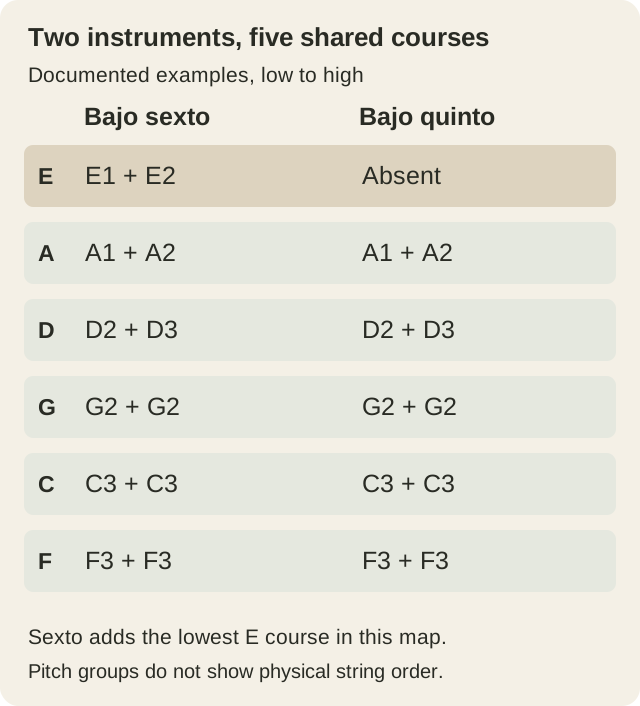
The note charts for D’Addario’s EJS86 bajo sexto set and EJS85 bajo quinto set document the pitch pairs below. The source charts list them in the opposite direction; this table reads from lowest course to highest.
| Course | Bajo sexto example | Bajo quinto example |
|---|---|---|
| E | E1 + E2, octave | Not present |
| A | A1 + A2, octave | A1 + A2, octave |
| D | D2 + D3, octave | D2 + D3, octave |
| G | G2 + G2, unison | G2 + G2, unison |
| C | C3 + C3, unison | C3 + C3, unison |
| F | F3 + F3, unison | F3 + F3, unison |
The letter names the note; the number identifies its octave register. E2 is one octave above E1. A1 and A2 are therefore two A pitches in different registers, while two G2 strings are intended to sound in unison.
The plus sign groups the partners rather than defining which string sits first across the neck. The map also describes these documented examples, not an instruction to install either named set on any instrument with the matching string count.
What the extra E course changes musically
In these examples, the sexto offers E1 below the quinto’s lowest open A1. That is additional available range. It can supply a lower note when a part calls for one, but a player can also leave that course silent.
Think of an accompaniment containing a low-register movement. On the sexto, the E course becomes one possible part of the phrase. On the quinto, the player works within a different lowest-course layout or chooses another voicing. The song and technique determine how that difference is used.
An extra course does not require every chord to include it. Including a low note, omitting it or changing the rhythm are musical decisions. The instrument’s capacity and the notes actually played should be described separately.
This distinction helps when listening to an ensemble. If another instrument is carrying the bass part, ask how the paired-string accompaniment relates to it: does it follow, leave space or contribute a separate movement? The answer comes from that performance, not simply from the word sexto.
Sources: D’Addario EJS86 bajo sexto set; D’Addario EJS85 bajo quinto note chart
Why ordinary guitar tuning is not the same layout
A conventional guitar uses E, A, D, G, B and E as its main open-string note names. The bajo sexto reference uses E, A, D, G, C and F, and the quinto retains the upper five of those bajo courses. The octave numbers also distinguish their lower registers.
For a guitarist, the change from G–B in ordinary guitar tuning to G–C in this bajo layout is especially relevant. The bajo course names proceed in fourths, whereas the guitar’s G-to-B relationship is a major third. A familiar guitar chord shape therefore cannot be assumed to produce the same harmony.
The conventional twelve-string guitar example documented by D’Addario’s EXL150 chart also differs in pairing: its lower four courses use octaves and its two highest use unisons. The bajo sexto example has three octave courses followed by three unison courses.
String count alone thus misses both the note layout and the interval within a pair. The same number of strings can serve a different register and musical role. Use the tuning to understand a part before transferring a fingering from another instrument.
Listen for the musical role
When listening to a bajo part, start with its rhythm. Notice where strokes fall, how long chords ring and where the player leaves silence. Then listen for the movement of the lower notes and the relationship to the melody.
In an accordion-and-bass setting such as the one described in Taylor’s overview, identify the parts separately. What is the accordion doing? Which notes belong to the bass? What does the bajo accompaniment add between or beneath them?
These questions keep the listening tied to a performance. An instrument can contribute rhythm, chord voicing or a lower movement without having to perform all of those functions throughout a song.
If you are learning a particular regional style, work with recordings and instruction from musicians in that tradition. A tuning table explains the available notes. It does not supply the stylistic phrasing, rhythmic approach or repertoire by itself.
Sources: Taylor Somos Collection FAQ
A first session for a guitarist learning the layout
Start with an instrument whose intended tuning and string configuration are documented. If the instrument is unfamiliar or modified, establish its supported setup with the maker or a qualified technician before changing strings or pitches.
Sound each course slowly and name the main note. Follow the chart from low to high, then reverse the direction. This begins to connect the names on the page with the positions under your hands.
Next isolate the partners on one octave course and one unison course. Hear the difference between two registers of the same note and two strings at the same intended pitch. Return to playing each pair together.
Choose a short phrase using the shared A, D, G, C and F layout. Learn where the melody or chord notes fall instead of importing a six-string shape unexamined. A teacher can help adapt the fingering and accompaniment to the instrument.
On a sexto, explore a simple phrase that includes the E course, then a version that leaves it silent. Listen to what changes in register and texture. This is a learning exercise, not a declaration that one version is more authentic or more useful in every song.
Finally practise a phrase with rests. Stopping the paired strings deliberately helps you hear the rhythm you are creating. More available notes do not remove the need to choose when the instrument should be silent.
Three questions to guide practice
| Question | Practical exercise | What you can learn |
|---|---|---|
| Which pitches are in this course? | Sound the partners separately, then together | The octave or unison relationship |
| Does the phrase use the lowest E? | On sexto, compare a phrase with and without that course | The role of the additional register in this phrase |
| How does the part interact with the ensemble? | Listen or play against the actual accompaniment context | Where the rhythm, voicing and rests leave useful space |
Keep the conclusion as specific as the exercise. If one version works better in a particular arrangement, describe that arrangement and what changed. The observation does not establish a universal winner between sexto and quinto.
Different voicings and instrument changes need their own context
The documented maps are a reference for understanding the families. They should not erase custom tunings or specialised designs. When discussing such an instrument, identify what is actually fitted and how it is intended to be tuned.
Removing the lowest course from a particular sexto, or adding strings to another instrument, is not established by this comparison as a suitable conversion. The maker’s design, hardware and setup requirements still apply. Likewise, an ordinary twelve-string guitar set is not automatically a bajo replacement set.
For day-to-day tuning, use a method that confirms the intended octave as well as the letter name. Guitar tuners explained provides the general input and reading principles; the instrument’s documented map supplies the target notes.
Hear the difference through the part
The central distinction is easy to remember once the maps are clear: the sexto reference adds a lowest E course to the five shared courses. Understanding the registers and pairings helps you hear what the player is doing, while the arrangement explains why those notes are being used.
To explore another paired-string guitar layout, continue with 12-string acoustic guitar. Keep each instrument’s tuning and musical context attached to the comparison.
Frequently asked questions
Does a bajo quinto have five strings?
No. The conventional instrument described here has five doubled courses, giving ten strings in total.
Is bajo sexto tuning just ordinary guitar tuning an octave lower?
No. The course names and octave/unison relationships differ. In particular, the reference bajo layout uses C and F for its upper two courses rather than B and E.
Must the sixth course be played in every chord?
No. The player decides which courses belong in the part. An available low register need not be present in every voicing.
Which instrument is better?
That question needs a musical role. The additional E range may matter to one part, while a player may prefer working with the five-course layout for another. The string count does not decide the result.
How this guide was prepared
Documentation reviewed October 18, 2026: Taylor’s Somos family explanation and D’Addario’s EJS86, EJS85 and EXL150 note charts. The course counts, octave labels and partners in the table and diagram were checked against those charts, reversing their high-to-low listing for low-to-high reading. Taylor supplies manufacturer context for accompaniment; the musical exercises are editorial suggestions. This documentation review included no hands-on playing, restringing or conversion. The pitch maps describe the named reference sets, not every custom tuning or approval for a stringing change.
Documentation checked .
Expanded the documentation method and attached the tuning-chart and accompaniment references to the relevant sections. The reference pitches, exercises and illustrations are unchanged.