
The decision in brief
A conventional twelve-string acoustic has six paired courses. In common standard tuning, low E, A, D and G use octave partners; B and high E use unison partners. Familiar chord relationships remain, but both strings in a course usually need fretting together. Confirm the model’s actual tuning, pair order and approved set before tuning or replacing strings. Judge its musical texture, fit and condition on the exact guitar; specialist unison-strung designs use a different arrangement.
What matters most
- Six courses normally mean four octave pairs and two high unison pairs.
- Pitch relationships do not specify physical pair order.
- Use the exact model’s approved tuning and complete set.
Twelve strings, six courses
A course is a group of strings played together. Six paired courses preserve the familiar six-string note relationships in a conventional twelve-string, while adding a partner to each course. This differs from a seven-string electric with a separate additional low string.
Taylor’s twelve-string FAQ describes four octave courses and two high unison courses, with both strings normally fretted by the same finger. Its general statements about comfort and sound are manufacturer descriptions, not our test results. Decide whether the paired texture supports the music you play rather than treating the string count as an upgrade.
Sources: Taylor: twelve-string FAQ, common courses and concert-pitch setup
The common standard tuning map
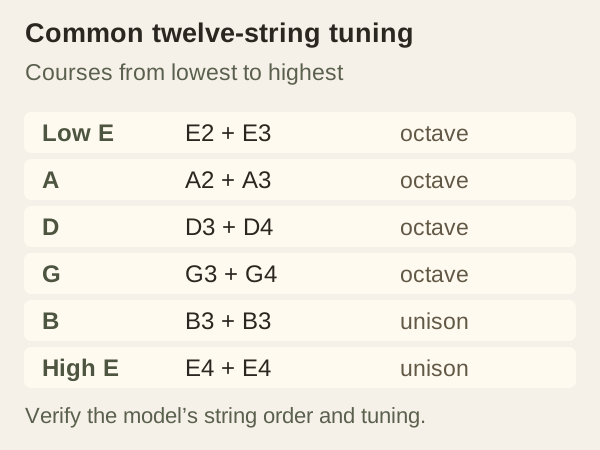
Read the courses from low to high: E, A, D, G, B, E. Scientific pitch notation keeps the two members of an octave pair distinct. “+” means the pitches belong to the same course; it does not show which string is nearer the player’s face.
| Course, low to high | Common pitch pair | Relationship |
|---|---|---|
| Low E | E2 + E3 | Octave |
| A | A2 + A3 | Octave |
| D | D3 + D4 | Octave |
| G | G3 + G4 | Octave |
| B | B3 + B3 | Unison |
| High E | E4 + E4 | Unison |
This expands the conventional six-string standard-tuning reference. Physical order is a separate question: Taylor’s reverse-stringing saddle is specified for certain right-handed twelve-strings using six pins and paired strings. Its instructions require professional installation and can require a different nut arrangement. Do not swap pair order by following this pitch table.
Sources: Taylor: twelve-string FAQ, common courses and concert-pitch setup; Taylor: reverse-stringing saddle fit and professional-installation limits
What the paired strings change musically
The extra strings add attacks and, in an octave pair, another pitch. “Shimmer” and “chorus-like” describe a listening impression; they do not specify a fixed detuning amount, loudness or electronic effect. Pair order, tuning, strings, touch, instrument and recording path affect the result.
Try a sparse accompaniment, a melody and the part you intend to record or perform. Listen to whether the additional notes help the rhythm and harmony or crowd the voice and other instruments. Keep the recording or amplified path documented. A pleasing processed demonstration does not establish the unamplified sound.
Test reach, spacing and fretting effort
Compare nut width, spacing within and between courses, neck profile, scale, action and body position. Sit and stand normally with suitable support. Try open chords, a barre shape and a melody, listening for both members of each pair under ordinary pressure.
If one string fails to ring, note the course and fret before blaming strength or technique. Nut height, fret condition and action may need assessment. Do not force uncomfortable stretches or assume excessive effort is inevitable. The action guide helps name the setup question.
Tune each string deliberately and recheck the pairs
Confirm the actual string, tuner peg, intended note and octave before turning anything. Mute the other strings, use an appropriate chromatic tuner and approach the approved pitch gradually. Recheck all courses after a pass. A letter-only E reading cannot distinguish E2 from E3; an octave partner must not be raised to an unintended octave.
Taylor’s FAQ states concert-pitch factory setup for its conventional twelve-strings. That does not approve standard pitch for every vintage, repaired or specialist instrument. A lower tuning can be a model or playing choice; it is not a compulsory rule for the whole category. If the instrument’s history or string identity is uncertain, obtain the correct instructions before raising load.
Sources: Taylor: twelve-string FAQ, common courses and concert-pitch setup
Choose a complete approved twelve-string set
Read all twelve gauges, pitch positions, attachment and approved tuning. A first-string number alone cannot identify a complete set. Martin’s MA180 extra-light example lists paired gauges in inches. Read from low E to high E, they are .047/.027, .039/.018, .030/.012, .023/.010, .014/.014 and .010/.010. Those product values do not prescribe physical order or approval for another guitar.
Check the actual model and condition before any change. Martin’s 2022 care guide calls for lighter sets on its twelve-string instruments; Taylor’s dated guidance lists a different maker-specific factory reference. A set name such as “light” is not a universal load limit. Use the acoustic-string guide for alloy and coating decisions after compatibility is established.
Use a set specified for the instrument. Do not add strings to a conventional six-string or guess octave partners from a second six-string pack. A broken string needs an identified correct replacement; repeated breaks at the same point need assessment of that contact.
Sources: Martin: MA180 twelve-string gauge row; product example, not universal approval; Martin care guide (2022), printed p. 7: twelve-string set limits and repair guidance; Taylor string FAQ (June 2023): dated model-specific factory examples
Inspect setup, structure and paired-note intonation
Inspect the bridge, top, neck, frets and repair record with the seller’s permission. Visible separation, cracks, unusual movement or uncertain neck condition calls for qualified assessment. A static image cannot establish structural health. Do not press, flex, dismantle or adjust the guitar to prove it is sound.
Tune open strings, then play each course and ordinary fretted chords. Note the pitch problem’s string, fret and playing pressure. Open-string tuning does not establish fretted-note accuracy; neither does one tuner reading identify its cause. Ask a competent technician about nut, saddle and action questions. The intonation guide explains the distinction.
Sources: Martin care guide (2022), printed p. 7: twelve-string set limits and repair guidance
Check the capo and amplified system you will use
Try the actual capo on the actual neck. Check that it spans the courses, holds both members clearly and works without excess pressure. Recheck every course’s pitch. Tightening indefinitely is not a remedy for a poor fit. See the capo guide for placement and pressure.
If buying an amplified instrument, test course balance, controls and output through the intended acoustic rig or interface at a permitted comfortable level. Assess the acoustic and amplified sound separately. A microphone recording cannot verify the installed pickup’s balance or venue performance.
When this advice changes
Taylor’s Somos collection documents an unison-strung doce doble. That concrete exception shows why twelve strings alone do not determine the pitch map. Use the exact design’s tuning and set; do not convert an unrelated guitar by guessing equivalent load.
Baritone, unusual-scale, vintage and repaired instruments require their own records and condition assessment. Confirm the maker’s current guidance, string length and attachment. The general checks still help, but the common octave map cannot authorize an unfamiliar configuration.
Sources: Taylor Somos collection: unison-strung doce doble exception
A twelve-string buying test you can repeat
- Identify the model, approved tuning, exact set and physical pair order.
- Review condition and repair history before tuning or adjustment.
- Tune each identified string cautiously, then recheck all six courses.
- Try your actual chords, melody and attack; note fit and paired-note clarity.
- Test the required capo and amplified path separately.
- Record uncertainties, service questions and the replacement set.
Keep one personal record: guitar/model, date, tuning reference, fitted set, pair order source, passage, capo/rig and observations by course. If a passage sounds busy, try another arrangement before changing strings or setup. This is a proposed comparison record, not an inspection or listening trial performed for this article.
Frequently asked questions
How is a twelve-string acoustic tuned?
A common standard layout uses six E–A–D–G–B–E courses. E, A, D and G are octave pairs, while B and high E are unison pairs. Verify the exact design.
Does a twelve-string use the same chord shapes as a six-string?
In the common standard arrangement, familiar course relationships remain, but each course contains two strings. Test spacing, fretting effort and clarity on the actual guitar.
Must every twelve-string be tuned down?
No universal rule applies. Use the pitch and set approved for the model and have vintage, damaged or uncertain instruments assessed.
Can I turn a six-string acoustic into a twelve-string?
Do not add strings to a conventional six-string. A paired-string instrument needs a complete design appropriate to its string system.
Can I use my normal capo on a twelve-string?
Only if it fits the actual neck and holds every pair cleanly with appropriate pressure. Test it rather than relying on a nominal size label.
How this guide was prepared
This AI-assisted documentation review checked Taylor’s common paired-course and concert-pitch FAQ, its restricted reverse-stringing saddle guidance and Somos unison-strung exception, Martin’s MA180 gauge row and 2022 care limits, and Taylor’s dated 2023 factory-string example. The pitch table expands the stated standard course relationships using scientific pitch notation. We visually counted the existing twelve-line schematic and checked the tuning card; neither specifies dimensions or physical order. No guitar was played, tuned, inspected, adjusted or load-tested. The personal record is proposed, and exact model instructions govern compatibility.
Documentation checked .
Separated pitch map from physical pair order, added a complete named-set gauge example with model limits, clarified non-invasive condition checks, and documented the two schematic images and unison-strung exception.
Sources and further reading
- Taylor: twelve-string FAQ, common courses and concert-pitch setup
- Taylor: reverse-stringing saddle fit and professional-installation limits
- Martin: MA180 twelve-string gauge row; product example, not universal approval
- Martin care guide (2022), printed p. 7: twelve-string set limits and repair guidance
- Taylor string FAQ (June 2023): dated model-specific factory examples
- Taylor Somos collection: unison-strung doce doble exception