
The short answer
Roundwound bass strings use a round outer wrap with a textured surface. Flatwounds present a smoother surface. Roundwounds commonly emphasize a bright attack, while traditional flats often give a more restrained top end and less sliding noise. Those are starting expectations: the exact construction, string condition, setup and technique matter. Compare a phrase you actually play before assigning either winding to a genre or calling one universally easier.
A moving bass line contains more than its written notes. The beginning of each note, the sound between positions and the moment a note stops all become part of the phrase. A different string surface can make you notice those details again.
This comparison concentrates on that playing experience. If you need to establish which replacement length or bridge fitting your bass accepts, the separate bass string guide covers that task. Here, start with a compatible, correctly tuned instrument and a musical question you can hear.
What matters most
- Winding names describe a surface construction, with other design details still to identify.
- Listen separately to attack, sustained sound, sliding noise and release.
- A smooth surface does not establish low playing effort or identical tension.
- Keep the phrase, string condition, setup and recording path attached to the comparison.
What roundwound and flatwound describe
The names concern winding construction. D’Addario’s bass-string explanation identifies a round outer wrap on roundwounds and a smooth surface on its flatwound category. A round wrap creates a repeated texture along the string. Flatwound construction uses a flattened outer wrap, often described as ribbon winding, to give a smoother contact surface.
These names do not specify the whole string. Core design, wrap material, diameter and other construction details remain separate. Two sets can share a winding label while differing in how they respond under the fingers. A coated roundwound also remains a roundwound; a surface treatment and a winding category describe different features.
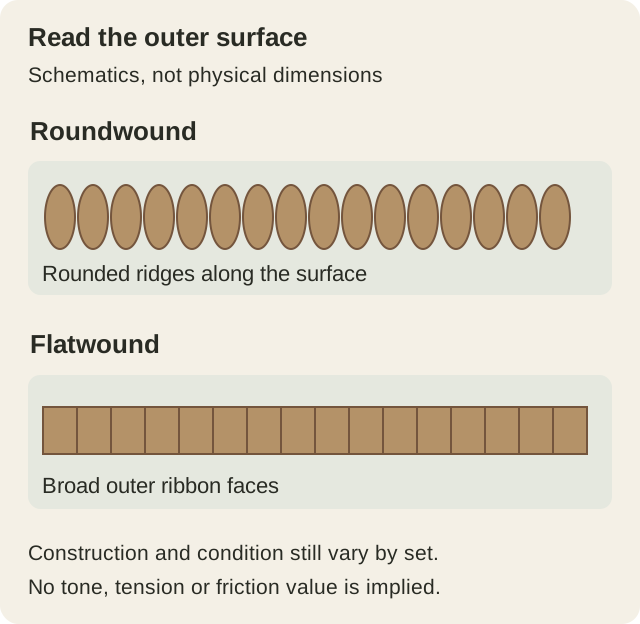
Use the diagram to understand the vocabulary, then examine the exact set’s description. It does not show a measured difference in friction, tension or sound. Half-round and other processed surfaces need their own product explanation rather than being forced into either illustration.
Sources: D’Addario ECB81 specifications
Separate attack, sustained sound and release
Listen to one note in stages. First hear the attack: the short beginning created by the finger or pick. Then hear the sustained portion. Finally hear how the player stops the note. A string change can seem dramatic because one of those stages becomes more conspicuous, even if the musical pitch stays the same.
Ernie Ball’s flat-versus-round guide describes roundwounds as a brighter starting point and traditional flats as more mellow, with less finger sliding noise. It also distinguishes its Slinky flatwounds from traditional flats. That distinction is useful evidence that the category includes different designs; the maker’s descriptions are not our comparative measurements.
Try a slow note followed by a rest, then repeat it as part of a regular groove. Ask whether the attack helps you hear the timing and whether the sustained note occupies the space you intended. A bright isolated note can be useful in one arrangement and distracting in another. The winding label cannot choose the part for you.
Keep the listening level comfortable and reasonably consistent. If one recording is louder, that can affect your preference. Write down any EQ or compression change so you know whether you are comparing strings at the same settings or comparing two deliberately different complete sounds.
Hear sliding noise separately from the note
A shift along the string is a useful exercise because it exposes the contact between hand and surface. Play a short phrase with one deliberate slide, then play the same notes with a lift and position change. Listen for what happens between the notes rather than concentrating only on their destinations.
The smoother flatwound surface is often used when a player wants less conspicuous sliding noise. It does not remove all unwanted sound. Contact pressure, lifting technique, gain and the recording path still affect the result. A finger can also excite an idle string while crossing it, regardless of the surface on the string being played.
Decide whether the slide belongs in the music. In a sparse line it may be distracting; in another phrase it may be an intentional transition. Practising a quieter shift and choosing a smoother set are different ways of addressing the question. You can explore both without treating the string as a substitute for control.
Surface smoothness and playing effort are different observations
Move a fingertip gently along the string, then fret a comfortable note with normal pressure. Those actions tell you different things. The first concerns the contact surface. The second includes the string’s response, action, fretting position and the pressure needed to make the note speak.
A smooth surface can still belong to a set that feels resistant under a bend or a firm fretting motion. Likewise, a textured set can feel manageable in an appropriate setup. Avoid using “soft” to mean both low surface friction and low effort. Describe the observation that matters: the slide is smoother, the fretted note needs less pressure, or the bend feels different.
Try the same small passage at the nut end and farther up the neck. If the effort varies strongly by position, include that in the note. A teacher or technician can help separate technique and setup questions from the surface preference. Do not continue an uncomfortable exercise just to complete a comparison.
A published example: the same gauge label can hide a difference
D’Addario lists both EXL170 roundwounds and ECB81 flats as 45–100 long-scale sets. Their current charts give different declared tension for the E1 string:
| Set and winding | Chart entry | Published tension |
|---|---|---|
| EXL170, roundwound | XLB100, E1 | 34.700 lbs |
| ECB81, flatwound | CB100, E1 | 40.300 lbs |
These are the maker’s listed values for those products, checked October 18, 2026. They are not measurements on our bass, and they do not establish a universal flatwound-versus-roundwound tension difference. The pages identify long-scale products; this table does not establish a complete laboratory method or a feel rating.
The listed wrap materials also differ: nickel-plated steel on EXL170 and stainless steel on ECB81. This is a comparison of two complete products, with winding and material both changing. It does not isolate winding as the sole cause of the chart difference.
The example explains why the printed gauge range is incomplete evidence for a like-for-like feel change. Check the exact product’s information and the instrument’s supported configuration. After a change, the complete setup may need assessment. Our setup guide explains the connected checks without prescribing one set of adjustment figures for every bass.
Use a short phrase with three different listening tasks
Choose a familiar phrase that you can play without concentrating on learning the notes. Keep its tempo manageable. Use it to ask one question at a time:
| Version | Listen or feel for | Keep in the record |
|---|---|---|
| A repeated note followed by silence | Attack, sustain and deliberate release | Picking method and note length |
| The phrase with one position shift | Surface contact and sound between notes | Slide or lifted shift, normal pressure |
| The phrase against its accompaniment | Whether the attack and duration support the part | Backing track and signal settings |
Record a brief example if that helps you remember the result. Identify the bass, set, string condition and signal path. A phone recording and a direct interface recording capture different paths, so keep the same method for the comparison you intend to make.
A practice note might read: “In the recorded verse phrase, my shifted notes were quieter with this set; the bass and EQ were unchanged, but string age differed.” This is an example of how to describe a result, not a report from our testing. The observation concerns that session, and the age difference remains part of its interpretation.
If you only have one set installed, the session can still be useful. It tells you what you want to change. You might discover that the distracting sound occurs during a shift rather than during the sustained note. That gives the next experiment a specific purpose instead of requiring you to replace strings because a category description sounds attractive.
Account for string condition and the complete rig
A fresh set compared with an old set introduces more than a winding change. Wear, contamination and previous use become part of the comparison. The result may answer whether the replacement improves your current sound, but it cannot isolate winding as the cause.
The same applies when two different basses are used. Pickups, setup and electronics accompany the string difference. You can compare which complete instrument supports the part, provided you describe that broader question. Avoid presenting the result as a controlled string experiment.
Begin with the settings you know, then explore a deliberate adjustment if needed. For example, you may want a quieter attack in one recording and clearer onset in another. Keep those versions identified. If the revised setting works, your conclusion concerns the set and rig together.
A winding style does not assign a technique or genre
Fingerstyle, picked lines, slides and muted parts can be explored on either category. The meaningful question is what the particular combination lets you articulate. An instrument description such as “vintage” gives less practical help than explaining the attack and duration needed in the song.
Try a phrase with short notes, then a version with longer notes. Adjust the release with your hands before changing the equipment settings. Listen for whether the notes overlap the next event in the accompaniment. A preferred string sound still needs an appropriate rhythm and note length.
For a fretless bass, follow its maker’s string and fingerboard-care guidance. This comparison does not establish a fixed wear rate for either winding on every fingerboard. For unusual string materials or specialist bass systems, compatibility takes priority over the general surface description.
Keep the result attached to a musical purpose
A useful conclusion might be that a smoother surface makes a particular shift quieter, while another set’s attack helps a picked phrase remain clear. Record the phrase and conditions behind that observation. You can then revisit the choice when the arrangement or technique changes.
For the replacement specification, return to the bass string guide. To explore how the number of strings changes the notes under your hands, continue with four-string versus five-string bass. Winding and string count answer separate playing questions.
Frequently asked questions
Are flatwounds always dark sounding?
Traditional flats are often described that way, but individual designs differ. Ernie Ball’s own comparison distinguishes traditional and Slinky flatwounds. Listen to the exact set in the part you play.
Do flatwounds eliminate finger noise?
A smoother surface can make sliding noise less prominent. It does not eliminate every contact sound or replace deliberate shifting and muting.
Will a 45–100 flatwound set feel like a 45–100 roundwound set?
The gauge label does not establish identical construction, declared tension or hand feel. Check the exact sets and reassess the supported setup after a change.
Should I change strings before trying a different technique?
First identify the sound or contact you want to change. A short shift or release exercise can reveal whether your present technique addresses it. A different compatible set can then become a purposeful experiment.
How this guide was prepared
Documentation reviewed October 18, 2026: D’Addario’s bass construction categories and EXL170/ECB81 specification charts, alongside Ernie Ball’s flat-versus-round explanation. The two E1 tension entries are published product values, not forces measured on a bass; winding and wrap material both differ. The surface drawing is schematic. The phrase, shift and release exercises are editorial suggestions, and the sample practice note is hypothetical. This documentation review included no comparative playing, friction, durability or listening test. Individual set construction, condition, setup and recording path remain part of any player’s result.
Documentation checked .
Clarified the documentation and test limits, rechecked the two E1 chart entries, and attached the surface, sliding-noise and feel references to their sections. The published tension values and illustrations are unchanged.