
The short answer
A conventional four-string bass uses E A D G from low to high. A common five-string adds a low B beneath those strings, giving access to B, C, C♯, D and D♯ below the four-string’s open E. It also provides another place to play familiar notes and another string to control. Some five-strings use a high C instead, so confirm the tuning. Compare musical range, positions, muting and the actual neck rather than treating string count as an ability level.
The first few minutes on a five-string can be confusing even when the notes are familiar. The string nearest your thumb may now be B instead of E, and a line you used to start on the lowest string has moved one string across. Naming the layout helps make that change deliberate.
This guide focuses on the playing task. The broader bass guitar guide covers complete-instrument choice, electronics and ownership. Here, use the bass’s documented tuning to explore which notes and movements actually change.
What matters most
- Confirm low-B, high-C or another tuning before comparing five-string basses.
- A conventional low B adds B, C, C♯, D and D♯ below the shared low E.
- Higher frets on the B offer alternate places for familiar pitches.
- Practise idle-string control and compare the actual neck, spacing and playing position.
Start with the actual open-string map
Yamaha’s tuning overview identifies E A D G as the conventional four-string layout and B E A D G as the standard low-B five-string arrangement. It also lists E A D G C as an alternative five-string tuning. The fifth string can therefore extend a different end of the instrument’s range.
| Layout | Open-string names | What changes |
|---|---|---|
| Conventional four-string | E A D G | The reference layout used here |
| Common low-B five-string | B E A D G | An additional lower string |
| High-C five-string alternative | E A D G C | An additional upper string |
The names in this table show the relationships, not approval to retune an unfamiliar instrument. Identify its installed strings, intended notes and supported setup. A five-string with a custom tuning needs its own map, even if its neck and bridge look conventional.
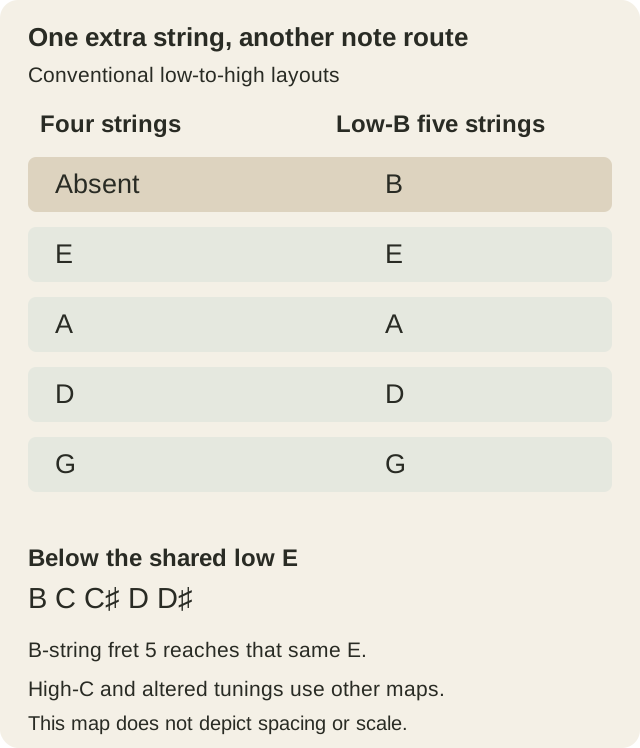
The low B adds five notes below the shared E
These fret examples assume a conventional fretted bass with one semitone per fret. On a conventionally tuned low-B string, the open note is B. Its first four frets give C, C♯, D and D♯. At the fifth fret it reaches the E already available as the lowest open string on the standard four-string. Those five lower notes are the extra pitches below that shared E.
The low B and shared open E are five semitones apart, a perfect fourth. This lower extension is not a full octave. The UNSW note and frequency reference explains the twelve-semitone octave used for this note-map calculation.
That is a register comparison. The fifth string continues above its fifth fret and gives additional locations for notes that overlap the other strings. Describing the whole string as “five new notes” would miss those position choices. Conversely, adding one string does not mean every note played on it is unavailable on a four-string.
Use a part you know to identify whether that lower register is needed. If the written or intended line contains a D below the standard open E, the conventionally tuned low-B bass provides it at the third fret. Playing a higher D on another string changes the register of the part, even though the note name stays D.
Sometimes that register change is an acceptable arrangement choice. Sometimes the original lower note matters to the composition or ensemble. Discuss the actual part rather than assuming every song benefits from its deepest available note.
Sources: Yamaha: Alternate Bass Tunings; UNSW Music Acoustics: Note names, MIDI numbers and frequencies
The same pitch can have a different location
Take a familiar three-note line: E, G, A. On the standard four-string’s E string, those notes can be played open, third fret and fifth fret. On the conventionally tuned five-string’s low B, the same pitches occur at the fifth, eighth and tenth frets.
| Note | Shared E string | Added low-B string |
|---|---|---|
| E | Open | Fret 5 |
| G | Fret 3 | Fret 8 |
| A | Fret 5 | Fret 10 |
The example gives a location choice; it does not claim the two routes have identical attack or feel. One begins with an open string and the other uses fretted notes on a different string. Play slowly enough to hear the result and to notice what your hand must do.
In a longer line, another string may let you remain nearer a position that serves the next phrase. Yamaha’s five-string playing article discusses that positioning possibility. Treat it as an option to explore, not a guarantee that adding a string automatically makes every line faster.
Try both routes with the same rhythm. Then add the next few notes of the song. The easier route may become clearer only when you include the transition into the following phrase.
Sources: Yamaha: 5 Tips for Playing 5-String Bass; UNSW Music Acoustics: Note names, MIDI numbers and frequencies
An idle low B still needs control
The extra string is present even when a part uses only E A D G. Listen during a rest after a cross-string phrase. If another string is still ringing or you hear a contact thump, the intended silence has not yet been achieved.
Yamaha’s playing article describes controlling the B through palm muting or using it as a thumb rest while other strings are played. It also cautions against pressing it so hard that contact with the pickup produces a thump. Those are technique examples to work through carefully on the actual instrument.
Your usual fingerstyle, pick or other technique may require a different combination of contacts. Begin with a single note, stop it deliberately, then cross to another string. Notice which hand can control the strings that are now idle without creating pressure or obstructing the next note.
Use a clean signal at a manageable listening level while learning the movement. Then include the processing you normally use. A rest that seems clean at one setting may expose additional contact sound at another. Work with a teacher if the muting motion feels awkward or creates tension.
Read neck width and string spacing as separate details
String count tells you how many strings are fitted. It does not supply the complete neck dimensions. Compare nut width, neck profile, spacing at the playing area and the bass’s overall reach using the exact models’ specifications and the instruments themselves.
Place the bass in your normal seated or standing position. Try a comfortable first-position line, a move to another string and a passage farther up the neck. Notice whether the hand can reach the intended string while the shoulder and thumb remain relaxed.
A greater overall neck width can coexist with closer spacing between individual strings. That is why the outer dimension and the gap you must navigate answer different questions. A preference based on one four-string and one five-string belongs to those instruments, not automatically to every model with those counts.
Scale length is another independent variable. It affects the fret layout but is not defined by the number of strings. Scale length explained gives the measurement context. If the concern is reach, include body position and balance in the discussion as well.
A first session for a four-string player
Start by naming each open string from low to high, then repeat in the opposite direction. On a low-B five-string, locate the familiar E A D G group without automatically starting on the lowest string. This builds a clear reference for material you already know.
Play an existing line entirely within that shared group. Preserve its rhythm and note lengths. Listen for the idle B during the rests. You are learning how to control the new layout while keeping the musical part familiar.
Next play the E G A location example above. Compare the open-E route with the fretted low-B route. Follow it with a short phrase of your own so the exercise connects to something you intend to play.
Finally try a passage that intentionally includes one of the five lower notes. Give it enough space to hear the pitch and its release. The purpose is to understand the added register, not to put a low B into every bar.
Keep a brief practice note: the tuning, passage, chosen route and any muting difficulty. That is more useful for the next session than deciding that the new format is universally better or worse after one unfamiliar attempt.
Explore the added register in the arrangement
A low note heard alone and the same note inside an ensemble answer different listening questions. Use your normal monitoring path to hear the part with the accompaniment. Ask whether the notes remain identifiable and whether their duration supports the rhythm.
If the new register seems indistinct, describe the observation before assigning a cause. The instrument, strings, setup, electronics, listening system and arrangement can all be relevant. A string count or a speaker-size label is insufficient evidence for a diagnosis.
You can also explore the upper shared strings while leaving the B silent. A five-string does not oblige the bassist to occupy the lowest available register. Moving between registers, repeating a higher phrase or leaving a rest are choices made for the song.
Altered four-string tuning changes the reference
A four-string can use a different documented tuning. Yamaha’s overview describes drop D and B E A D among the alternatives. A properly supported B E A D four-string reaches a low B while giving up the conventional open G at the top. That creates a different layout from both examples in the main comparison.
Confirm the required strings, nut fit, tuning and setup with the instrument maker or a qualified technician before making a substantial change. Listing an alternative does not approve it for every bass or establish one suitable gauge. The bass string guide covers the compatibility record.
A high-C five-string raises another question: the added upper string supplies a different register and position pattern. Return to its actual map instead of applying the low-B exercise unchanged. The useful comparison always names the tuning as well as the string count.
Sources: Yamaha: Alternate Bass Tunings
Choose the notes and movements you need to learn
Four strings and a low-B five-string share a familiar E A D G foundation. The added string offers a lower register and alternate locations, with an additional muting task. Work through those changes separately and connect them to a real phrase.
If your current instrument already supplies the part, you can continue developing timing, articulation and control on it. If the new register or position choices serve your music, learn the fifth string as part of the complete layout. For a different physical variable, short-scale bass explained separates fret spacing from the whole-instrument reach.
Frequently asked questions
Does every five-string bass add a low B?
No. Low-B B E A D G is common, but E A D G C and other arrangements exist. Identify the intended tuning of the particular instrument.
Can I play four-string parts on a conventional five-string?
The familiar E A D G strings remain available. You can begin there, while controlling the idle B and adapting to the actual spacing.
Does a low-B bass add a full octave below open E?
No. The conventional low B is below E by a perfect fourth. The open B and its first four frets give five chromatic notes below that shared E.
Should a beginner always start with four strings?
Use the intended music, teaching support and actual playing fit to decide. Either format requires timing and muting practice; a clear need for the added register can make a five-string a reasonable starting instrument.
How this guide was prepared
Documentation checked October 18, 2026. Yamaha’s tuning and playing articles support the named tuning layouts, position choices and muting examples. The chromatic notes and E–G–A fret locations were independently checked against the twelve-semitone system described by UNSW Music Acoustics; they assume a conventional fretted bass with one semitone per fret. These are note-map deductions, not measured intonation or a model comparison. The code-native graphics show abstract paths and note relationships, with no physical spacing claim. The exercises are editorial practice suggestions; no instrument trial, recording test or performance improvement was measured.
Documentation checked .
Clarified the conventional semitone-per-fret condition for the low-B note and position examples, independently checked their note arithmetic, and attached the tuning and technique sources to the relevant sections.