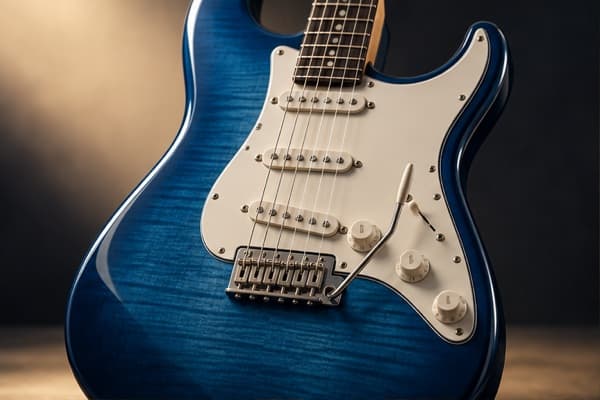
The decision in brief
A guitar setup checks and, where needed, adjusts the instrument for a particular string set, tuning and playing style. Start with condition and a stable tuning reference, then evaluate neck relief, string height, nut behavior, bridge operation, intonation and the final playing result. Measurements only make sense with defined reference points and the correct model's guidance. A truss rod controls relief; it is not a general shortcut for lowering all action. Use a technician for uncertain adjustments, nut or saddle cutting, fret work and structural problems.
What matters most
- Specify string gauge, tuning and playing style before discussing a setup target.
- Retune and remeasure after changes; setup variables interact.
- Relief, action, nut height and intonation describe different parts of the string path.
- A useful service request records symptoms, conditions and the final playing checks.
What a guitar setup includes, and what needs separate repair
A setup aims to put a serviceable instrument into a useful playing condition for a defined use. That can include strings, tuning, neck relief, bridge or saddle adjustment, intonation and checks of hardware and electronics. The exact service package varies, so ask what the quoted work includes rather than assuming the word setup describes a standard bundle everywhere.
A loose connection or an incorrect saddle setting may be addressed during routine work. A cracked bridge, damaged truss-rod nut, lifted fret, neck-angle problem or failing neck joint can require repair beyond that scope. Inspection comes first because adjustment cannot safely solve every structural fault. If the instrument has changed suddenly, describe that change before asking for lower strings.
Separate the desired result from a particular repair method. You might want easier first-position chords, a clean bend high on the neck or stable tuning after bridge movement. Those are useful playing goals. Asking for a specific rod turn before the instrument is examined skips the diagnosis. A technician can decide which variables explain the symptom and whether the request is achievable with the existing instrument.
Define strings, tuning and the playing baseline
Record the instrument model, bridge type, current strings and intended tuning. Include the full gauge set where possible, not just the thinnest string's number. Tell the technician if you expect to alternate tunings or use unusually heavy picking. A setup optimized for one stable condition may need a compromise when the instrument frequently moves between different conditions.
Fender's factory-specification page explicitly relates its guidance to the factory string gauges and calls the values starting guidance within limited parameters. It also notes that playing application can justify variation. This is why copying one published number onto another guitar is not a complete setup plan. Model design and the player's technique belong in the decision.
For your own baseline, tune the guitar and play a familiar passage before changing anything. Note which string and fret produce a symptom, whether it occurs open or fretted, and whether it is audible through the intended listening path. Keep a short written record. A repeatable observation is more helpful than saying the guitar feels wrong after several unrelated changes have already been made.
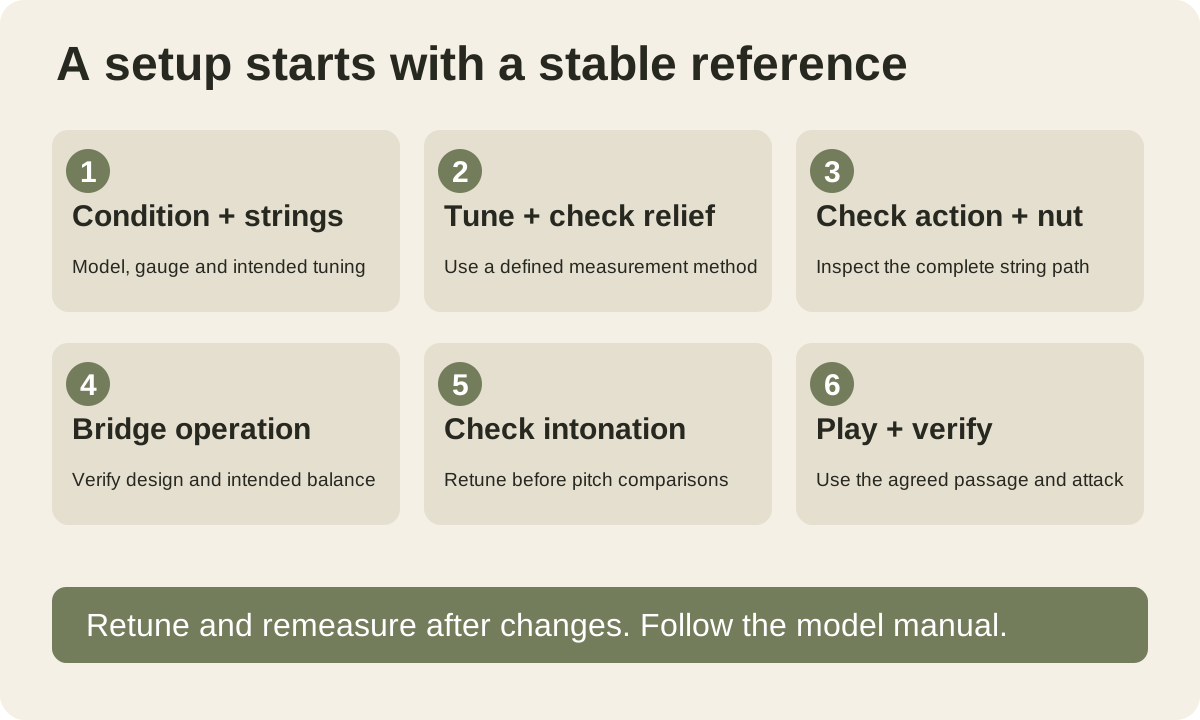
A practical setup order with retuning between checks
| Stage | Question to answer | Record or verify |
|---|---|---|
| Condition and strings | Is the instrument serviceable and in the intended string set? | Damage, wear, gauge and tuning |
| Tuning and relief | What is the neck doing under the reference condition? | Measurement method and model guidance |
| Action and nut behavior | Is the string path workable for the player's technique? | String, fret, support condition and symptoms |
| Bridge function | Does the bridge operate in its intended state? | Design, balance and return behavior |
| Intonation | Do fretted pitches compare usefully with tuned open strings? | Consistent pressure and repeated readings |
| Final playing check | Does the instrument meet the stated playing goal? | Chords, bends, dynamics and control function |
This is an inspection framework. The actual adjustment sequence follows the instrument's construction and manual. A floating bridge may need its balance established early and revisited as other settings change. Nut issues should be diagnosed even when cutting the slots is outside the planned service. There is no benefit in completing the later checklist on an unstable starting condition.
Retune before judging a new measurement or playing result. Keep earlier observations so you can compare the effect of each change. If several settings interact, work methodically toward the intended condition instead of making rapid compensating adjustments. The aim is a repeatable instrument state, not a race through a list of screws.
Check neck relief without treating it as overall action
Relief describes the neck's curvature along the string path. An inspection commonly uses a string held against two reference frets and measures the gap at a specified point between them. The fret choices and acceptable range must come from guidance suited to the model. The way the guitar is supported and its tuning should also be kept consistent.
For its Stratocaster procedure, Fender first checks tuning, uses a capo at the first fret, holds the sixth string at the last fret and reads the gap between that string's underside and the eighth-fret crown. Those reference points define the example; they do not supply a method or target for every acoustic, bass or vintage design. Include the string, held frets and reading fret in a setup note, together with the applicable model guidance.
The truss rod is used to address relief where the instrument has an adjustable design. It is not a universal control for nut slots, fret condition, bridge height or neck angle. If the rod meets unusual resistance, has a damaged adjustment point or produces no expected response, stop and obtain service advice. Our relief and truss-rod guide explains the distinction in more detail. Confirm a relief problem before deciding that the rod needs adjustment.
Measure action and inspect first-position behavior
Action is string height at a defined location. Measure from the top of the relevant fret to the underside of the string, using the method specified for the instrument. State which string and fret you measured and whether anything was fretted or capoed. A quoted action value becomes ambiguous when those conditions are omitted.
Listen and feel as well as measuring. First-position chords, a sustained note farther up the neck and a bend can expose different limitations. High action near the bridge is not necessarily the same problem as difficult fretting close to the nut. Likewise, a low numerical setting is not automatically an improvement if the player's attack produces unwanted buzz or a bend chokes.
Nut-slot work requires a separate diagnosis and suitable tools. Filing removes material and can be difficult to reverse without repair or replacement. Ask a technician to assess slot height, width and seating if open-string behavior or first-position effort suggests a problem. Read the action measurement guide for the measurement language and the fret-buzz guide for symptom patterns. Use those observations to support a diagnosis rather than selecting one cause from a single symptom.
When this advice changes: bridge design and adjustment limits
Many electric bridges allow adjustment with screws, but the controls and relationships vary. Some use individual saddles; others adjust a shared bridge height or have restricted saddle geometry. A moving bridge adds a balance and return-to-pitch question. Identify the system before following an adjustment video that happens to show a similar body shape.
An acoustic guitar often uses a fitted saddle rather than a set of individually height-adjustable electric saddles. Removing material, changing its seating or modifying its top profile can affect several functions and may not address the underlying neck or top condition. Fender's acoustic manual treats saddle and bridge relationships within the instrument's design. Leave uncertain saddle modification to an experienced repairer.
If the available adjustment range is exhausted, treat that as diagnostic information. Continuing to lower a saddle is not a solution to every neck-angle or structural problem. The correct service can be more substantial than a routine setup. Tell the technician about past modifications and whether the present hardware is original. The bridge comparison gives context for design choices, while the exact model documentation governs the work on your instrument.
Check intonation after the main playing geometry is settled
Tuning an open string establishes that reference pitch. Intonation asks how fretted notes relate to it. Use a reliable tuner and a consistent method, retuning the open string before repeated comparisons. Keep fretting pressure and attack similar so a change in technique is not mistaken for a change in bridge compensation.
An octave-fret comparison is a useful part of an inspection, but it does not prove that every chord in every position will be mathematically exact. Check the actual notes and chords you use as well. If first-position notes sound wrong while another comparison looks acceptable, include nut behavior, strings and fretting pressure in the investigation rather than immediately moving a saddle again.
Action, relief, string condition and tuning stability need to be understood before final intonation decisions. Otherwise you can compensate for a temporary state and need to repeat the work. Our intonation guide covers the comparison in depth. If a saddle reaches its travel limit or an acoustic instrument needs compensation work, ask a technician to assess the complete cause. A tuner provides evidence; it does not identify the mechanical repair on its own.
Judge the completed setup with a playing checklist
Play the passage used for the baseline, then test several different tasks. Include open strings, first-position chords, notes across the neck and bends where relevant. Vary the attack from your quietest normal playing to your strongest normal playing. A setting that works only when you deliberately avoid your usual technique is not a complete assessment.
On an electric guitar, listen through the intended amplifier or recording path as well as acoustically. Check pickup balance, the switch, volume and tone controls, the output connection and any bridge movement you plan to use. Pickup height is another model-specific variable, so avoid copying a distance without the prescribed measurement condition. On an acoustic, listen for clear response and unwanted rattles using the actual playing position.
Retune and repeat any test that seemed inconsistent. Distinguish a reproducible problem from one accidental touch or an unfamiliar technique. Record what improved and what remains unresolved. If a compromise is necessary, describe it plainly: for example, easier light playing versus extra clearance for a hard attack. The result should be judged against the agreed use, not an abstract claim that the lowest possible strings are always best.
Prepare a useful technician handover
A good handover lets another person reproduce the question. Bring the instrument, its intended string set if agreed, and the tuning information. Explain any alternate tuning, capo use, unusual bridge operation or particular passage that matters. If you can demonstrate the symptom consistently, do so before describing a preferred repair.
- Instrument: model, bridge type and relevant modifications.
- Reference condition: strings, gauges, tuning and playing environment.
- Symptom: exact string and fret, open or fretted, acoustic or amplified.
- Playing goal: easier chords, clear bends, stronger attack or reliable bridge use.
- Work boundary: routine adjustment, approved repair and any work requiring a separate quotation.
- Completion check: the passage and functions to verify together.
Ask what is included in the service and how an unexpected repair will be handled. Prices and turnaround differ by location and instrument, so obtain a current local quote. For a newly purchased guitar, clarify the seller's service and return arrangements before commissioning irreversible changes. For a used purchase, our inspection checklist helps identify condition questions that should be resolved before setup promises influence the purchase.
Recheck the baseline when the playing condition changes
A new gauge set, a different tuning or a change in environment can justify a fresh inspection. That does not mean every string change needs a rod adjustment. Return to the recorded baseline, tune the guitar and check whether a measurable or audible problem has appeared. Follow the maker's care guidance and avoid treating setup as a fixed calendar of automatic screw turns.
Keep the completed service note with the gauge, tuning, measurement methods and agreed result. If the instrument later changes, that record gives a technician something concrete to compare. It also prevents a temporary preference from becoming a supposed factory requirement. A useful baseline is specific enough to reproduce and flexible enough to reflect the player's changing needs.
The practical conclusion is simple: inspect first, define the use, measure consistently and verify by playing. Make only adjustments you understand and can perform with the right documentation and tools. For uncertain geometry, material removal or structural symptoms, a clear technician handover is the most useful next step. A successful setup is the instrument working reliably for its intended task, with its limitations understood.
Frequently asked questions
What is included in a guitar setup?
Common work includes strings, tuning, relief, action, intonation and playing checks. The package depends on the technician and instrument. Confirm whether nut work, fret work, electronics or repairs are included.
Can I lower action just by adjusting the truss rod?
The rod controls relief where an adjustable design is fitted. Overall action also involves the nut, frets, bridge and geometry. Diagnose the variable before adjusting it.
What action measurement should every guitar use?
There is no universal value. Use the model's guidance and defined measurement points, then assess the player's normal technique, bends and desired result.
Should I set intonation before changing strings?
Establish the intended serviceable string set, tuning and main playing geometry first. Retune and use consistent fretting pressure when comparing open and fretted pitches.
When should a technician handle the setup?
Use a technician for uncertain adjustments, unusual rod resistance, nut or saddle cutting, fret work, exhausted adjustment range and structural symptoms. Provide the exact playing problem and intended strings and tuning.
How this guide was prepared
We checked Fender's factory-setup and Stratocaster support pages and the acoustic owner's manual supplied under the filename 2011 Fender Acoustic Guitar Manual, particularly its neck, action and service sections (printed pages 26–29). The web procedures retain their factory-string and model conditions; the older acoustic manual illustrates repair boundaries and does not replace current instructions for an owner's model. The setup sequence and technician worksheet are editorial proposals. We measured no instrument, calibrated no tool, adjusted no hardware and diagnosed no reader's guitar. The retained guitar image and workflow are editorial illustrations. AI assistance was used for source comparison and language review; no human technical reviewer is claimed.
Documentation checked .
Added a defined Stratocaster relief-measurement example, linked setup and service claims to their specific sections, clarified the editorial image scope, and recorded the documentation review and model limits.