
The decision in brief
Choose a cutaway if regular playing above the neck-to-body joint requires easier hand access. Choose a non-cutaway if that range is not needed or a symmetrical traditional body is preferred. A cutaway changes body geometry, but its audible effect cannot be separated from bracing, body shape, materials and construction by looking at the outline alone; compare the actual guitars rather than assuming a major loss of tone.
What matters most
- Identify the highest fret and passage that must be played.
- Test access seated and standing.
- Inspect heel shape and neck-to-body joint.
What a cutaway changes
A cutaway is an indentation in the treble-side upper bout near the neck joint. It creates room for the fretting hand to reach higher positions. Taylor describes access as the primary function and notes that cutaways are also chosen for appearance.
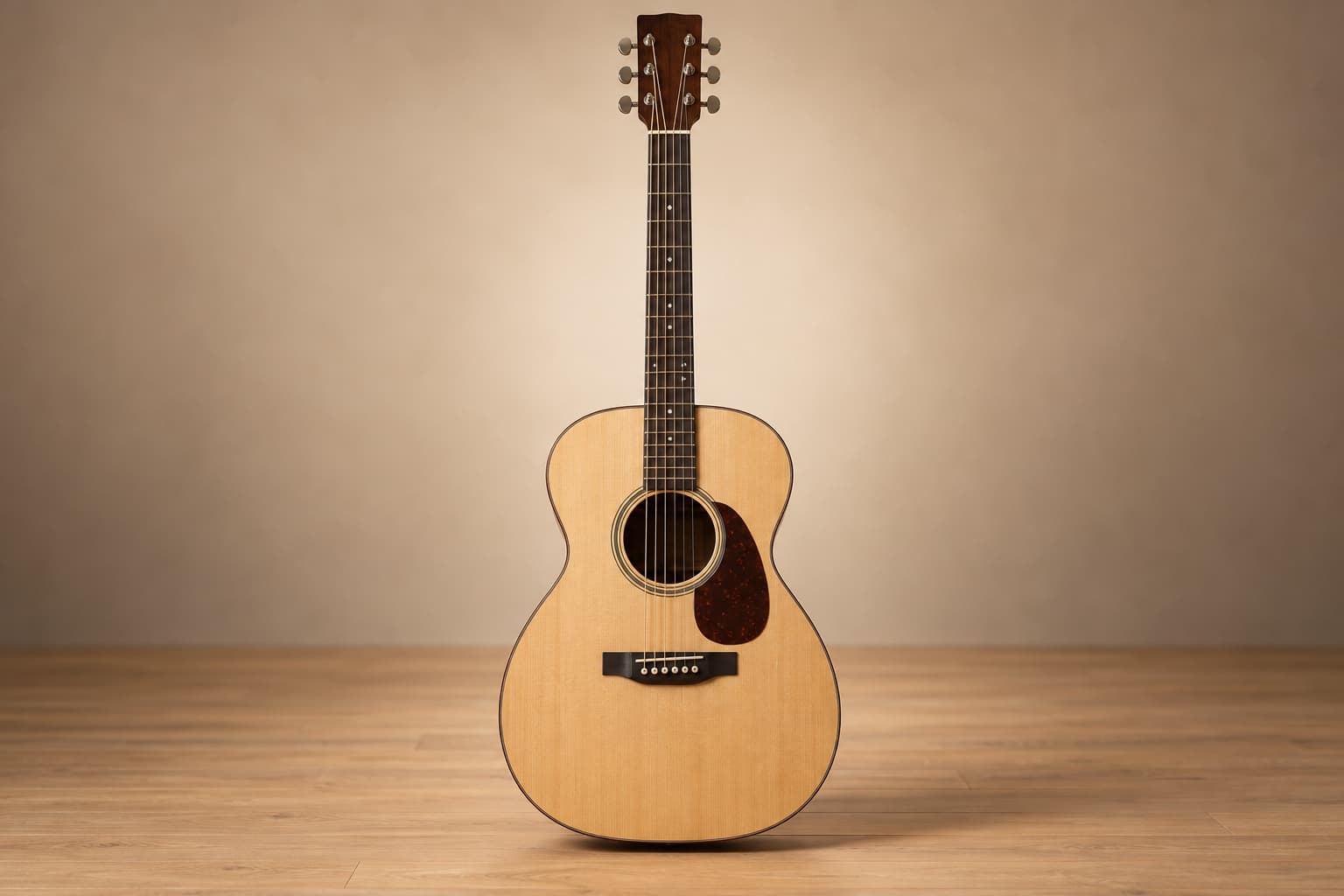
A non-cutaway retains the full, generally symmetrical upper bout. It can still provide usable access depending on the neck joint, heel and playing position, but the body begins to obstruct the hand earlier.
The label says nothing about electronics. Many cutaway guitars are acoustic-electric because stage players value both features, but non-cutaway instruments can also have pickups, and a cutaway can be fully acoustic.
Distinguish Venetian, Florentine and other cutaway forms
A Venetian cutaway has a rounded profile. A Florentine cutaway forms a sharper point and usually involves a different construction process. Beveled and soundport designs add other geometry. These names describe form, not a guaranteed sound or comfort result.
The depth and angle of the cutaway, body waist, neck heel and joint fret determine access. Two Venetian designs can feel very different. Inspect the complete transition from neck to body and test the hand path rather than selecting by the style name.
Non-cutaway models also vary in where the neck joins the body. In Taylor’s Grand Concert example, twelve- and fourteen-fret versions use the same stated scale length while placing the bridge differently. This illustrates a separate neck-joint variable; it does not establish the geometry of every twelve- or fourteen-fret guitar.
Sources: Taylor: Venetian and Florentine forms; Taylor: twelve- and fourteen-fret neck joints
Evaluate the tone question without oversimplifying it
Removing part of the upper bout changes air volume, plate area and structural details, so in a controlled matched pair some difference may exist. Taylor's current guidance says the tonal impact of its cutaway designs is small relative to the access benefit. That statement belongs to its designs and should not be expanded into a universal measurement.
Body shape, depth, top thickness, bracing, bridge position, materials, finish and strings can create larger differences between two store guitars. If the cutaway and non-cutaway models are not otherwise matched, the comparison is of complete instruments.
Use conditional observations: “In this pair, the non-cutaway had more low-end fullness at matched distance” or “The cutaway sample produced similar balance with easier access.” Avoid claiming that every cutaway loses bass or every non-cutaway sounds fuller.
Those quoted listening statements are hypothetical ways to record a result. This site did not make the observations or test a cutaway and non-cutaway pair for this guide.
Test whether the extra access is actually useful
Play the highest passage the player expects to use. Approach it from below rather than placing the hand directly on the final fret. Check thumb travel, wrist angle, palm contact with the heel and control during bends or vibrato. Repeat seated and standing.
Classical-position posture, a conventional seated position and a strap can change access. The player's hand size and technique also matter. A cutaway may make the route easier without making a thick heel disappear.
If the repertoire stays below the neck joint, the feature may be aesthetic rather than functional. That is still a valid preference, but it should not be sold as necessary capability.

Compare the decision factors
| Factor | Cutaway | Non-cutaway |
|---|---|---|
| Upper-fret access | More space for the fretting hand | Body limits access earlier |
| Outline | Asymmetrical upper bout | Traditional symmetrical upper bout |
| Tone assumption | Evaluate the complete design | Do not assume automatic superiority |
| Common context | Lead, stage and contemporary designs | Traditional appearance and lower-position playing |
| Electronics | Common but not required | Available on many models |
The best comparison uses related models from the same maker, identical strings and stable room conditions. Even then, individual samples and construction tolerances can affect the result.
Choose body shape before treating the cutaway as the main decision
Lower-bout width, body depth and waist affect comfort and response. A compact non-cutaway may be easier to hold than a deep cutaway dreadnought; a grand auditorium cutaway may balance differently from a jumbo without one.
Start with fit against the torso and strumming arm, then evaluate projection and balance. Taylor's body-shape overview makes the same practical point: body dimensions shape both feel and voice. The cutaway is one feature within that foundation.
For online comparison tables, list body shape, depth, scale, nut width, neck joint and cutaway separately. This prevents the cutaway label from standing in for the complete instrument.
Separate cutaway choice from amplification choice
A stage player may need both upper-fret access and a pickup, which is why the features often appear together. Test the electronics independently: controls, battery access, output, feedback behavior and compatibility with the intended amplifier or DI.
A non-cutaway with a well-chosen pickup may be the better stage guitar for a player who remains in lower positions. A cutaway without suitable electronics may still need a microphone or added system. Build the requirement list before choosing the outline.
Feedback resistance is not guaranteed by the cutaway. Body volume, pickup type, monitoring and stage level are more direct factors.
Use a cutaway decision checklist
- Identify the highest fret and passage that must be played.
- Test access seated and standing.
- Inspect heel shape and neck-to-body joint.
- Compare related guitars with the same body family and strings.
- Evaluate body depth and arm comfort before the cutaway.
- Test acoustic and amplified response separately.
- Choose appearance as a stated preference, not a tonal fact.
- Check current specifications rather than inferring electronics from the outline.
If access never changes the playing outcome, choose between the actual guitars on comfort, response, setup and visual preference.
Conclusion: make access the first cutaway question
A cutaway gives the fretting hand more room at the upper register. A non-cutaway preserves a traditional full upper bout. The tonal effect depends on the complete design and should be judged from matched instruments rather than outline-based assumptions.
Choose body shape and physical fit first, then test the highest music the player will use. If the cutaway makes that passage easier, it has a clear job. If not, let setup, response and preference decide.
Frequently asked questions
Does a cutaway reduce acoustic guitar tone?
It changes body geometry, but the practical audible difference depends on the complete design. Compare related instruments instead of assuming a large universal loss.
Is a cutaway needed for beginners?
Usually not unless the learning material uses high positions. Comfort, setup and suitable body size are more immediate beginner priorities.
What is the difference between Venetian and Florentine cutaways?
A Venetian cutaway is rounded; a Florentine forms a sharper point. Exact construction and access still vary by model.
Are all cutaway guitars acoustic-electric?
No. Cutaway and electronics are separate features, even though they commonly appear together.
Can a non-cutaway guitar play high notes?
Yes, but the body and heel may make the highest positions less comfortable to reach.
How this guide was prepared
Taylor documentation supplies the cutaway definitions and its own assessment of tonal influence. The access checklist and suggested comparison conditions are editorial guidance. The listening statements illustrate possible observations; this page reports no matched-pair acoustic test. Steel- and nylon-string images illustrate geometry rather than a tonal comparison.
Documentation checked .
This update adds claim-level sources and explains the limits of maker tone descriptions, neck-joint examples and illustrative instrument comparisons.