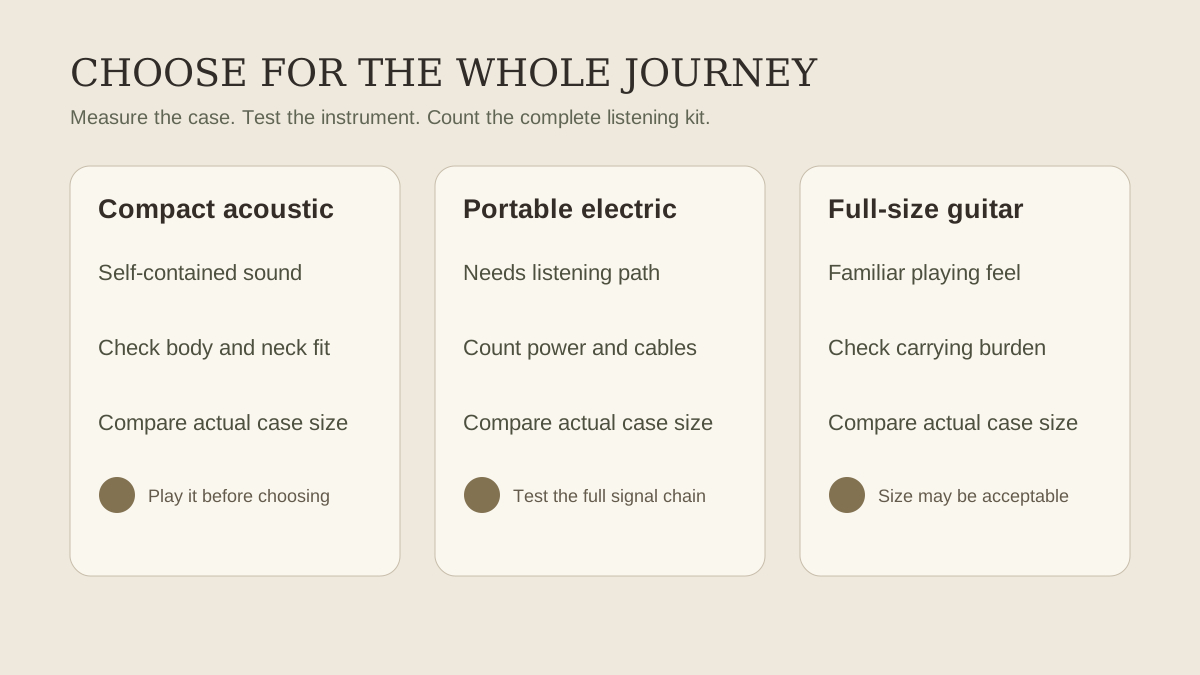
The decision in brief
Choose a travel guitar by the musical task, the complete carried kit and the protection the route needs. Record overall instrument length and case exterior separately from nominal scale, then try the actual guitar and listening equipment. A compact body does not guarantee a short scale, comfortable reach or cabin acceptance. Keep dimensions, trial observations and unverified transport conditions in separate fields.
Start with the journey and playing task
Name the journey and the music first: a walk to lessons, a train trip, a small room or a performance. Record how the case will be carried and stored, which handling you control and whether electricity is available. A compact instrument can lose its carrying advantage when an amp, power supply and cables are added.
Taylor’s travel overview states that the label has no official size or scale threshold. Its preference claims do not establish what you should carry. If the family is undecided, use the acoustic/electric comparison. This page asks whether a portable format solves your actual journey.
Measure the complete instrument, then the case
Record instrument overall length, body width/depth, weight and case exterior length/width/depth. Record the packed kit weight too. Nominal scale concerns fret placement; an open string’s speaking length also reflects its contact points and compensation. Neither is the length of the case.
| Documented example | Maker-listed scale | What else is needed |
|---|---|---|
| Taylor Baby shape | 22¾ in | Exact instrument and case dimensions |
| Taylor GS Mini shape | 23½ in | Exact instrument and case dimensions |
| Traveler Ultra-Light Electric | 24.75 in | 28 in overall; listed bag 30 × 6.5 × 3 in |
These are current maker examples, not recommendations or site measurements. The Traveler example shows how overall length and scale can differ. Its page lists no built-in headphone amp; a compact electric still needs a compatible listening route. Do not transfer its dimensions to another variant or treat the listed bag size as airline permission.
Sources: Taylor: Baby shape dimensions; Taylor: GS Mini shape dimensions; Traveler Guitar: Ultra-Light Electric dimensions and listening equipment

Test the small guitar as a real instrument
Try the actual guitar with the support and posture you will use. Check first-position reach, balance, picking-arm placement, controls and a familiar higher-position passage. If you cannot yet play the task, ask for a slow demonstration and a teacher’s help. A brief comfortable trial does not establish every future session.
D’Addario’s tension account relates vibrating length, pitch and string unit weight. Shorter length lowers ideal tension when the same string and pitch are held constant; it does not prove that every short-scale instrument feels easier. Record installed strings, tuning and setup. The scale guide explains the reference.
Tune, play normal passages and recheck tuning and persistent unwanted noise. Record symptoms before assigning a cause. Uncertain nut, bridge, fret or structural condition needs assessment; size and a travel label do not certify reliability or suitability for a child.
Sources: D’Addario: string length, pitch and unit-weight conditions
Choose the sound and listening path honestly
Try the musical job, not only a solo chord. For voice accompaniment, sing and play the usual passage. Keep your room and listening position consistent when comparing acoustics. If several design or setup variables differ, the result concerns complete instruments and cannot isolate body size.
For an electric, verify instrument input, monitoring output, cable and power for the amp, headphone device or interface. An output jack does not establish a headphone driver. Try the connection and usable level, including latency where relevant. Physical picking and string noise remain in the room; headphones do not prove silence.
Record unplugged usefulness and amplified suitability separately. A pickup can provide another listening path; it does not establish that you like the instrument’s unamplified response. An untested destination system remains an open question.
Sources: Traveler Guitar: Ultra-Light Electric dimensions and listening equipment
Protection and handling matter as much as size
Fit the actual guitar in its protection. Check support, closures, carrying attachments, clearance around vulnerable parts and accessory placement without forced pressure. A nominal size class cannot confirm fit. The case and gig-bag guide covers the protection decision.
For a carrier journey, check the carrier’s current written instrument/baggage rules and practical storage arrangements directly. This guide verifies no carrier rule, right or available space. Keep the transport decision open until the actual route and case are checked.
Follow the exact maker’s environmental and arrival instructions. Taylor’s humidity guidance says its conditioned wood still needs care under humidity extremes; that is not a universal safe range or travel immunity. Check destination storage against your instrument’s guidance, keep condition notes and seek assessment for concerning changes.
A practical comparison in the shop
Use this as a proposed comparison; no journey or instrument was tested for this guide.
- Record the musical job, route and storage constraints.
- Measure the actual case exterior and note the complete packed kit.
- Carry the kit in the intended way with permission; try the guitar with normal support.
- Repeat familiar passages, tune and note fit, useful response and unresolved symptoms.
- Try the exact listening device, connections and power if required.
- Check protection fit and current route conditions; leave unverified items visible.
| Record | What belongs there |
|---|---|
| Verified facts | Exact unit, scale, instrument/case measurements and equipment |
| Personal observation | Fit and sound under the recorded trial conditions |
| Unverified condition | Transport acceptance, destination rig or repair question |
| Decision | Problem solved, accepted compromise and next check |
In a hypothetical choice, the compact guitar fits storage but needs an unacceptable extra listening kit. Keeping a familiar guitar or choosing a different format may better meet that task. A smaller number alone does not decide.
Decision checklist and practical conclusion
Choose the format whose complete kit, acceptable playing condition and fitted protection meet the journey you actually make. Confirm the measurements and use; preserve the unknowns about handling, destination and condition.
If a familiar instrument can be carried and protected acceptably, a replacement may solve no essential problem. If a smaller format helps carrying but remains uncomfortable or misses the required sound, compare another candidate before committing.
Frequently asked questions
Is a travel guitar always three-quarter size?
No. The label does not establish one scale or dimension. Check the exact instrument, case exterior and complete kit.
Can a small guitar use standard tuning?
Use the exact maker’s string and tuning guidance. Shorter scale, string construction and setup remain relevant; the travel label supplies no approved tuning range.
Does a portable electric have a headphone output?
Not necessarily. Check its manual and the actual listening device, power and connections; an ordinary guitar output is not itself a complete headphone path.
Will it be accepted in an aircraft cabin?
This guide confirms no carrier rule or available storage. Verify the current route, carrier policy and actual case dimensions directly; the label and a maker’s fit claim are insufficient.
How this guide was prepared
We read Taylor’s travel definitions, Baby/GS Mini shape dimensions and humidity guidance, Traveler Guitar’s Ultra-Light Electric specifications and D’Addario’s tension variables. Named dimensions are maker-listed examples, not recommendations, measurements or proof of carrier acceptance. The journey brief and four-field comparison are proposed editorial methods. We played, packed and transported no instruments, inspected no case, checked no airline rules and performed no human technical or fit assessment. AI assistance was used for source comparison and language review. The retained diagram and guitar illustration do not establish actual dimensions or protection performance.
Documentation checked .
Separated overall/case dimensions from scale, added a compact electric specification example and equipment limit, removed the fixed shop-test duration, and added a journey-specific record with transport and care boundaries.