Start here
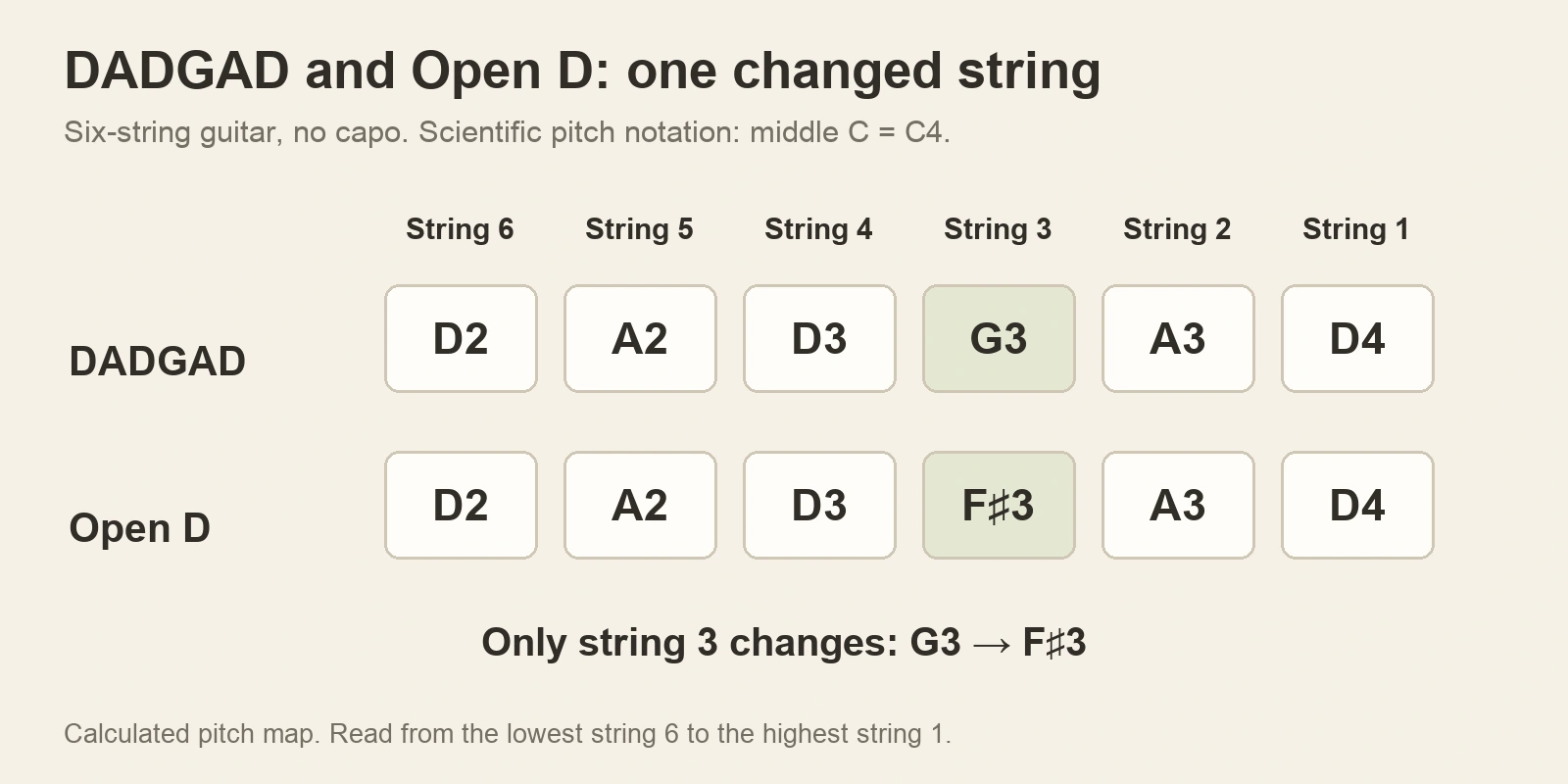
DADGAD is D A D G A D; Open D is D A D F♯ A D, from string 6 to string 1. Only their third strings differ. Open D supplies a D major chord across the open strings. DADGAD supplies D, G and A, which form Dsus4 without a major or minor third. Choose for the notes and open-string harmony your part needs.
Read the six target pitches
Use the table and voicings on a six-string guitar without a capo. Registers use scientific pitch notation: middle C is C4.
| String | E standard | DADGAD | Open D |
|---|---|---|---|
| 6 | E2 | D2 | D2 |
| 5 | A2 | A2 | A2 |
| 4 | D3 | D3 | D3 |
| 3 | G3 | G3 | F♯3 |
| 2 | B3 | A3 | A3 |
| 1 | E4 | D4 | D4 |
Use a chromatic tuner and confirm the octave as well as the letter. From E standard, both tunings lower strings 6, 2 and 1 by a whole step. Open D also lowers string 3 by a semitone; DADGAD leaves it at G3. Keep the starting tuning written beside the targets.
The standard-tuning guide identifies string numbers and registers. Recheck all six strings after each pass.
Sources: Fender: Open D and D modal/DADGAD
Hear what the third string contributes
Fender lists Open D and D modal/DADGAD separately. Reading their pitches gives the harmonic distinction: F♯ is the major third above D; G is the fourth. DADGAD’s open strings contain no F or F♯ to establish a minor or major third.
Pick strings 6 and 4 to hear the D octave, then sound string 3 separately. Compare that note in the two prepared tunings. Keep the same light attack. This is a proposed exercise; we have not supplied an audio comparison or ranked either sound.
Sources: Fender: Open D and D modal/DADGAD
Compare the same open-string grip with string 3 included
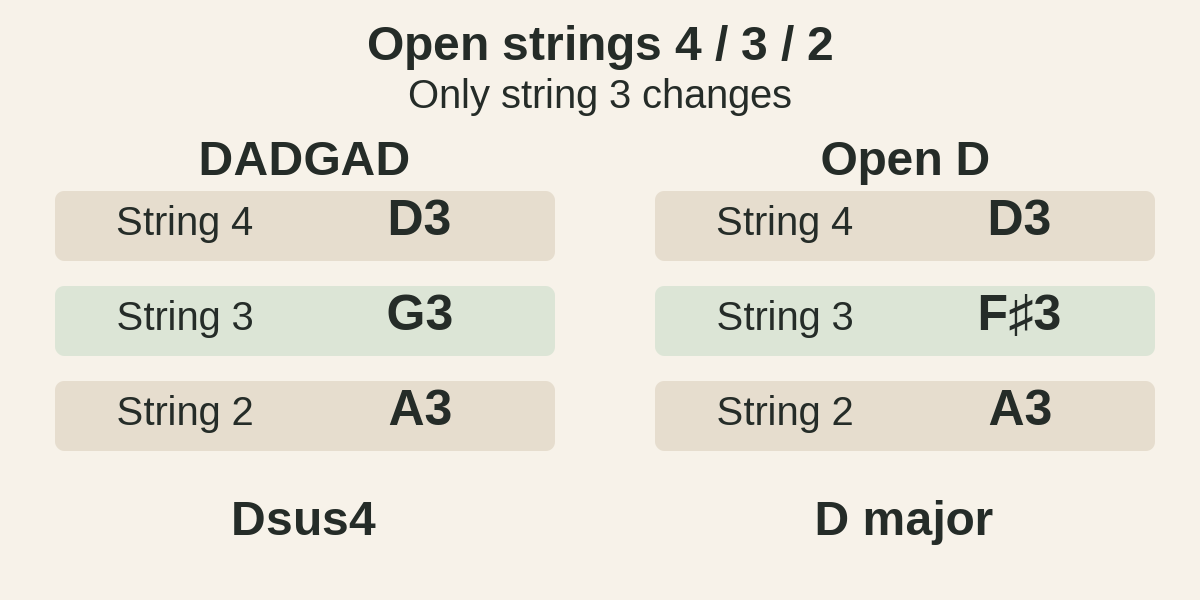
Pluck only strings 4, 3 and 2, all open: frets 0 / 0 / 0. Keep strings 6, 5 and 1 quiet. This time the changed third string is inside the chord, so the same grip produces different harmony.
| Tuning | Notes on strings 4 / 3 / 2 | Harmony |
|---|---|---|
| DADGAD | D3 / G3 / A3 | Dsus4 |
| Open D | D3 / F♯3 / A3 | D major |
In one prepared tuning, play the three notes separately, then together. Write the middle note and chord name before trying the other tuning. Use the tuning table when changing pitch and recheck all six strings. This is an original note calculation and proposed exercise; no audio demonstration is supplied.
The two voicings in the next section answer a different question: what can remain identical when string 3 is omitted? They do not demonstrate that all familiar shapes survive a tuning change. If other strings ring, name the complete set of notes again.
Try two voicings that avoid string 3
| Frets on strings 4 / 2 / 1 | Sounding notes | Chord |
|---|---|---|
| 4 / 0 / 0 | F♯3 / A3 / D4 | D/F♯ |
| 3 / 0 / 0 | F3 / A3 / D4 | Dm/F |
These are derived three-note voicings with the third in the bass. Pluck only strings 4, 2 and 1; keep strings 6, 5 and 3 quiet. They work in both tunings because none of those three selected strings changes between the tunings.
An unrestricted six-string strum adds other notes, including the changed string 3. Do not assume the minor voicing remains the same harmony when those strings ring. The chord comparison explains why sounded notes matter alongside grip.
Retune and check the actual guitar
Record the original tuning, complete string set and bridge type before changing anything. Follow the hardware instructions, including unlocking a locking nut where required. Floyd Rose documents how a floating bridge couples string and spring balance; changing one string can move the others.
At the target tuning, check normal-attack pitch stability, unwanted buzz and fretted accuracy. A heavier set is a separate change with possible fit and setup consequences. Use the string-gauge guide rather than assigning one gauge to every guitar.
Choose for the passage and keep the result
Choose Open D when the part needs that open D-major voicing. Choose DADGAD when its open D–G–A combination fits the arrangement. A song’s pitches, muting and chosen fingerings decide the result; a genre label alone does not.
Download the blank comparison record (English CSV). Record all six pitches, the strings allowed to ring and the intended chord. If you want another open-chord option, compare the Open G guide. Restore the recorded starting tuning using the instrument’s procedure.
How this guide was prepared
We checked Fender’s published tuning sequences and Floyd Rose’s explanation of floating-bridge tuning interaction. We assigned octave registers from E standard and derived the chord names by pitch class. The two three-note voicings are editorial note calculations and a proposed playing exercise, not recorded demonstrations. The November 25 revision calculated the notes on open strings 4, 3 and 2 in each documented tuning. Chord names follow those pitch classes; the diagram is a calculated reference, not a recorded comparison.
Documentation checked .
Added a same-grip Dsus4/D-major comparison including string 3, a localized note diagram and contextual incoming links.