The decision in brief
A power chord contains a root and a perfect fifth, often with an octave doubling. A barre is a fretting technique: one finger stops several strings at one fret. These descriptions can overlap. A barred grip can play a power chord, while a full major or minor barre voicing also includes a third. Choose the notes the part needs, then choose a workable grip; replacing a major or minor chord with a fifth removes information from the harmony.
Compare note content and fretting technique separately
The 5 in G5 names the fifth above G; it does not mean five strings, fret 5 or finger 5. G5 can use just G and D, or double one of those notes in another octave. Adding an octave does not add a major or minor third.
A barre describes how strings are stopped. Fender’s F-major lesson shows both a small two-string barre and a full E-family barre, so “barre chord” does not necessarily mean six sounding strings. A player may also stop the fifth and octave of a power chord with one finger. Count the sounding notes before naming the harmony.
Sources: Fender: power-chord formula and octave doubling; Fender: partial and full F-major barres
Check three G-root voicings in E standard
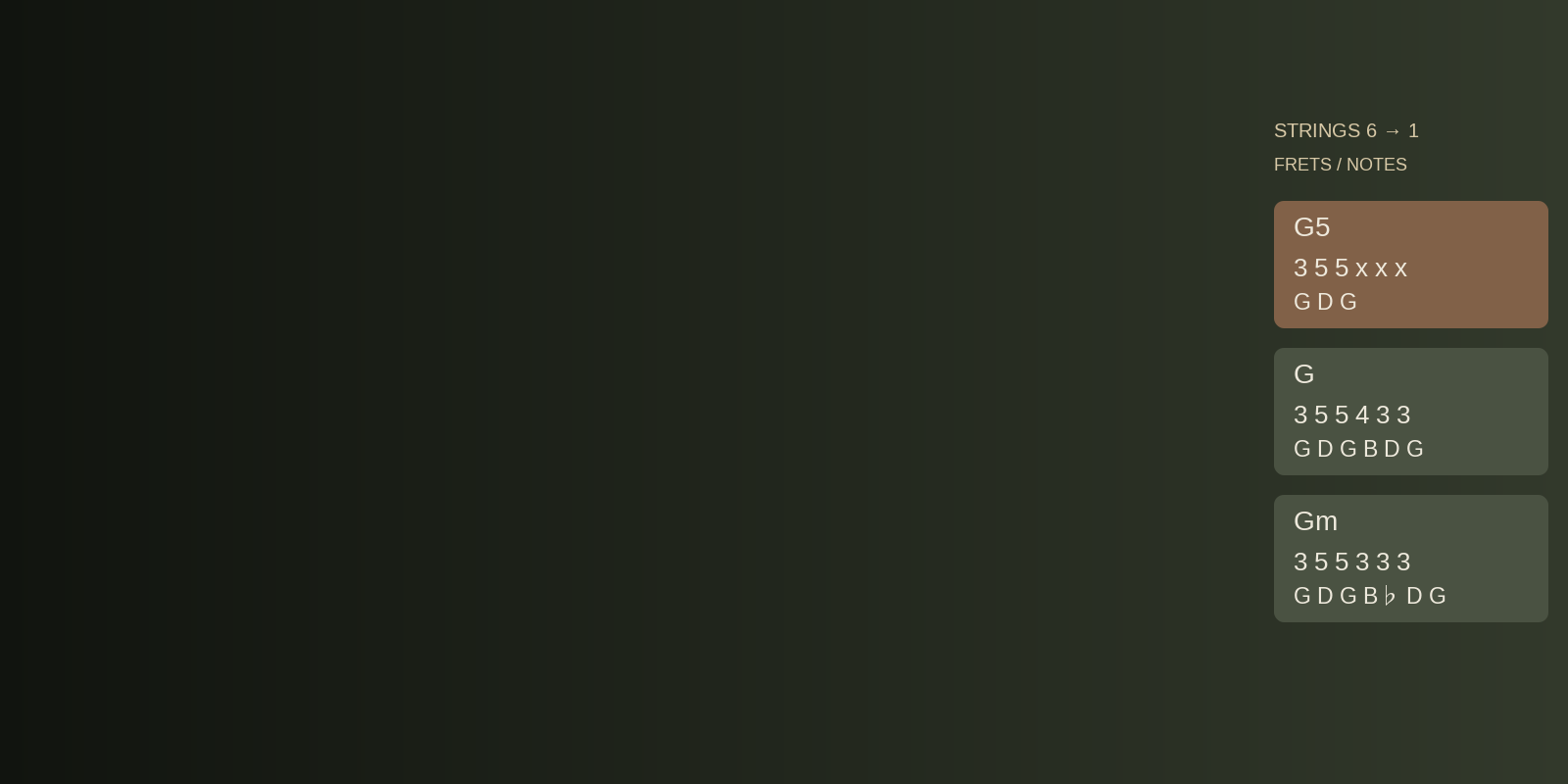
Read each fret sequence from string 6 to string 1. Here x means that the string should not sound; these are chord-grip records, not muted rhythmic events. The note rows are derived from E A D G B E with no capo.
| Voicing | Frets: 6 / 5 / 4 / 3 / 2 / 1 | Sounding notes, low to high | Third |
|---|---|---|---|
| G5 | 3 / 5 / 5 / x / x / x | G–D–G | Absent |
| G major | 3 / 5 / 5 / 4 / 3 / 3 | G–D–G–B–D–G | B |
| G minor | 3 / 5 / 5 / 3 / 3 / 3 | G–D–G–B♭–D–G | B♭ |
The two full voicings differ at string 3: fret 4 supplies B and fret 3 supplies B♭. The lowest three notes stay G–D–G. Playing only those lowest three removes the third that distinguishes the two full shapes. Conversely, accidentally letting an upper string ring may change the intended fifth chord. Confirm the starting tuning before transferring these fret numbers.
Compare the same short part with deliberate strings
- Begin with a comfortable, clean sound. Form G5, pluck its three intended strings individually and keep the others quiet.
- Try the full G-major and G-minor voicings only if the grip is comfortable. Pick each intended string and identify the changed note on string 3. Stop if the movement hurts; do not solve it by squeezing harder.
- Use the same simple pulse and note endings for each voicing. Compare which notes are present before comparing your familiarity with the grip.
- If the part uses overdrive or distortion, repeat it at the playing settings you actually need. Record that condition and the result rather than assuming a genre requires one chord type.
The sequence is an original practice proposal. It does not establish learning speed or a tone ranking. The pick-and-fingers comparison covers the separate choice of how to start simultaneous or successive notes.
To practise the attack and ending of a power chord, try the palm-muting exercise.
Choose a voicing without hiding a substitution
If a chart calls for G5, keep its note content intentional. If it calls for G or Gm, omitting the third may be a useful arrangement choice, but it no longer communicates that major/minor distinction by itself. Other instruments may supply the third; check the actual arrangement rather than assuming they do.
For a difficult full grip, ask a teacher for a smaller voicing containing the required notes. A partial barre, individually fretted notes or another position can preserve the harmony without the original six-string shape. Neither more strings nor a wider barre proves a better musical result.
Write down the required harmony, the strings you intend to sound, the grip and any missing note. If reach or accidental muting remains the obstacle, the fit-and-playing-task guide helps separate instrument fit from labels. Keep that question distinct from deciding which chord the music needs.
How this guide was prepared
We checked Fender’s power-chord definition and its partial/full F-major barre examples on November 10, 2026. The G5, G-major and G-minor note inventories are editorial derivations from six-string E standard and semitone fret steps; the major grip is the E-family shape moved to fret 3. The practice comparison is proposed. We tested no player, grip, guitar or distortion setting.
Documentation checked .