
Start with the question
Fuzz belongs to the wider family of distorted guitar sounds, so pedal names do not define a clean technical boundary. Compare the actual pedals with your guitar and amp: picking response, guitar-volume changes, sustained notes, chords and pauses. Placement depends on the circuit; some vintage-style fuzzes need direct pickup interaction, while other models provide buffer-related controls. Read the named pedal’s instructions before treating “fuzz first” as a rule.
What matters most
- Names overlap; compare the actual response in your rig.
- Keep guitar-volume changes separate from pedal-output changes.
- Use circuit-specific buffer and wah instructions.
Compare a pedal response rather than the label
BOSS groups fuzz with gain effects while describing it as a distinctive distortion sound. That is useful category language, but it does not give every fuzz or distortion pedal an identical circuit or response. A mode switch or tone circuit can create large differences inside a single category.
Begin with a job: a sustained single-note part, a chord passage that needs clear note changes, or a sound controlled from the guitar’s volume knob. Choose a short passage that exposes that job. A genre label alone does not tell you whether either candidate works in your amplifier.
If your question is how overdrive differs from distortion, use the existing overdrive/distortion comparison. This guide adds the separate questions of fuzz response and pickup interaction, rather than making a three-category ranking by aggressiveness.
Keep a clean comparison record
Use the same guitar, pickup, cable and amp setting for a first pass. Start at a modest listening level. Compare the pedals one at a time before stacking them, keeping unrelated modulation and time effects out of the route. Note whether the amplifier is set relatively clean or already driven; repeat the comparison as a separate condition if you need both.
Set each pedal for a useful sound rather than forcing all knobs to the same clock position. The controls do not necessarily cover the same ranges. Record the settings and adjust output for a practical listening comparison, while noting whether the amp’s response changes. Matching a final playback level later is different from matching the signal that drives the amp.
Play one sustained note, a short chord phrase, quieter and firmer attacks, and a deliberate stop. Listen for the response the part needs. Describe the observation for that setting instead of turning it into “all fuzz is loose” or “distortion is always tighter.” No result from this proposed comparison is supplied here.
Try guitar-volume changes as their own comparison
After the full-volume reference, reduce the guitar volume to a repeatable marked setting while leaving the pedal and amp controls unchanged. Play the same part, restore the guitar volume and repeat. Note changes in level, texture and useful attack separately; getting quieter does not by itself prove that the sound became clean.
BOSS describes the FZ-1W Vintage mode as sensitive to input-volume changes and lists buffered bypass among the pedal’s features. Those are statements about that named design. They neither prove every fuzz behaves that way nor specify how an unrelated pedal responds to a buffer before its input.
Keep pickup selection fixed during the first volume comparison. If you later switch pickups, label it as another condition. A control sweep that works with one guitar and mode may not supply the range you need elsewhere in the arrangement.
Sources: BOSS: FZ-1W modes, volume response and buffered bypass
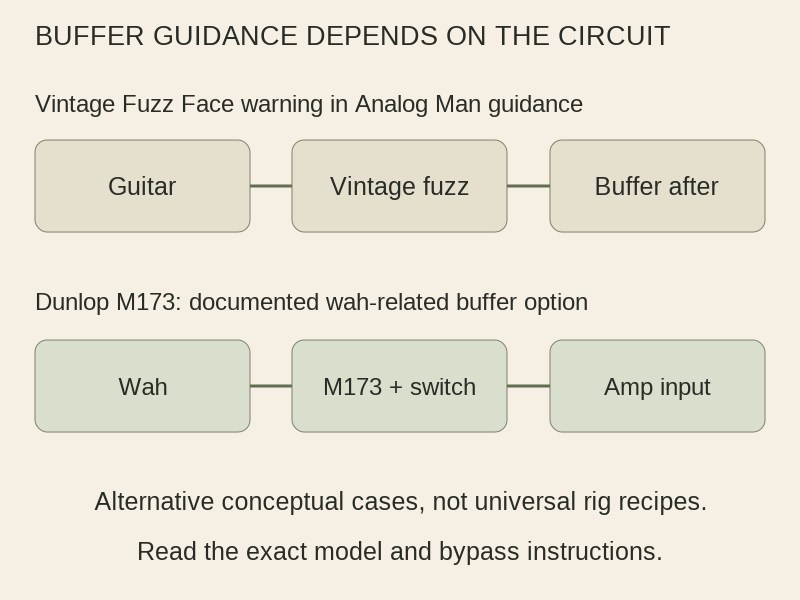
Check the documented buffer exceptions
| Source | Documented point | Boundary |
|---|---|---|
| Analog Man buffer guide | Vintage Fuzz Face circuits can lose cleanup with an earlier buffer | Circuit-specific pickup interaction |
| Dunlop M173 manual | Buffer switch addresses some wah-related oscillation; tone may brighten | Named switch and wah condition |
| BOSS FZ-1W features | Buffered bypass is a listed feature | Bypass type does not specify every active-input interaction |
Analog Man recommends placing buffers after the vintage circuits it discusses. Use that warning when the actual design depends on the direct pickup connection; an earlier tuner can matter even when its effect is off if its bypass remains buffered. The bypass guide helps identify that separate state.
Dunlop’s M173 manual provides a specific counterexample to a blanket ban on buffers around fuzz: its Buffer switch is intended for oscillation that can occur with a wah ahead of it, and the manual notes a possible brighter sound. Follow that model’s directions rather than transferring the switch behaviour to every fuzz.
Before rearranging, save the original order and confirm power and connection instructions. Compare one change, then restore the reference. The two conceptual routes in the diagram are alternatives for documented conditions, not two complete pedalboards declared universally compatible.
Sources: Analog Man: vintage Fuzz Face circuits and buffers; Dunlop: M173 Classic 108 Fuzz manual, buffer switch
Choose the response that solves the part
| Question | Keep in the note |
|---|---|
| Wanted sound | Passage, pickup and amp condition |
| Control response | Guitar-volume setting and restored reference |
| Playing | Single notes, chords, attack and stopping |
| Signal chain | Earlier buffers, wah state and exact pedal mode |
| Decision | Useful setting and any unresolved limitation |
If the preferred setting makes rests noisy, separate the wanted sustain from the unwanted pause before adding a noise gate. More gating can change the ending you were trying to preserve. A gate setting does not establish that the fuzz itself is defective.
Keep the comparison narrow enough to repeat. One pedal may supply the guitar-volume range you need, another may suit a more constant drive sound, and neither needs to win every task. Choose by the part and documented connections rather than by a universal fuzz-versus-distortion hierarchy.
Download the blank English record (CSV). The sheet contains no completed observations or site test results.
How this guide was prepared
BOSS’s effects-order discussion, Analog Man’s buffer guidance, Dunlop’s M173 manual and the BOSS FZ-1W feature list were checked. The comparison passage and decision record are editorial proposals. No listening impressions, noise measurements or headroom tests are presented as performed.
Documentation checked .