
The decision in brief
Overdrive pedals commonly aim for amp-like breakup and picking response, while distortion pedals commonly offer a more saturated texture. These are useful starting descriptions, not guarantees of circuit type, gain or sound. Choose by the range of sounds each actual pedal gives through your amp at the listening level you use. A fair comparison separates the pedal’s drive setting from its output level and checks both quiet playing and the intended musical part.
What matters most
- Overdrive and distortion product ranges overlap.
- Compare response and texture at a useful listening level.
- Document the amp condition and test the actual musical part.
Use the labels to form a shortlist
BOSS describes overdrive in terms of a driven-amp character and distortion in terms of stronger saturation. Real product ranges overlap: its overdrive guide says the BD-2 family can cover crunch through distortion, and the OS-2 combines separate overdrive and distortion circuits with a parallel blend.
| Starting point | Possible reason to try it | What to verify |
|---|---|---|
| Overdrive | You want a useful transition from cleaner notes into breakup | Picking response, guitar-volume response and the amount of drive available |
| Distortion | You want a more sustained or saturated texture | Chord separation, attack and usable lower-gain sounds |
| Hybrid or multiple modes | You need several textures from one device | What each mode changes and whether its output stays useful |
These are audition questions, not a rule assigning effects to genres or rhythm and lead parts. Choose a sound for the passage you play.
Sources: BOSS: overdrive and distortion terminology; BOSS OS-2: separate circuits and parallel blend; BOSS: overdrive gain range and amplifier interaction
Separate distortion amount from output level
On the SD-1 example, Drive changes the amount of overdrive, Level sets the effect output and Tone adjusts the tonal balance. Other pedals may label or implement controls differently. Read their manual before assuming the same knob position means the same response.
For a texture comparison, bring the candidates to a similar perceived listening level. A louder pass can be more impressive without solving the musical problem. Revisit the output after changing gain or tone; do not use one initial level match for every later setting.
Keep the amplifier input setting fixed for the first comparison. If you record the results, use playback volume for the later preference match. Changing the amp’s input gain during that match can also change its distortion. Our overdrive settings guide gives the fuller control sequence.
Compare the amp conditions you will actually use
An overdrive can generate its own altered signal and can also push a following stage. Low Drive and high output do not guarantee an unchanged clean boost. BOSS discusses using overdrive with different amp types and using extra output to push a tube amp.
Make two separate audition conditions when they are relevant to your rig: a cleaner amp channel and your usual driven channel. Save the settings for each. A pedal that supplies most of the breakup in the first condition may behave differently in the second.
If more pedal output mostly adds saturation and little useful loudness, record that result. Do not keep raising the final listening level to chase a boost. The amp guide helps identify the channel, gain, master and listening route you are evaluating.
Sources: BOSS: overdrive gain range and amplifier interaction
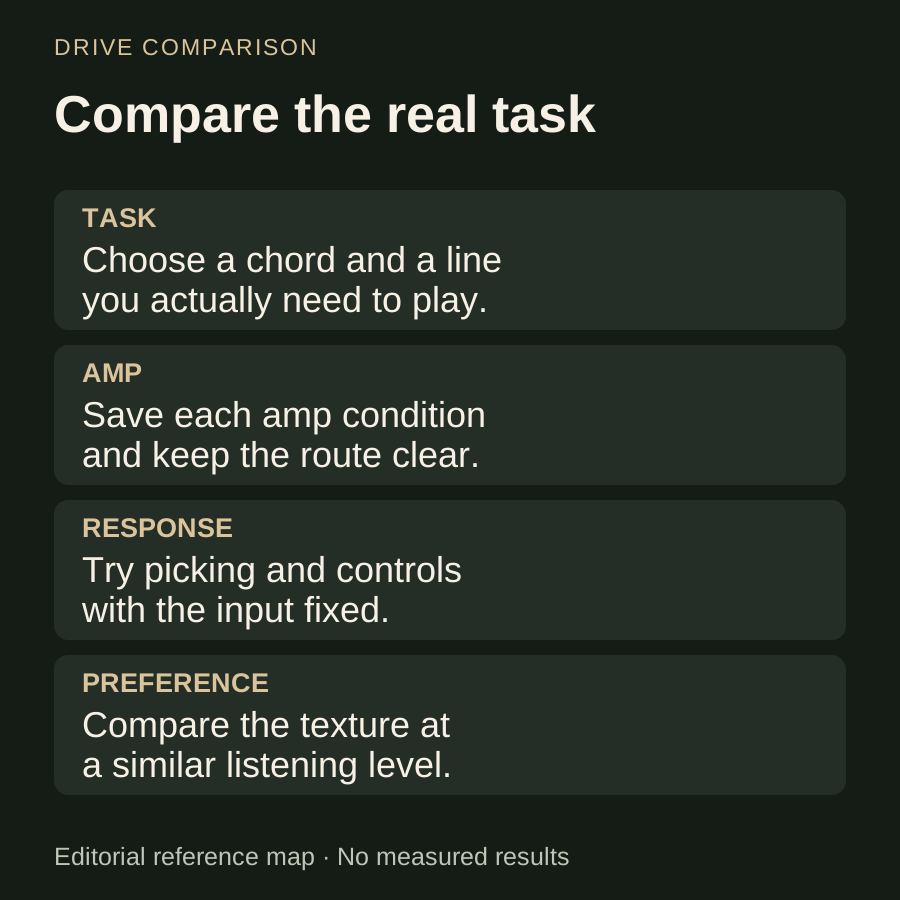
Run the same short audition on each candidate
The following is an editorial comparison routine, not a completed pedal test. Use a modest listening level and follow the exact power and connection instructions.
- Record the guitar pickup, guitar controls, pedal, amp channel and listening output. Establish a repeatable bypass reference.
- Set a useful starting texture on the first pedal. Bring its output near the reference, then repeat the same short chord and single-note phrase.
- Play the phrase gently and more firmly without changing controls. Try a deliberate guitar-volume change, then restore it. Note the response instead of presuming every overdrive will clean up.
- Try the amount of saturation the actual song requires. Listen to rests and low notes as well as the sustained lead sound.
- Repeat with the second pedal at a comparable listening level. Photograph settings and record any unmatched conditions.
- If relevant, repeat both pedals through the second saved amp condition. Treat it as a separate comparison.
A looper placed before the pedals can repeat a signal for settings work, but it does not perform new picking or guitar-volume changes. Do the response check live. The looper guide explains what the recorded loop captures.
Choose one useful sound before stacking two pedals
First establish whether one candidate covers your required rhythm and lead textures. If it does, another gain stage may add complexity without answering a missing need. If it does not, state what the second stage should change.
When comparing an overdrive feeding a distortion with the reverse order, retain the same guitar, amp condition and phrase. Reduce outputs before changing connections and follow the devices’ instructions. Adjust one route at a time, then recheck the final level and pauses.
The OS-2’s documented parallel blend is a different arrangement from two external pedals connected in series. Do not treat its Color control as proof that either external order will sound the same. Use the pedal-order guide to plan the complete chain.
Choose from the observed response
| Your need | Useful observation | Next decision |
|---|---|---|
| A cleaner-to-driven transition | Response to actual picking and guitar-volume changes | Keep the pedal and settings that give a controllable range |
| Saturated rhythm or lead | Attack, sustain, chord separation and noise in rests | Choose the texture that works with the part |
| A louder featured part | Prominence against accompaniment in the real rig | Check useful level rise separately from added distortion |
| Several sounds | Required modes, switching and repeatable settings | Confirm one device’s range before adding another stage |
Keep the result local to the tested setup: “This setting kept my chord clearer through this channel” is a usable finding. It is not a universal ranking of overdrive and distortion. If neither candidate meets the task, reconsider the amp condition or the missing sound before choosing from a label.
Frequently asked questions
Does overdrive require a tube amp?
No. An overdrive can provide an altered signal before different amp or modelling inputs. The useful result depends on the pedal, following stages and listening output; a tube amp is not a category requirement.
Can distortion be used for rhythm and overdrive for lead?
Yes. Those labels do not assign a musical role. Compare the actual part for attack, note separation, sustain, level and useful response before choosing.
How this guide was prepared
We read BOSS’s terminology and overdrive articles, the SD-1 manual and the OS-2 product documentation. They support scoped control and circuit examples; broad manufacturer sound claims are not treated as universal results. The audition, decision table and recording suggestions are proposed editorial methods. We auditioned or measured no pedals and claim no independent sound test or human expert review.
Documentation checked .