
The decision in brief
Choose a pick, fingers or hybrid picking by the notes and articulation the part needs, then allow for what you have practised. A held pick gives one contact point; fingers can address separate strings, and hybrid picking combines a held pick with free fingers. Compare the same small task first. A difference in familiarity should not become a verdict that one method is better for everyone.
Know which plucking method you are comparing
Flatpicking uses a held plectrum, usually between the thumb and index finger. Fingerstyle uses the plucking fingers and thumb; the term can include fingerpicks as well as direct contact. Hybrid picking keeps a held pick available while free fingers pluck other strings. Fender’s overview describes these as distinct approaches.
For this comparison, write down whether you use fingertips, nails or fingerpicks. “Fingers” alone leaves that detail unresolved. For a held pick, record the actual pick and how much of its tip is exposed. You are comparing specific ways of contacting the string.
An acoustic or electric guitar label does not settle the technique choice. Start with the passage and the intended articulation. If the question concerns the instrument itself, the beginner electric-guitar guide covers that separate decision.
Sources: Fender: flatpicking, fingerstyle and hybrid picking
Match the method to the notes in the part
| Task | What to examine | Useful method to include |
|---|---|---|
| One-note line crossing strings | Timing, unwanted strings and repeatable attack | Held pick and fingers on the same line |
| Bass notes with a separate upper voice | Whether both voices remain deliberate | Thumb-and-finger playing; hybrid if already familiar |
| Two non-adjacent strings together | Whether both notes start when intended | Fingers or held pick plus a free finger |
| A strummed chord | Chosen strings, accents and note endings | The actual pick or finger strum you plan to use |
These are exercise choices, not performance rankings. A player can adapt a part to several methods. Define whether notes must sound together or may be spread across a beat before judging a result.
Fender’s Travis-picking lesson gives one example of separating voices: the thumb alternates bass notes while fingers play treble notes. That is a particular fingerpicking approach. It does not define every fingerstyle pattern or require every song to use an alternating bass.
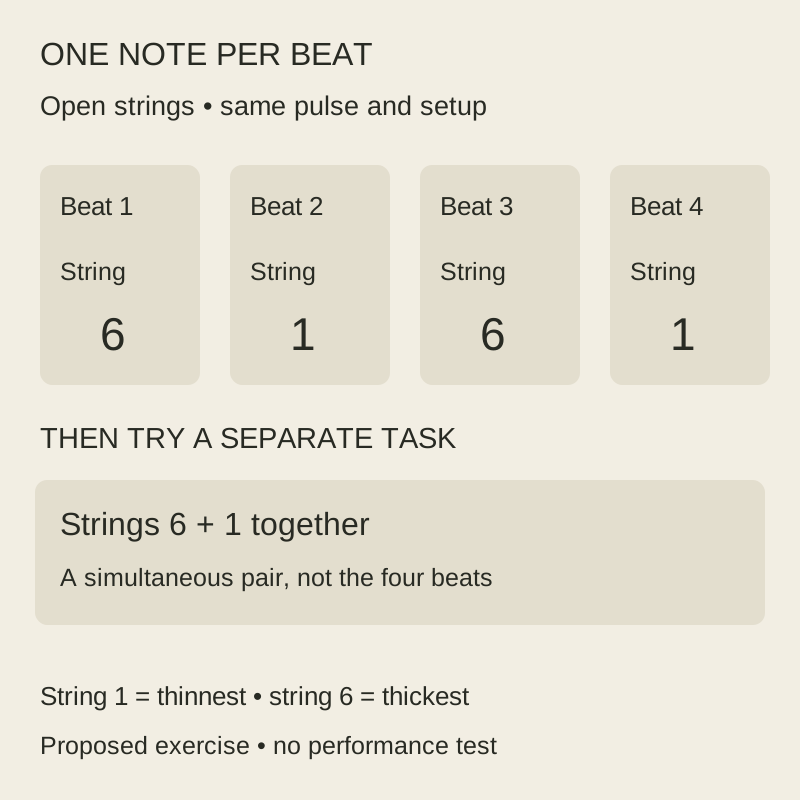
Check simultaneous notes as a separate demand
Next decide whether your actual part needs two separated strings to start together. If it does, try plucking open strings 6 and 1 together with thumb and finger. A player familiar with hybrid picking can instead use the held pick for the bass string and a free finger for the upper string.
Treat that as a new task, separate from the alternating four beats. A single flatpick sweep across several strings creates another articulation and can sound intervening strings. It should not silently replace a specified simultaneous pair in the comparison. Muting and rearranging the part are additional choices to practise.
You do not need to learn hybrid picking merely to complete this exercise. If both methods you already use serve the song, keep both available. The lead and rhythm comparison helps place a bass figure, chordal part or melody in its musical context.
Sources: Fender: flatpicking, fingerstyle and hybrid picking
Describe contact and control without a universal ranking
For the pick pass, start with a relaxed hand and a grip firm enough to retain the pick. Fender’s grip explanation places the pick between thumb and index finger and distinguishes exposed tip for strumming and single-note control. Adapt the contact to the task; forcing an uncomfortable movement is not a useful comparison.
For each method, keep the plucking position as consistent as practical and note any change in contact. A fingertip, a nail and different picks are different comparison conditions. If you prefer one recorded sound, describe that setup and passage instead of concluding that all picks sound bright or all fingers sound warm.
Familiarity needs its own entry. A method practised for years and one tried for a few minutes have not had comparable preparation. Ask a teacher to check an uncertain motion or grip before increasing the task’s difficulty. This page offers a proposed practice comparison, not an assessment of your technique.
Sources: Fender: holding a guitar pick
Choose the next practice step from the result
| Record | What to write |
|---|---|
| Part requirement | Alternating notes, a simultaneous pair, a strum or another specific articulation |
| Setup | Guitar, contact method, pick identity if used and plucking position |
| Preparation | How familiar each method is and the pulse you used |
| Observation | Timing, extra strings, note endings and whether the motion felt comfortable |
| Next session | One task to repeat or a motion to ask a teacher about |
Choose the method that currently makes the intended part reliable, and name a small task if you want to develop another option. For example, you could keep the pick for a rehearsed line while practising thumb-and-finger coordination separately. That is a practice plan, not a prediction of how quickly either technique will develop.
Once the hand task is clear, use effects only if they support the part. The compressor guide provides a separate way to compare dynamic changes without using a louder output as the deciding factor.
How this guide was prepared
We checked Fender’s picking-style overview, Travis-picking lesson and pick-grip explanation on November 2, 2026. These instructional sources support technique definitions and the attributed alternating-thumb example. Our open-string exercise and observation record are editorial proposals, not a reproduction of a song or a timed performance test. We evaluated no players, picks or guitars and make no universal speed, comfort or sound ranking.
Documentation checked .