The decision in brief
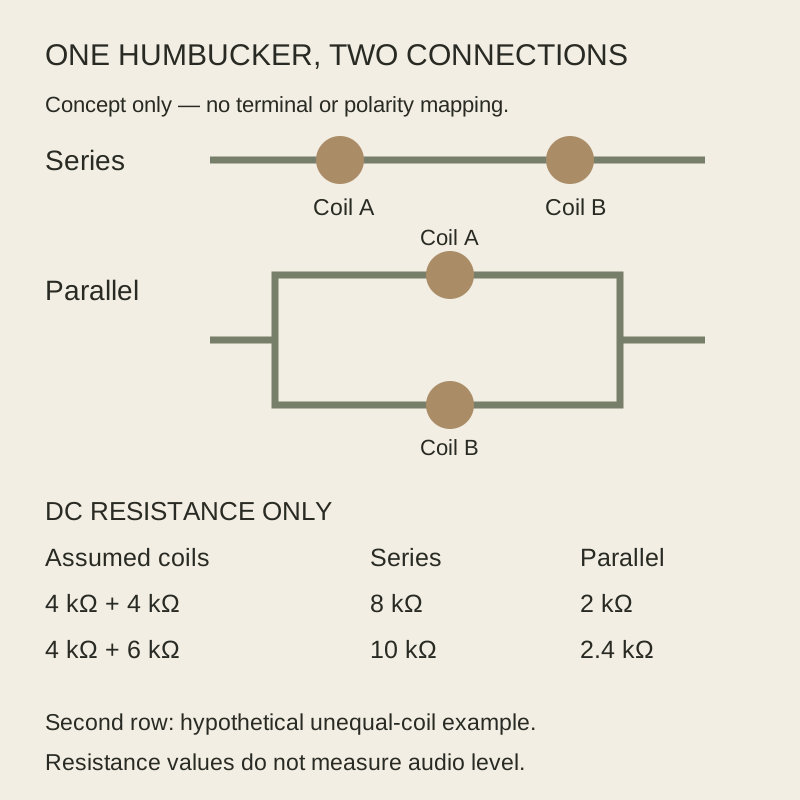
Series and parallel can both use the two coils of one humbucker. Series puts them in one successive electrical path; parallel connects them across common output nodes. Correctly connected, both can retain the paired hum-cancelling relationship. A full split used alone instead uses one coil. Verify the actual pickup and switch, then compare drive and tonal preference as separate listening questions.
First ask which coils or pickups are being connected
This comparison concerns the two coils inside one conventional passive humbucker. A guitar can also connect two complete pickups in series or parallel. That is another switching boundary: selecting a neck pickup and bridge pickup together does not identify the internal connection of either humbucker.
Write a mode description such as “bridge humbucker, its two coils in parallel.” It is more useful than “both on.” The latter could mean two complete pickups, two coils, or a selector position with an automatic split.
Seymour Duncan’s internals explanation describes access to each coil’s start and finish through four-conductor wiring. The correct magnetic and electrical relationships preserve the wanted string signal while opposing similarly induced hum. Physical winding direction alone is not a complete wiring rule. The humbucker guide covers that mechanism.
Sources: Seymour Duncan: humbucker internals and four-conductor access
Parallel keeps two coils; splitting changes that
| Mode | Coils in use | What the description establishes |
|---|---|---|
| Series | Both | One successive connection through the two coils |
| Parallel | Both | Two branches across common output nodes |
| Full split used alone | One | The paired hum-cancellation mechanism is normally lost |
Seymour Duncan’s documented series/split/parallel switch example keeps hum cancellation in its parallel mode. It describes a single-coil-like sound, not a guarantee that the result duplicates a separate single-coil pickup. The circuit and the actual listening setup remain part of the result.
“Parallel” also does not mean “out of phase.” Correct coil relationships are still required. A partial split or a split combined with another pickup needs its own description; the one-coil row does not explain every selector design.
Use the single-coil and humbucker comparison for the broader family decision. Here the practical question is whether another mode of the same installed pickup helps the part you play.
Sources: Seymour Duncan: series, split and parallel switching example
Use resistance arithmetic without turning it into output
Seymour Duncan’s support example assigns 4 kΩ to each coil: series is 8 kΩ, one split coil is 4 kΩ, and parallel is 2 kΩ. Its out-of-phase series example still reads 8 kΩ. The same DC reading therefore does not establish the intended signal relationship.
For two isolated resistances R1 and R2, series gives R1 + R2 and parallel gives (R1 × R2) ÷ (R1 + R2). Applying that arithmetic to an explicitly hypothetical 4 kΩ and 6 kΩ pair gives 10 kΩ in series and 2.4 kΩ in parallel. For equal coils, parallel DC resistance is one quarter of their series DC resistance. That shortcut does not apply to unequal coils.
| Assumed coil resistances | Series | Parallel | Full split |
|---|---|---|---|
| 4 kΩ and 4 kΩ | 8 kΩ | 2 kΩ | 4 kΩ |
| Hypothetical 4 kΩ and 6 kΩ | 10 kΩ | 2.4 kΩ | 4 or 6 kΩ, depending on retained coil |
These values describe a DC model, not frequency-dependent impedance, loudness or a measured guitar. In-circuit readings can include other paths and controls. DiMarzio explicitly warns that DC resistance is not a direct tone or output indicator. A quarter of the resistance is not a claim of a quarter of the sound level.
Do not open a pickup or disconnect its wiring simply to reproduce the table. A technician can decide what isolation and measurement would be appropriate if the guitar needs diagnosis.
Sources: Seymour Duncan support: 4 kΩ coil resistance examples; DiMarzio: DC resistance is not a direct tone or output indicator
Confirm the mode before changing the circuit
Look for the exact pickup identity, guitar schematic and documented switch states. Four-conductor access can enable suitable switching; it does not tell you the terminal assignment or contact pattern of an unknown switch. A shield is a separate connection.
The cited Seymour Duncan switch article distinguishes two on-on-on contact patterns. Its example uses a specific one. A similar-looking mini toggle is not enough evidence to copy the diagram, and wire colours need their own maker’s key.
If a guitar already has supported modes, use those controls as documented. For a proposed modification, give a technician the exact components and the sounds you want available. Confirm physical space, wiring access and reversibility before work. This is a comparison for players, not a colour-based soldering tutorial.
Sources: Seymour Duncan: humbucker internals and four-conductor access; Seymour Duncan: series, split and parallel switching example
Separate amp drive from tonal preference
First leave the amplifier input settings and guitar controls fixed. Play the same chordal part and short lead line in each documented mode. Record any change in level, attack or how the amp responds. This pass answers what happens when you actually switch during a performance.
Next compare recordings at a similar playback volume. Adjust playback after recording, rather than changing guitar volume or amp input gain during the original pass. That second pass helps you judge tonal preference without silently changing the drive condition. It does not make the two electrical modes equivalent.
Keep the pickup position, cable, amp channel, strings and playing task consistent. Include pauses to observe noise separately. Hum-cancelling does not mean that every kind of hiss or interference disappears. These are proposed listening checks; we have not carried them out on a sample guitar.
Choose the mode that makes the transition work
Test the actual transition in a song or exercise. If one mode suits a rhythm part and another suits a lead phrase, check whether the level difference is useful at the gain you use. A preferred sound in isolation may still need a control or rig decision for the complete part.
| Record | Question answered |
|---|---|
| Exact pickup and internal mode | What was actually selected? |
| Fixed-input pass | How did switching affect level and drive? |
| Similar-volume playback | Which attack and balance did you prefer? |
| Pauses and uncertainty | What noise or undocumented state remains? |
A quiet or thin result is not enough to diagnose a wiring fault from text. Keep any uncertain mode out of the comparison until its function is confirmed. If all existing modes serve the task, there is no need to replace the pickup simply to obtain another category label.
For the next comparison, read neck versus bridge position. Changing where the pickup senses the string is a separate variable from changing the connections within that pickup.
How this guide was prepared
We checked Seymour Duncan’s internals article, switch example and resistance support note, plus DiMarzio’s resistance explanation, on November 1, 2026. The 4 kΩ plus 4 kΩ example follows the support note; the unequal 4 kΩ and 6 kΩ case is an explicitly hypothetical DC calculation, not a pickup measurement. Listening steps are proposed. We wired, measured and auditioned no pickups. Diagrams omit terminals, lead colours and switch contacts and cannot be used as soldering instructions.
Documentation checked .