The decision in brief
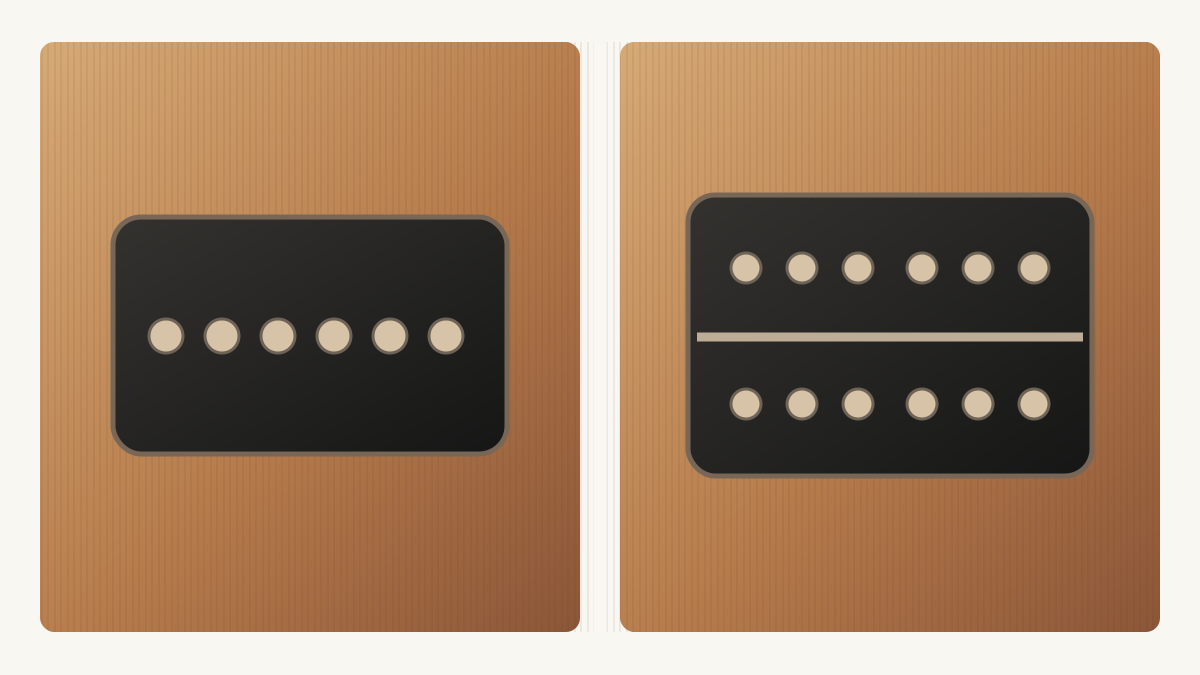
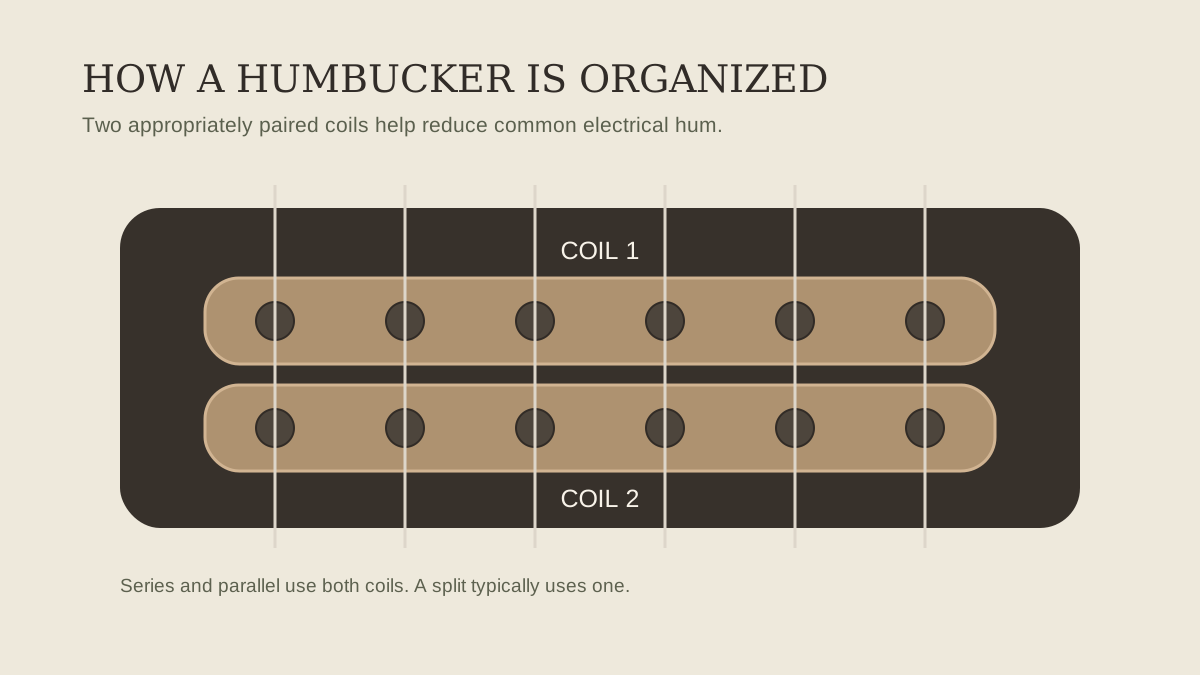
A conventional humbucker pairs two coils so similarly induced magnetic hum opposes while the wanted string signals add. Opposite magnetic polarity and the electrical connection work together; the coils need not be physically wound in opposite directions. Series, parallel and split are separate modes, and a split used alone usually loses the paired hum cancellation. Verify the exact construction, switching and fit. Compare amplifier drive with input settings fixed, then recordings at similar playback volume for preference.
What matters most
- Confirm magnetic and electrical pairing and the exact active mode.
- Keep DC resistance, output and audio-frequency impedance separate.
- Compare drive with fixed input settings, preference at similar playback volume, and fit from actual drawings.
What makes a humbucker a humbucker
The conventional two-coil humbucker combines opposite magnetic polarity with an electrical connection that preserves the string signal while opposing hum induced similarly in both coils. Seymour Duncan’s internals article explains that reversing coil connections can supply the required electrical relationship even when both coils were physically wound the same way. A winding-direction slogan alone is incomplete.
This addresses particular magnetic interference, not every electrical noise. DiMarzio distinguishes mains-related hum from higher-frequency noise that humbuckers do not completely remove. Hiss, interference elsewhere in the rig and connection faults remain separate questions. A hand-on/hand-off observation alone cannot certify grounding.
Coil count and powered electronics are separate specifications. Read the exact pickup and circuit documentation rather than identifying them by a cover or battery. The single-coil versus humbucker comparison covers the broader family choice; this guide concentrates on the humbucker’s modes and installation information.
Sources: Seymour Duncan: coil connections and humbucker internals; DiMarzio: hum, other noise and connected circuitry
Series, parallel and split are different modes
Series connects the coils successively; parallel gives their signals separate paths to the combined output. Both can retain hum cancellation with the appropriate magnetic and electrical relationship. Seymour Duncan’s on-on-on switch article documents one specific series/split/parallel circuit. Its switch contact pattern and wire colours are examples to check, not instructions for every pickup.
| Mode | What is active | What remains to verify |
|---|---|---|
| Series | Both coils | The exact pickup, load and selector diagram |
| Parallel | Both coils | Correct pairing and the actual level/response |
| Full split, coil used alone | Usually one coil | Which coil remains and expected loss of paired hum rejection |
Fender defines a split as disabling one coil; a tap takes a connection from partway through a winding. These are different functions. A full split is also different from a partial split or a combined mode involving another pickup. A switch label cannot identify the active coils by itself, and a split is not guaranteed to reproduce a dedicated single-coil design.
Sources: Seymour Duncan: a specific series/split/parallel switch example; Fender: coil splitting and tapping definitions
Why two humbuckers need not sound alike
Keep DC resistance, output and impedance separate. DiMarzio explicitly rejects DC resistance as a direct tone or output indicator. An ohmmeter’s DC reading does not describe the passive pickup’s whole frequency-dependent impedance. It is not a universal loudness scale or a reason to select the largest kΩ number. Maker output figures also need their stated comparison method; DiMarzio limits its relative output comparison to its own pickups.
The connected load and signal path matter. Record the controls, cable, amplifier input and any powered circuit. A pot value, magnet name or “vintage” label cannot by itself predict the sound of the complete guitar. Follow exact circuit guidance rather than turning common control values into universal requirements.
Separate two listening questions. Leave amplifier input settings fixed to hear switching level and how a signal drives the rig. Then adjust recorded playback volume for a similar listening level when judging preference. Changing guitar volume or amplifier input gain also changes the drive condition.
Sources: DiMarzio: DC resistance is not a tone or output ranking; DiMarzio: hum, other noise and connected circuitry; Seymour Duncan: DC measurement and frequency-dependent impedance
Choose pickup position and layout for a real job
Identify the actual pickup model, physical position and selector mode. A neck/bridge model name indicates intended application; it does not guarantee mounting or the sound of that position. HH and HSS codes also leave switching details open. The layout guide covers those complete arrangements, while the P-90 comparison addresses a different coil-family choice.
Write down a musical task: a sustained clean line, a rhythm part at the required gain, or a useful transition between positions. Try the passage and the controls you will actually use. Record noise in pauses separately from the wanted notes. These are proposed player checks, not genre assignments or a report of guitars we tested.
Verify physical and electrical fit before replacement
Before a replacement, compare current drawings and wiring instructions with the exact guitar. Check cavity and mounting, cover clearance, height range, string-to-pole or rail alignment, connector pinout, conductor access and the intended controls. A cover format or the word humbucker cannot establish a drop-in fit.
Four-conductor wiring exposes the start and finish of each coil for suitable switching; a shield is a separate connection. Colours and connector assignments need the actual maker’s diagram. Do not transfer a colour-only recipe, infer a pinout from appearance or treat the conceptual image as a soldering diagram.
Keep the old parts and wiring record if reversibility matters. Ask a guitar technician to assess uncertain fit, powered/passive compatibility, faults or work requiring routing. Distinguish a working pickup that lacks a desired sound from a failed switch or connection before deciding on a replacement.
Sources: Seymour Duncan: coil connections and humbucker internals
A fair comparison and troubleshooting routine
This is a proposed owner comparison, not an experiment performed for this article.
- Record guitar, pickup model, physical position, active coil mode, controls, strings and tuning.
- Keep cable, amp channel, input settings, speaker and room consistent. Record documented height/setup rather than assuming a universal gap.
- Play the same clean passage with input settings fixed; repeat at the gain you use as a separate condition. Keep the recorder below clipping and document any necessary input change.
- Compare recordings at similar playback volume for attack, chord separation and preference.
- Check pauses, useful modes and control sweeps. Record room orientation and unexplained noises.
- For a swap, resolve dimensions, connections and switching before altering the instrument.
| Record | Your observations |
|---|---|
| Fixed-input pass | Drive, selector balance and recorded settings |
| Similar-volume playback | Playback adjustment and tonal preference |
| Noise | Mode, gain, room and symptom |
| Unknown | Other guitar differences, untested rig or unclear fit |
If two guitars differ in position, strings, wiring or setup, the result concerns the complete instruments. It cannot isolate coil architecture. A cut-out when a cable or selector moves deserves diagnosis; replacing a pickup before finding the fault can leave the problem unresolved.
The useful humbucker decision
Choose the complete pickup system that supplies your required sounds, manageable noise, useful controls and verified fit. Paired coils explain a hum-reduction mechanism; the name does not guarantee output, tone or silence.
Keep facts, personal preference and unknowns in separate notes. If a working guitar meets the task, a category label creates no need to replace its parts. If it does not, identify the limitation and confirm a proposed change against the exact documentation.
Frequently asked questions
Does a humbucker eliminate all guitar noise?
No. Correct pairing reduces hum induced similarly in the coils. Higher-frequency interference, hiss and faults elsewhere can remain; touching the strings is not a complete grounding diagnosis.
Is a coil-split humbucker the same as a single-coil pickup?
A full split usually leaves one humbucker coil active. Its construction and circuit can differ from a dedicated single-coil. Check whether another coil is also selected; a tap is a separate winding connection.
Does parallel wiring still cancel hum?
It can with both coils connected in the correct magnetic and electrical relationship. Check the actual pickup and selector diagram; parallel is different from a full split.
Are humbuckers always louder than single coils?
No. Compare exact models and conditions. DC resistance is not an output ranking. Keep amp input settings fixed for drive, then compare recordings at similar playback volume for preference.
Can any humbucker replace any other humbucker?
No. Verify dimensions, mounting, clearance, string alignment, leads or connectors, controls and switching for the exact guitar before work.
How this guide was prepared
We read Seymour Duncan’s coil-connection and series/split/parallel explanations, Fender’s split/tap definitions, and DiMarzio’s DCR and noise guidance. For passive pickups, we distinguish a DC reading from frequency-dependent impedance. Maker explanations establish scoped concepts, not measured noise rejection or universal sound rankings. The two-pass record is an editorial proposal. We viewed the retained SVG files and corrected which images are used; they are concepts, not internal photographs or wiring instructions. We played, installed, rewired or electrically measured no pickups and claim no human technical reviewer. AI assistance was used for source comparison and language checks.
Documentation checked .
Corrected the physical-winding simplification, separated magnetic hum from other noise and split from tap/parallel, added DCR/impedance limits and two distinct listening passes, corrected image use, and added traceable methodology and section sources.
Sources and further reading
- Seymour Duncan: coil connections and humbucker internals
- Seymour Duncan: a specific series/split/parallel switch example
- Fender: coil splitting and tapping definitions
- DiMarzio: DC resistance is not a tone or output ranking
- DiMarzio: hum, other noise and connected circuitry
- Seymour Duncan: DC measurement and frequency-dependent impedance