
The decision in brief
Soprano and concert ukuleles commonly share g–C–E–A tuning, so changing size does not automatically require different chord shapes. Compare the actual scale, nut width, body support and setup. Try the same passage on both: the useful choice is the instrument that gives you comfortable reach and enough finger space for the music you want to play.
Check the tuning before comparing the sizes
Kala describes g–C–E–A as the standard tuning for soprano, concert and tenor, with the fourth-string G above the C in pitch. With the same tuning and string arrangement, a familiar chord shape gives the same named chord on soprano and concert.
Check the actual instrument’s string set, especially its high-G or low-G arrangement. A low-G setup changes the fourth-string register; it is a separate choice from soprano versus concert. Use a compatible set and the maker’s guidance rather than retuning unfamiliar strings by guesswork.
If you are choosing a first instrument and need the wider lesson and purchase checks, start with the beginner ukulele guide. This article concentrates on the comparison between two sizes.
Read scale, nut width and body size separately
| Listed dimension, inches | Kala KA-15S soprano | Kala KA-C concert |
|---|---|---|
| Scale length | 13.625 | 14.8125 |
| Fingerboard width at nut | 1.375 | 1.4375 |
| Body length | 9.5 | 11.0625 |
These are the manufacturers’ listed dimensions for the named models, checked on October 22, 2026. They are not our measurements, category standards or a matched construction experiment. They show why one word such as bigger cannot describe every part of the comparison.
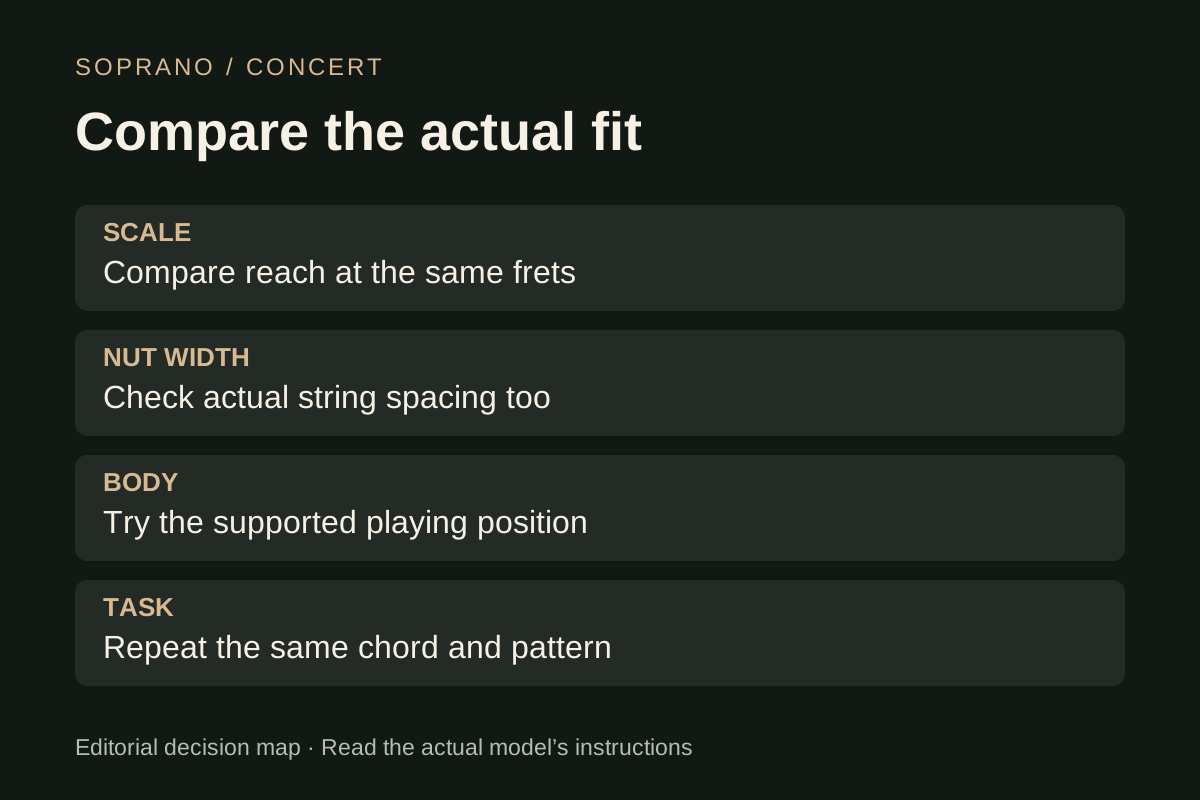
Scale concerns the sounding length; nut width concerns the neck at its nut end; body length concerns the part you support. Compare the distance your fingers must cover at the same frets on each actual instrument; scale length gives useful context for that reach, while setup and neck geometry still matter. Nut width alone does not tell you the actual spacing between strings. Check the actual string spacing on each ukulele; the neck edges are not the string positions.
Other models can combine these features differently. Record all three dimensions for the candidates you will actually try. Neither a nominal family label nor the table establishes comfort for a particular player.
Sources: Kala KA-15S: listed measurements; Kala KA-C: listed measurements
Try both with the same small musical task
Tune both instruments to their intended reference, then use a chord change and a short single-note pattern you know. If you are new, ask a teacher or shop player to demonstrate a suitable task. Keep the playing position consistent and avoid using a difficult new passage as the only fitting test.
- Support the body. Can you keep it stable without gripping the neck just to hold it up? Include a suitable strap if that is how you will practise.
- Reach the notes. Notice whether the first-position stretch feels manageable and whether your wrist can remain comfortable.
- Find finger space. Check whether adjacent fingers crowd each other during the chord change. Distinguish that from a note that needs excessive pressure.
- Repeat the task. Compare the same movement on the other instrument before making the size decision.
A larger hand does not automatically require concert, and a child does not automatically require soprano. Stop an uncomfortable trial and change the position or candidate. This is a suggested fitting exercise, not a medical assessment or a test we conducted.
Separate a sound preference from a setup issue
Use the same short strum or picked phrase, similar effort and a consistent listening or recording position. First establish that each instrument is tuned and working properly. If you compare recordings for preference, listen at similar playback volume.
Two complete instruments can differ in strings, construction, setup and condition as well as size. Describe which complete instrument you prefer rather than assigning the result to scale or body length alone. This article reports no measured loudness, sustain or tonal advantage.
If a note buzzes, will not speak cleanly or needs excessive effort, ask a competent player or technician to help establish why. Such a symptom should not be accepted as proof that the size is unsuitable. Resolve the condition question before treating one difficult sample as a verdict on every soprano or concert.
Record which part of the fit improved
| Your observation | What to compare next |
|---|---|
| Fingers feel crowded | Actual string spacing, neck shape and the same chord on another candidate |
| First-position reach feels long | Scale and playing position, with a shorter candidate for reference |
| Body will not stay comfortably supported | Body dimensions and the supported practice position |
| Notes are hard to fret or buzz | Setup and technique assessment before a size verdict |
| Both feel comfortable | Useful sound, lesson compatibility, case fit and purchase support |
Keep the model, tuning, known strings and playing task beside each note. A clear record might say that one candidate made a particular chord change easier while the other was easier to support. You can then choose the tradeoff that matters instead of trying to name a universal beginner size.
Choose for the practice you will actually do
Shortlist a soprano when compact handling and its actual neck feel support your playing. Shortlist a concert when the particular instrument offers useful finger space and body support without making reach awkward. If neither fits, compare a different model or another family.
Before choosing, confirm the intended tuning, compatible spare strings and a case or bag that fits the actual dimensions. Ask how an unresolved setup or fit problem will be handled. A family name is a useful browsing filter; the completed trial supplies the personal decision.
When the instrument is for a child, include the learner and teacher where possible. The child-led instrument fitting guide offers related questions about support and a manageable task, though its guitar dimensions do not transfer to ukulele.
Frequently asked questions
Do soprano and concert use different chord shapes?
With the same g–C–E–A tuning and string arrangement, the same shape gives the same named chord. Confirm high-G or low-G setup and any alternate tuning on the actual instrument.
Is concert always better for larger hands?
No. Compare the actual scale, neck shape, string spacing and setup. A particular concert may offer useful room, but the family label alone does not establish a better fit.
How this guide was prepared
We checked Kala’s KA-15S and KA-C measurement listings and its April 2025 tuning explanation. These two models are specification examples, not representative samples or product recommendations. Differences between them cannot isolate the effect of size alone. The trial and worksheet are editorial suggestions; we did not measure, play-test or assess players on these instruments.
Documentation checked .