The decision in brief
Choose a child’s guitar around the music or lesson requirements and an actual holding-and-playing trial. Compare body size, scale length, neck spacing, weight and setup separately. An age chart or a label such as 3/4 is only a starting filter; it cannot establish fit. Involve the child and teacher, include the required practice equipment, and leave the purchase open if reach or playing condition remains unresolved.
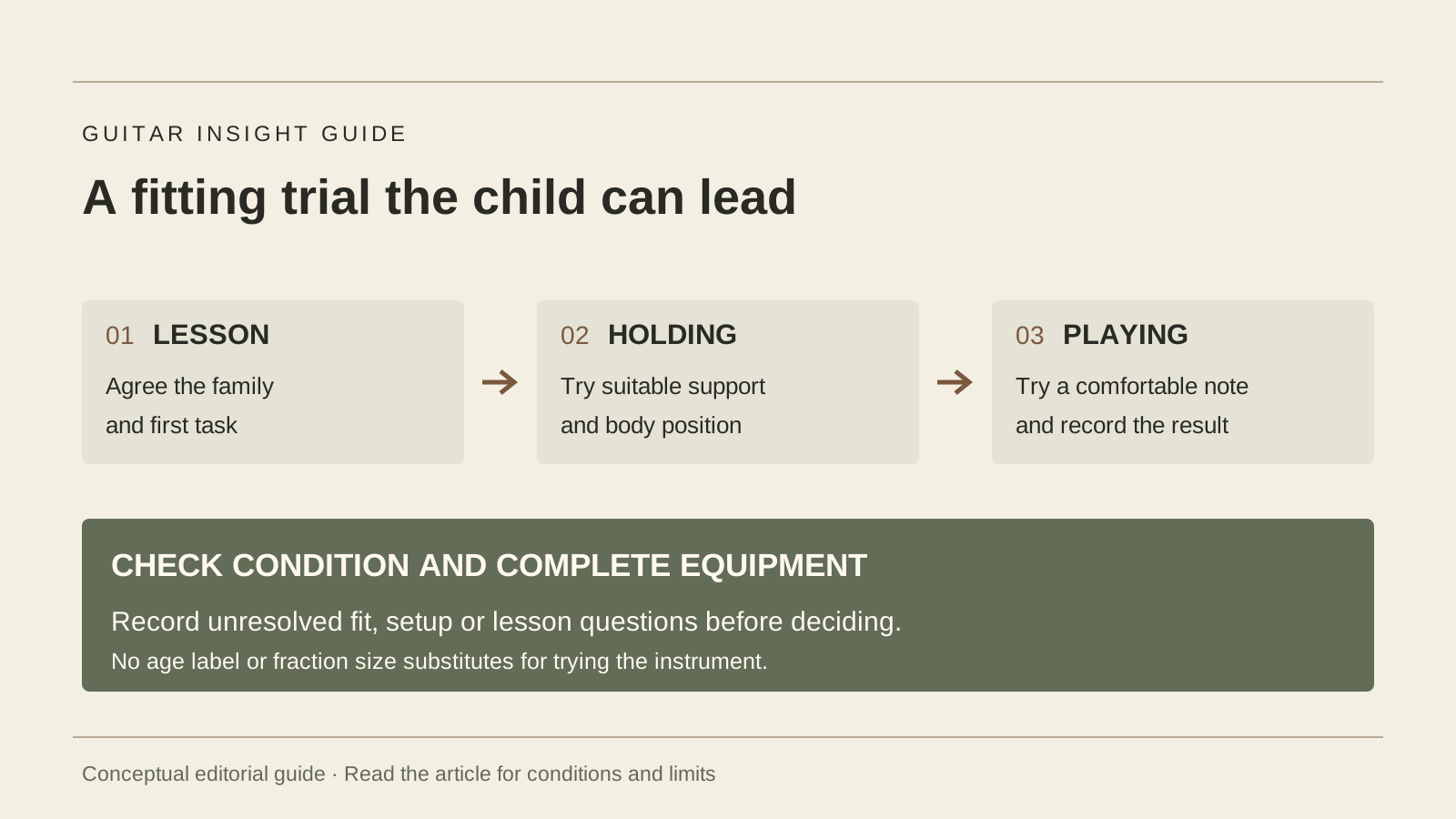
The diagrams in this guide are original editorial concepts, not photographs, measurements or wiring instructions.
What matters most
- Start with the child’s lesson and a comfortable current playing task.
- Compare scale, body and neck measurements separately from age or size labels.
- Record condition, complete equipment and any question that remains unresolved.
Agree the lesson and the sound before the size
Ask the teacher what the course actually requires: instrument family, handedness, tuning, technique and any necessary equipment. Then ask the child which music or sound they want to explore. A generic starter bundle cannot answer either question.
Nylon-string, steel-string acoustic and electric guitars are different systems. Yamaha’s selection guide rejects the idea that every beginner must start with nylon and later move to steel. Use the maker-approved strings for the instrument; do not convert one family into another by changing string material.
An electric guitar is a possible first choice when it meets the lesson and fit requirements, with a suitable listening setup. A nylon-string course may require its own neck spacing and technique. Use our acoustic versus electric guide if the family is still undecided.
Sources: Yamaha acoustic selection guide: string families and playing requirements
Read scale length, body and neck as separate measurements
A size label leaves several fitting questions unanswered. As a named example, Yamaha’s Asia/Oceania CS40II specification describes a 3/4 classical-style body and separately lists a 580 mm scale, 450 mm body length, 920 mm total length and 48 mm nut width. Those are different measurements, not interchangeable descriptions of one size.
| CS40II documented field | Published value | What it describes |
|---|---|---|
| Scale length | 580 mm | The model’s scale specification |
| Body length | 450 mm | Length of the body rather than the whole instrument |
| Total length | 920 mm | Whole instrument dimension |
| Nut width | 48 mm | Neck width at the nut, not outer-string spacing |
This example is not a recommendation, a measured sample or a claim that all 3/4 guitars share those values. Do not interpret 3/4 as a promise that every dimension is 75% of a full-size guitar. Confirm the exact model and regional specification. Our scale-length guide and nut-width guide explain those separate terms.
Let the child try the current task
Taylor’s comfort discussion distinguishes holding the body from neck playability. Its explanation is useful for organizing a trial, but it does not establish an age rule or prove that any model fits every child.
Use a suitable chair and agreed support or strap, with a parent, teacher or appropriate helper. Let the child try the intended practice position. Observe whether the picking arm can reach the strings and whether the fretting hand can move to the notes being taught. Record the body edge, neck position and any need to keep repositioning the guitar.
Ask for a simple task at the child’s present level, such as plucking an open string and fretting one comfortable note. Do not demand a large chord stretch as proof of fit. Stop an uncomfortable movement and seek individual guidance if a concern persists. A brief shop trial cannot establish long-session comfort or a clinical outcome.
A compact body does not automatically establish a short scale or a narrow neck. Compare the alternatives using the same task, and record the dimensions that changed. The small-hands fit guide develops the neck and body comparison.
Check playing condition before blaming small hands
Note installed strings, intended tuning and any setup work already done. Ask the teacher or a capable demonstrator to check notes the child cannot yet assess. Record unexpectedly difficult fretting, persistent buzz, unstable tuning or an intermittent electric signal.
These are observations to assess, not proof that the child needs a different size. A guitar that needs service can distort a fitting comparison. Ask an appropriate technician to identify the work, feasibility and cost before treating it as a quick adjustment. A parent should not turn an adjuster or substitute strings to complete the shop trial.
The action explanation helps distinguish string height from other setup factors. Keep the proposed remedy separate from work that has actually been completed and checked.
Budget for the lesson-ready setup
Write a complete list with the teacher before comparing offers. Depending on the chosen instrument, it may include a tuner, suitable protection, support or strap, approved replacement strings and an electric listening route. Check what is included rather than assuming every bundle is complete.
For electric practice, demonstrate a suitable amp or headphone route and its controls with an adult. For lessons away from home, check that the child and accompanying adult can manage the packed instrument and accessories. Use the case and gig-bag guide to compare the actual journey.
Check the seller’s current delivery, trial, return or exchange and service terms directly. This article verifies no price, rental availability, return right or future trade-in value. A rental or loan may be an option to investigate locally when fit or interest remains uncertain.
Keep a parent–teacher trial record
Use this proposed record to make the decision reviewable. It is not a scored developmental test.
| Record | What to write | Who confirms it |
|---|---|---|
| Learning plan | Family, handedness, tuning, first tasks | Child and teacher |
| Instrument tried | Model/version, strings, scale, body and neck notes | Seller documentation plus observed unit |
| Present fit | Holding, reach and a comfortable current task | Child with a suitable helper |
| Condition | Observed symptoms, completed work and unresolved checks | Teacher or technician as appropriate |
| Complete setup | Equipment, carrying plan and written seller terms | Parent or responsible buyer |
| Follow-up | What change would prompt another trial | Child, parent and teacher |
Before paying, be able to describe why this guitar fits the present task. If the reason is only “for ages eight to ten” or “room to grow,” repeat the actual fitting check. Future growth does not resolve current reach or condition.
After lessons begin, revisit the record when the task, comfort or instrument condition changes. Arrange another trial with the teacher when needed; this guide does not prescribe a fixed replacement age or promise that one guitar will last through a particular stage.
Frequently asked questions
What guitar size should an eight-year-old use?
Age alone cannot settle it. Use the actual child, lesson, body and neck dimensions, setup and a comfortable current playing task. Ask the teacher to compare suitable candidates rather than treating an age chart as a final answer.
Is a 3/4 guitar 75% as long as a full-size guitar?
Do not assume a fraction label scales every dimension. Yamaha lists scale, body length, total length and nut width separately for its CS40II. Compare the actual specifications of the models in question.
Should I buy a larger guitar so the child can grow into it?
Confirm current fit first. A larger future capacity does not compensate for a present task the child cannot comfortably perform. Consider another trial or a locally available loan/rental option if the choice is unresolved.
How this guide was prepared
We checked Yamaha’s regional CS40II specification, Yamaha’s acoustic selection PDF and Taylor’s October 2017 comfort/playability explanation on October 20, 2026. Published dimensions illustrate separate specifications for one named model, not a size recommendation for a child. The supervised trial, family budget record and reassessment checklist are original editorial suggestions. No child, posture, guitar or teaching outcome was assessed; no medical advice, current prices or seller terms were verified. AI assistance supported research comparison, drafting and language checks.
Documentation checked .