The decision in brief
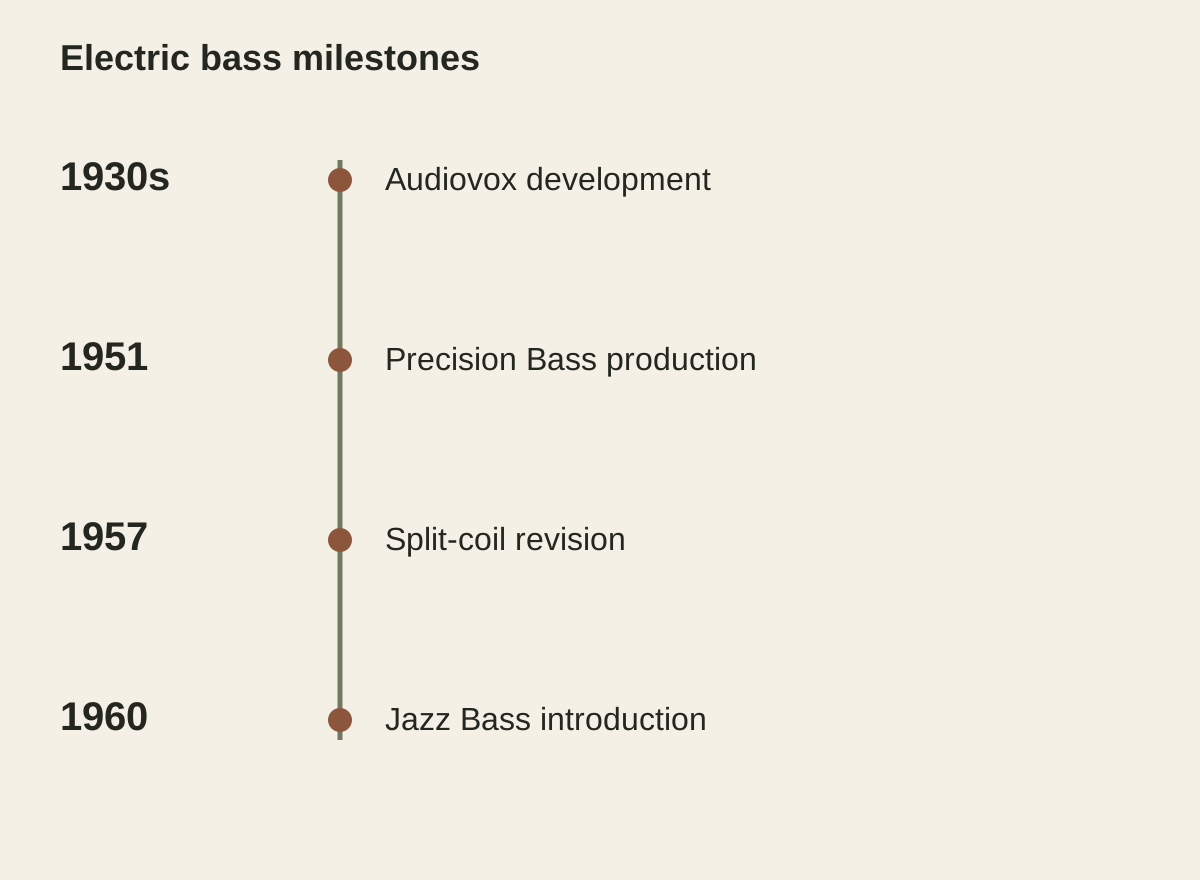
The bass guitar grew from attempts to make the bass role louder, portable and easier to intonate in amplified ensembles. Paul Tutmarc's Audiovox company produced horizontal, fretted electric bass instruments in the 1930s, but they remained regionally distributed. Fender's Precision Bass, commercially produced in 1951, made the solid-body electric bass a scalable mainstream instrument with frets, a strap-held playing position and a 34-inch scale. The Jazz Bass followed in 1960, and later makers expanded pickup systems, active electronics, fretless designs, short scales and five- or six-string ranges. The upright bass remained a separate, active tradition throughout.
Before the bass guitar, the upright bass carried the low register
The double bass supplied foundation, pulse and harmonic movement in orchestras, jazz groups, dance bands and popular ensembles. Its acoustic body could produce substantial low-frequency energy, but the instrument was large to transport and could be difficult to hear as bands and amplification became louder.
Microphones and pickups helped amplify upright basses, yet feedback and uneven response created practical problems. Builders and musicians began asking whether the bass role could be placed in a smaller, horizontal, guitar-like instrument. Frets could also provide clear reference points for players moving from guitar.
The bass guitar did not make the upright obsolete. The two instruments have different scale, technique, envelope and cultural histories. Electric bass history is better described as a new solution for the bass function than as a linear replacement.
Paul Tutmarc built important electric-bass experiments in the 1930s
Seattle musician and inventor Paul Tutmarc developed electric instruments through his Audiovox company. HistoryLink documents the Model 736 Electronic Bass Fiddle, a compact, fretted bass designed to be held horizontally. Advertisements and surviving instruments place this work in the 1930s.
Tutmarc's bass was historically important but did not achieve national mass distribution. That distinction matters: it demonstrates that the core idea predated the best-known commercial success, while also explaining why later histories often began elsewhere.
Claims that one person simply “invented the electric bass” should therefore define the standard. Tutmarc is central to early horizontal solid-body electric-bass development; Fender later established the first broadly successful mass-market system.
HistoryLink’s account cites contemporary newspaper and advertisement records and describes the Model 736’s horizontal playing position and limited regional distribution. This guide keeps the date at “the 1930s” rather than assigning one exact year to every stage of Tutmarc’s work.
Sources: HistoryLink: Tutmarc, with cited contemporary records
The 1951 Precision Bass made the category commercially practical
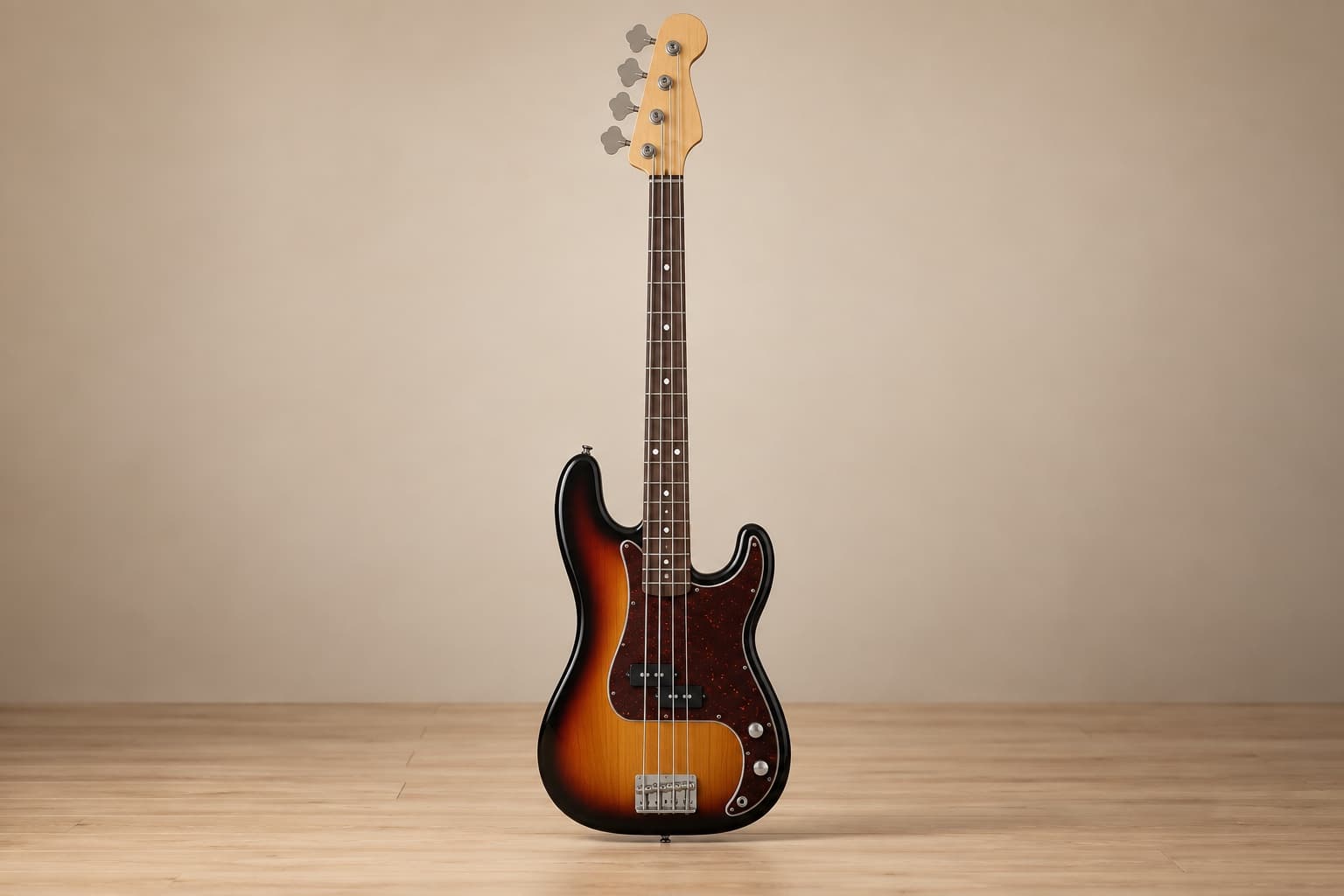
Fender began commercial production of the Precision Bass in October 1951. Its solid double-cut body, fretted neck, magnetic pickup and strap-held position gave working musicians a portable instrument that could be played through an amplifier. The name “Precision” referred to the ability to fret notes accurately rather than locate pitches on an unfretted upright fingerboard.
Leo Fender settled on a 34-inch scale, which became a major long-scale reference. The original model used a slab body and single-coil pickup; later 1950s revisions introduced body contours and the split pickup arrangement strongly associated with the model today.
Commercial success depended on more than the bass itself. Amplifiers and loudspeakers had to reproduce low frequencies reliably, and ensembles had to learn how the new attack and sustain fit drums, guitars and recording equipment.
Fender dates its first body-contour revision to the 1954/55 model year and the familiar split-coil revision to 1957. The original 1951 single-pickup layout and later Precision configuration are separate historical stages. A modern bass with a split pickup is not, by that feature alone, an accurate picture of the 1951 specification.
Sources: Fender: Precision Bass production and design revisions
Players turned a practical instrument into a new musical language
In the 1950s and 1960s, electric bass entered country, pop, R&B, soul and rock sessions. Its defined attack could align closely with the kick drum, while frets supported repeatable lines in studios and live work. James Jamerson's Motown recordings demonstrated melodic movement and rhythmic nuance far beyond simple root notes.
Amplification allowed bassists to sustain notes, use articulation consistently and be heard beside electric guitars and drums. Muting, flatwound and roundwound strings, fingerstyle, pick playing and later slap techniques created different envelopes and roles.
The technology did not determine one style. The same basic four-string format supported soul, reggae, rock, punk, funk, country, jazz fusion and many other languages because players used timing, note length and tone control differently.
Sources: Fender: Precision Bass production and design revisions
The Jazz Bass expanded ergonomics and pickup control in 1960
Fender introduced the Jazz Bass in 1960 as a more deluxe companion to the Precision. It used an offset body, a narrower neck at the nut and two single-coil pickups. Blending the pickups created a broader set of position-dependent sounds and a different physical feel.
The model name reflected Fender's intended market, but players in funk, rock, fusion and other styles defined much of its later identity. This is a recurring historical lesson: a manufacturer's intended audience does not fix an instrument's eventual use.
Other makers developed short-scale basses, hollow and semi-hollow formats, violin-shaped bodies and distinct pickup systems. The bass guitar quickly became a category rather than one model.
Fretless, active and extended-range basses broadened the instrument
Removing frets brought continuous pitch control and an attack closer to some upright techniques, though fretless electric bass remained its own instrument. Active onboard preamps offered buffering and equalization. Five-string basses commonly added a low B, while six-string formats often added both lower and higher range.
Short-scale designs reduced reach and changed string feel; multiscale systems addressed tension across extended ranges. Headless and ergonomic bodies responded to balance and transport. None of these features guarantees quality. They trade simplicity, weight, maintenance and technique for specific capabilities.
Recording also changed. Direct injection boxes, amplifier microphones, compression and software processing let engineers combine clean fundamental information with amplifier character. A bass is now commonly evaluated as part of a recording and reinforcement chain.
History explains the specifications on a modern bass
| Historical need | Design response | What to check today |
|---|---|---|
| Portability | Horizontal solid body and strap | Weight, balance and case length |
| Reliable pitch | Frets and defined scale | Fretwork, intonation and setup |
| Ensemble volume | Magnetic pickup and bass amplifier | Output, noise and speaker capability |
| Broader tone control | Multiple pickups and active EQ | Control logic, battery and gain staging |
| Extended range | Five or more strings | String spacing, neck width and low-string definition |
A historical model name can describe a useful reference, but the complete specification determines whether a current bass fits the player and musical role.
Conclusion: commercial success and first invention are different questions
Tutmarc's 1930s instruments show that the horizontal, fretted electric bass existed before the category became mainstream. Fender's 1951 Precision Bass transformed the idea into a widely distributed, repeatable working system, and the 1960 Jazz Bass expanded its ergonomics and electronics.
Later players and makers added new techniques, strings, scales, pickups and body formats. The useful historical lesson is to separate invention, distribution and musical adoption: each stage helped create the modern bass guitar.
Frequently asked questions
Who invented the electric bass guitar?
Paul Tutmarc's Audiovox company produced an important horizontal, fretted electric bass in the 1930s. Fender's 1951 Precision Bass later became the first broadly successful mass-market solid-body electric bass system.
When was the Precision Bass introduced?
Fender began commercial production of the Precision Bass in October 1951.
Why is it called the Precision Bass?
Its frets let players locate notes with repeatable precision compared with the unfretted fingerboard of an upright bass.
When was the Jazz Bass introduced?
Fender introduced the Jazz Bass in 1960 with an offset body, narrower neck and two single-coil pickups.
Did electric bass replace the upright bass?
No. Electric and upright basses remain distinct, active instruments with different technique, response and musical associations.
How this guide was prepared
The early Audiovox account comes from HistoryLink, which cites contemporary records; Fender supplies its Precision and Jazz Bass production milestones and design revisions. The modern-specification checklist is editorial interpretation. No historical bass was authenticated or tested. The instrument illustration identifies no dated specimen; the timeline separates early invention from wider commercial adoption. This update adds a separate scrolling container to the comparison table and checks the terminology used in existing translations against this English text with AI assistance. Historical sources were not newly added or rechecked, and this update involved no instrument testing or human expert review.
Documentation checked .
This update adds a separate scrolling container to the modern-bass specification table for narrow screens and corrects terminology in the existing translations.