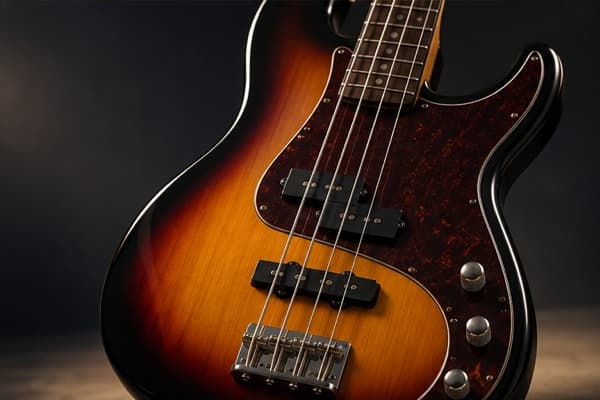
The decision in brief
A standard bass guitar usually plays lower notes and often uses four thicker strings; a standard guitar usually has six strings and covers more chord voicings and higher melodic range. Bass commonly connects rhythm to harmony, while guitar can supply chords, riffs or lead lines. Neither is universally easier. Choose by the music you want to make, the part you want to play, the instrument's reach and balance, and the amplifier or headphone setup you can actually use.
Bass and guitar at a glance
| Question | Common four-string bass | Common six-string guitar |
|---|---|---|
| Standard tuning, low to high | E–A–D–G | E–A–D–G–B–E |
| Register | Lower; standard open E is one octave below guitar's low E | Higher overall range and more adjacent chord options |
| Typical ensemble task | Connect pulse, groove and harmony | Chords, riffs, melody, accompaniment or lead |
| Physical tendency | Longer scale, wider string spacing and thicker strings | Shorter scale and closer-spaced, thinner strings |
| Amplification | Bass-capable amp or suitable interface/headphones | Guitar amp or suitable interface/headphones |
These are conventional examples, not definitions of every instrument. Short-scale basses, five- and six-string basses, baritone guitars and extended-range guitars complicate the neat table. Compare the exact model, tuning and role you intend to use.
Sources: Yamaha: conventional and alternative bass tunings (June 2024); Fender: conventional bass/guitar roles and learning differences
Listen for the part you want to play
The bass often makes the harmony feel grounded while interacting closely with the drums. A line can outline the chord root, move through passing notes, create a repeated hook or deliberately leave space. Simple-looking bass parts are not automatically simple to perform: note length, timing, dynamics and muting can change a whole group's feel.
Guitar parts can provide strummed harmony, arpeggios, riffs, melody, texture or solos. A guitarist may play one note at a time; a bassist may play chords or melodic passages. The meaningful contrast is the usual musical function and register, not a rule forbidding either technique. Listen to one song you love twice: first focus on its low line, then on its chord or melodic guitar part. Which part do you want to learn?
If the part you hear is mainly a low rhythmic motif, bass may be a better starting point even if the guitar is more visible on stage. If you want to accompany singing with full chords, a six-string guitar may be the more direct tool. The bass buying guide begins after that role decision.
Sources: Fender: conventional bass/guitar roles and learning differences

Tuning, range and the Bass VI exception
In conventional tuning, a four-string bass uses the same pitch-class names as the guitar's lowest four strings but sounds an octave lower. This makes the two instruments related on a fretboard while giving them different roles in the mix. A five-string bass often adds a lower B; alternative tunings exist, so verify the actual instrument and string set rather than treating a label as sufficient.
Fender describes its Bass VI format as a six-string bass using E–A–D–G–B–E one octave below standard guitar tuning. That model-specific example shows why string count does not establish register or make an instrument a baritone guitar. Check the exact model’s tuning, compatible string set and nominal scale; our scale-length guide explains the measurement separately from overall instrument length.
Sources: Yamaha: conventional and alternative bass tunings (June 2024); Fender: Bass VI tuning and its distinction from baritone guitar
Feel and technique: test the actual instrument
Bass strings are generally thicker and the scale often longer, so the left hand may travel farther, particularly near the nut. The wider spacing of a conventional four-string bass gives the plucking hand a different target from tightly grouped guitar strings. Yet a short-scale bass can feel more manageable than a large-bodied guitar, and poor setup can make either instrument difficult.
Try the instrument seated and standing. Can you reach the first fret without collapsing your wrist? Does the body or neck dive? Is the strap comfortable with the full weight? Play a simple line for two minutes rather than judging only the first chord. On guitar, try both a chord and a single-note phrase. Watch for discomfort that persists beyond normal unfamiliarity; do not treat pain as a skill requirement.
Fingerstyle, pick playing, muting, fretting and timing are useful on both instruments. When moving between them, practise how long each note lasts and how the part interacts with the ensemble. Transferable fretboard knowledge does not remove the need to learn the new instrument’s touch and role.
The complete practice setup is different
A solid-body electric bass or guitar produces some acoustic string noise, but its amplified result needs a suitable signal and monitoring path. Check the exact amplifier, speaker, input and headphone or interface instructions. Some devices serve both instruments: Yamaha’s THR-II reference manual lists dedicated bass models alongside guitar models. That is an example for the named THR-II units, not evidence that every guitar practice amp accepts bass use at every level.
Both need a tuner, case, strap, cable or interface as appropriate, replacement strings and periodic setup. Bass strings and cases differ from guitar equivalents, but exact cost varies widely; compare a complete usable kit, not only the instrument price. For shared housing, test the intended headphone path and remember that string and foot noise can still be audible in the room.
If you already own a guitar rig, list which components genuinely transfer. A cable or interface may be usable, but speaker and amp limits, processing and monitoring should be checked separately. The lower register can expose room and headphone limitations that are easy to miss in a short shop demonstration.
Sources: Yamaha THR-II Reference Manual (October 2024), pp. 20–21: bass modes
Is bass easier than guitar?
No instrument is universally easier. A four-string bass may offer fewer strings to navigate and a simple first line can be approachable. Holding a consistent groove, managing note length and playing cleanly against a drummer are demanding skills. Guitar may present more early chord shapes and tighter string spacing, yet many learners gain quick satisfaction from familiar chords or riffs. A poor setup makes both paths harder than necessary.
Choose a first lesson or practice piece that reflects the actual role. For bass, play a steady root-note pattern with a recording and listen to the kick drum. For guitar, try a small chord change and a single-note riff. Whichever task keeps you engaged and fits your hands and practice space is a stronger signal than a generic difficulty ranking.
A practical decision test
- Name three songs and identify the low part and the guitar part in each.
- Try a correctly set up example of both, seated and standing.
- Play at the volume and through the gear you expect to use at home.
- Compare reach, balance and the time you want to spend on each musical role.
- Budget the complete kit and note the lesson or group-play opportunity available to you.
If you choose bass, compare scale, string count, balance and electronics using the bass guitar buying guide. If you choose guitar, begin with the electric guitar buying guide or our acoustic vs electric comparison. Learning one does not prohibit the other; it gives you a perspective on the same music from a different register.
| Personal trial record | Write down |
|---|---|
| Musical role | The song and the part you want to learn |
| Physical fit | Exact instrument, seated/standing reach and balance |
| Practice path | Verified amp/interface and monitoring method |
| Useful result | The passage you could play comfortably and what still needs help |
The record is a suggested exercise, not a scored test. Repeat the task if the instrument, setup, room or intended music changes.
When this advice changes
An acoustic bass, upright bass, nylon-string guitar or seven-string electric changes the physical and amplification comparison. A player with a mobility limitation should prioritize the actual ergonomic trial and appropriate professional advice over the category averages here. In an ensemble with a bassist already in place, a low-tuned guitar may fill a different job than another bass.
Changing the repertoire, room or group can change the best first instrument. Repeat the listening and fit test for the new use rather than treating the original choice as a permanent ranking of bass and guitar.
Frequently asked questions
Is a bass guitar just a guitar with four strings?
No. A common four-string bass has a lower register, usually longer scale, different strings and a distinct typical ensemble role.
Is bass easier than guitar?
Neither is universally easier. Early note patterns may be simpler on bass, while timing, muting and groove are substantial skills; setup and motivation matter.
Can a guitarist learn bass?
Yes. Fretboard and musical knowledge transfer, but lower-register listening, touch, timing and muting need deliberate practice.
Can I use a guitar amp for bass?
Check the amplifier and speaker maker's compatibility guidance. A bass-capable amp or suitable interface and monitoring path is the safer baseline for normal practice volume.
Is a six-string bass the same as a guitar?
No. String count alone does not determine tuning, register or intended role. Verify the exact instrument, including Bass VI-style models.
How this guide was prepared
This guide compares conventional four-string bass and six-string guitar roles using Fender’s player overview and Yamaha’s June 2024 tuning explanation. Fender’s Bass VI account is used only for that format’s register, and the THR-II manual is a named compatibility example rather than a recommendation. The listening, fit and practice-path record is an editor-designed exercise readers can repeat. We did not test instruments, amps or headphones, measure their response or establish that one instrument is easier for every learner. Existing editorial images are illustrative and are not evidence of a tested model. This layout revision adds a separate scrolling container to the personal trial-record table. AI assistance was used to compare the HTML and preserve all existing wording and factual conditions. Source documents were not rechecked for this layout-only update; it includes no instrument test or human expert review.
Documentation checked .
Adds a separate horizontal-scrolling container to the personal trial-record table so the surrounding decision steps and paragraphs remain in the normal reading flow. Existing wording, facts, sources and images are retained.