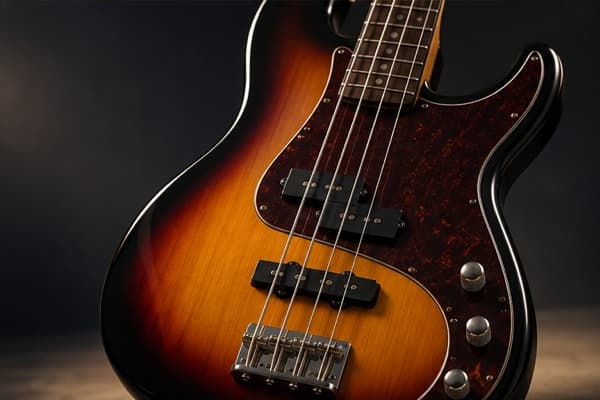
The decision in brief
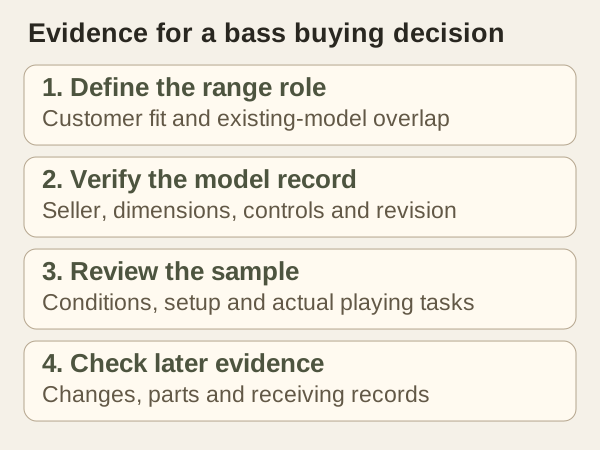
Define the bass’s role in your retail range, verify the seller and exact model revision, then compare documentation, an identified sample and service responsibilities. Keep the sample’s received condition separate from authorized work and rechecks. Essential missing evidence means a hold. Sample approval sets a reference for later checks; it does not establish shipment consistency, supplier capacity or a safe order size.
What matters most
- Keep seller/model evidence separate from sample findings.
- Preserve received condition, authorized work and retest.
- A reference sample does not establish delivered-lot quality.
Define the bass's job before comparing suppliers
Write the customer job before requesting a catalogue: a first bass for a stated repertoire, a different physical fit, or an instrument covering a required lower note. Identify the model it would complement or replace. Record which need is currently unmet; a finish option alone may add choice without changing musical coverage.
Compare reach, balance, actual string spacing, controls and usable response for that job. Yamaha’s selection guide provides background categories, including powered preamps and string count. Those categories do not verify a supplier or predict every player’s comfort. Use the range-planning framework for the wider assortment decision.
Sources: Yamaha bass-selection PDF, printed pp. 5–8: comparison categories; manufacturer guidance
Verify the seller, model identity and documentation
Record the legal seller, named contact, supply role and exact model code used on the quote, sample and specification. Ask which party is responsible for product questions, replacement parts and agreed remedies. Resolve conflicting names or revisions before approving public descriptions.
Keep a dated document index. A photograph cannot verify internal materials, authority to sell a brand, certification, capacity or service performance. Obtain appropriate evidence for any claim that affects the decision, and qualified advice for the actual commercial or jurisdictional question. This checklist is an editorial method, not a completed company investigation.
Normalize the bass specification sheet
Specify string count and tuning, nominal scale, neck dimensions and their reference points, spacing, fretted/fretless design, pickups, controls, power, bridge route and fitted strings. Record missing information as “not supplied”. Keep the measurement quantity, location and units with each number.
| Field | What must be identified | Decision supported |
|---|---|---|
| Neck and scale | Model drawing or stated measurement method | Reach and fit to assess on the sample |
| String replacement | Exact set, ball-end seat, route, winding and taper | Whether a replacement fits the actual instrument |
| Electronics | Pickups and preamp separately; controls, power and bypass | Demonstration and service instructions |
| Setup | Strings, tuning, method and agreed criterion | Comparable received and corrected condition |
| Hardware | Part code, revision and compatible replacement | A documented repair route |
D’Addario’s June 2021 bass-string guide measures its winding length from the ball-end junction to the taper. It asks the player to check the ball-end seat-to-nut route. That differs from nominal instrument scale. Request the appropriate fit method for the actual string and bridge rather than assuming that “long scale” is a universal length. The specification-comparison guide covers the broader record.
Sources: D’Addario Support (2021): bass-string winding length and fit method
Check the bass-specific player experience
Use normal playing tasks for the intended customer role. Compare seated and standing reach with a secure suitable strap, balance, spacing, muting and access to the required notes. Record the sample’s tuning, string set and setup. String count or scale alone cannot settle the whole fit.
Use a known working bass rig at a comfortable permitted level. Keep input settings documented when checking output and clipping; compare recorded sound at similar playback volume when judging preference. Include rests, the lowest required note and the intended technique. Describe observations without diagnosing a cause from one sound. The player’s bass guide supports staff explanations.
Inspect the sample with conditions recorded
Identify the unit and photograph its packaging and condition before cleaning, restringing or adjustment. Follow the exact maker’s arrival and climate guidance. Record tuning, strings, relevant room conditions, tool, reference points and the criterion being checked. Keep visible observations separate from document-supported specifications.
Fender’s setup reference assumes factory string gauges and allows changes for the player. Its numbers are not acceptance limits for every bass. Ask an authorized competent person to assess uncertain neck function, remaining adjustment range or structural concerns; do not turn a truss rod or dismantle the sample simply to fill a checklist. Preserve original findings, authorized work and connected rechecks as three distinct states. See the sample evaluation guide.
Sources: Fender Support: factory-string assumptions and conditional setup guidance
Test controls and ask who handles service
Record the pickups and powered preamp separately. Yamaha’s guide explains battery-powered preamp operation; it does not establish the pickup circuit in an unrelated bass. Check the exact model’s control functions, stated neutral setting, power specification, battery access, output switching and any passive bypass. Do not assume a knob midpoint is flat or a depleted battery leaves a usable output.
Ask who identifies the correct replacement revision, authorizes a remedy and supplies each required part. Record the evidence and any unanswered question. Test normal controls under an agreed demonstration; leave electrical modifications to an authorized competent person. The active-versus-passive guide explains the circuit distinction.
Sources: Yamaha bass-selection PDF, printed p. 7: powered preamp context
Tie the approved sample to the supplied revision
Keep the approved specification revision, photographs, fitted set, control instructions, accepted limitations and authorized changes with the sample record. Agree how proposed substitutions will be reviewed before supply. A model name alone cannot show that pickups, bridge, strings or neck dimensions remain unchanged.
Define receiving checks separately. If lot sampling is used, agree the lot, selection method and acceptance/rejection plan with competent support. NIST distinguishes deciding lot acceptability from estimating lot quality. A demonstration sample may be selected or specially prepared; it cannot show the variation in ordinary supplied units. It is not a random sample from a defined delivered lot. Retain receiving findings through the receiving workflow.
Sources: NIST handbook 6.2.1: purpose and limits of acceptance sampling
Calculate usable value and make a staged decision
Use your own confirmed purchase, transport, preparation, parts, storage and return costs where applicable. Keep expected costs labelled as estimates and replace them with actual records when available. A quotation cannot establish display-ready cost or future defect rates.
Essential identity, specification, structural, functional or service gaps require investigation before approval. A score cannot cancel a hold. Choose approve for a stated scope, hold for evidence, revise and retest, or reject; name the owner and next evidence needed. Any first-purchase quantity and terms depend on the buyer’s circumstances. No universal trial order, margin or lead time is established here.
When this advice changes
Headless, multiscale, fretless, acoustic or extended-range basses need additional model-specific string, playing and condition checks. Use documentation for the actual layout and appropriate technical assessment. A conventional solid-body checklist cannot fully evaluate every design.
Cross-border or regulated claims can require specialist checks outside this method. If the range has no documented gap, improving staff knowledge or availability may answer the customer need without another model. Keep that decision separate from a supplier’s claimed capability.
A buyer checklist you can reuse
Use one record for each decision. Keep uncompleted checks visible; do not turn an empty cell into a pass.
| Record item | Write down | Hold if essential evidence is missing |
|---|---|---|
| Range role | Customer task and current-model comparison | Demand or fit question remains unresolved |
| Identity and revision | Seller, model, documents and sample ID | Records conflict or responsibility is unclear |
| Sample states | As received, authorized work, retest and conditions | Functional or structural concern is unresolved |
| Support and change control | Parts, remedies and approval of substitutions | A required repair or revision route is unknown |
| Decision | Scope, evidence, owner and next action | Approval would depend on an unverified assumption |
Hypothetical example: a sample’s battery-powered controls function, but the seller has not identified a replacement preamp revision. Record the observed function and the missing service evidence separately. If parts support is a requirement for this range role, hold that decision until it is resolved. This is an example of the record, not a supplier finding or a test performed by this site.
Frequently asked questions
What should I ask a bass guitar supplier first?
Identify the seller, exact model and revision, then request the specification, fitted set, control instructions and service responsibilities needed for the intended range role.
Does one approved sample establish shipment consistency?
No. It defines evidence for that identified unit and approval scope. Delivered stock needs a separate agreed inspection plan and receiving records.
Does “active bass” mean its pickups are active?
Not necessarily. Record pickups and powered preamp separately and verify the actual circuit, power and bypass instructions.
What should I do when essential evidence is missing?
Put the decision on hold, identify the missing evidence and responsible person, and state the recheck needed. Do not replace the gap with a favorable total score.
How this guide was prepared
This AI-assisted documentation review checked Yamaha’s bass-selection categories and powered-preamp description, D’Addario’s dated winding-length fit method, Fender’s conditional setup guidance and NIST’s sampling definition. The decision record and service example are editorial proposals, not a NIST-certified or NIST-endorsed protocol. No supplier identity, capacity, certification, terms, sample, shipment or cost was investigated or tested. We do not adopt the manufacturer guide’s universal wood-tone, skill-level or scale-based quality rankings. Exact model instructions and the buyer’s agreed requirements govern the assessment.
Documentation checked .
Added a unit-linked hold and decision record, separated sample states from delivered-stock evidence, clarified winding-length and electronics checks, and identified the limits of the proposed method.