The decision in brief
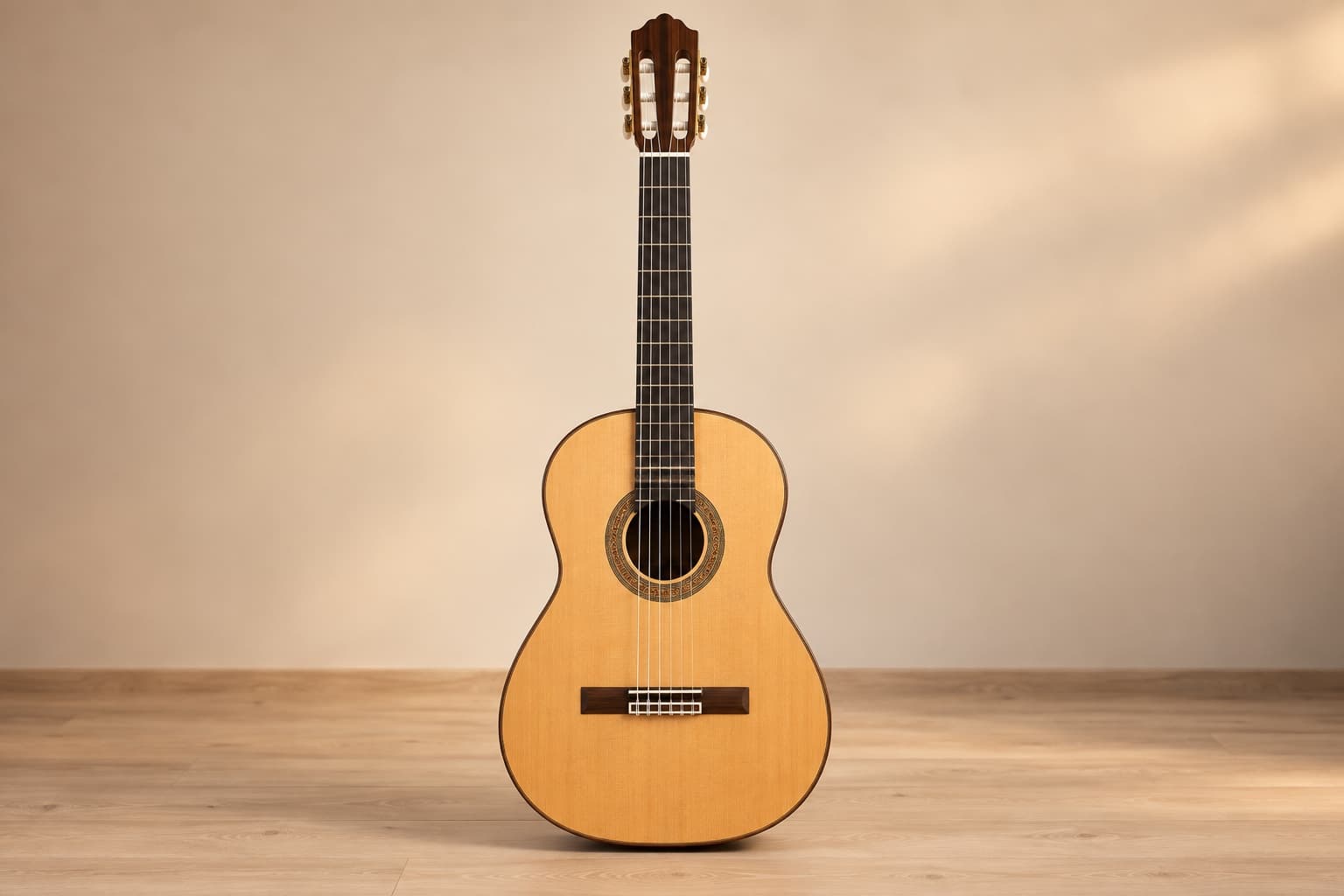
The classical guitar's recorded European history reaches back through Renaissance and Baroque guitars with paired courses. Six single strings became common around the turn of the nineteenth century. In mid-nineteenth-century Spain, Antonio de Torres enlarged and refined the concert guitar, using body proportions and fan-braced soundboards that became a central reference for later makers. Performers and workshops expanded its concert role in the twentieth century, while nylon-string development during the 1940s offered an alternative to scarce and inconsistent gut trebles. Modern classical, flamenco and crossover guitars retain this lineage while adapting structure and ergonomics to different uses.
Recorded guitar history begins with changing forms, not one ancient instrument
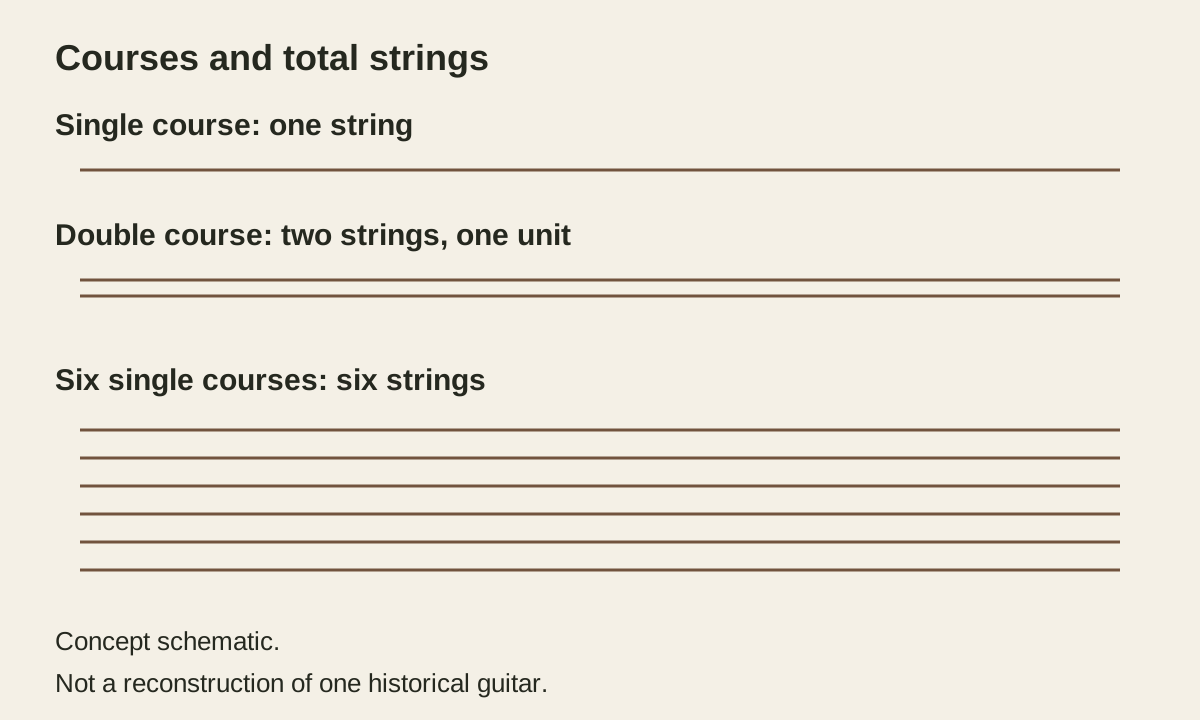
The Metropolitan Museum of Art traces written guitar sources to the fourteenth century. Renaissance guitars often had four courses and Baroque guitars five, with pairing common. A course is one playable unit: it can contain a single string or strings placed together and played as a group. Course count and total string count therefore need separate descriptions. The Met’s guitar dated about 1800 is explicitly catalogued as a six-string, single-course instrument.
Many plucked instruments existed across Europe, North Africa and the Middle East, and broad origin stories often overstate a direct line from one ancient object to the modern guitar. The reliable history follows documented instruments, music and workshops rather than visual resemblance alone.
By the late eighteenth and early nineteenth centuries, six single strings were becoming established. Workshops developed fixed frets, saddle bridges, raised fingerboards and changing body proportions. Composers and performers such as Fernando Sor and Mauro Giuliani worked with early nineteenth-century guitars whose layouts preceded the later Spanish concert format. The change was gradual across workshops, rather than a universal conversion on one date.
Sources: The Met: documented Spanish-guitar development (2017); The Met: six single courses, guitar dated ca. 1800
Six single strings supported a new repertoire and technique
The move from paired courses to six single strings simplified tuning, articulation and maintenance while expanding melodic and harmonic control. The familiar E–A–D–G–B–E tuning became a durable standard, though local and historical alternatives remained.
Nineteenth-century players wrote studies, chamber music, songs and solo works that treated the guitar as more than accompaniment. The instrument flourished in domestic and salon settings, but its limited projection remained a challenge in the larger concert culture of the Romantic period.
Makers therefore searched for more responsive soundboards, stable necks, useful scale lengths and bodies capable of filling a room without becoming structurally heavy. These pressures prepared the ground for the Spanish concert guitar.
Antonio de Torres established a central reference for the modern concert guitar
Antonio de Torres Jurado worked in Spain during the middle and later nineteenth century. The Met places the start of his work in the 1850s and describes his concert guitars as a culmination of earlier changes in body size, soundboard design and construction. Torres refined a larger concert format and used fan bracing to support the top.
It is safer to say that Torres standardized and demonstrated a highly influential system than to claim he invented every feature. Fan bracing existed in related forms, and other makers contributed. His instruments showed how body geometry, light construction and soundboard control could produce a stronger concert voice.
Later Spanish workshops, including the Ramírez tradition and makers such as Santos Hernández, developed the system further. Torres became a benchmark because his design logic proved transferable, not because every later classical guitar copied identical measurements.
Sources: The Met: documented Spanish-guitar development (2017)
Performers and makers built the twentieth-century concert tradition together
Francisco Tárrega helped establish modern technique and repertoire at the end of the nineteenth century. In the twentieth century, Andrés Segovia expanded the guitar's international concert presence, encouraged new compositions and worked closely with makers. The Met preserves the 1912 Manuel Ramírez guitar associated with his early career and the 1937 Hermann Hauser guitar he later used extensively.
Design developed through collaboration between performers and workshops. Players communicated requirements for projection, balance, sustain and response; makers interpreted them through body structure, bracing, scale and workmanship. Concerts, recordings and teaching helped spread the resulting instruments and repertoire.
Segovia was influential, but classical-guitar history is larger than one performer. Regional schools, women performers and composers, Latin American traditions, flamenco practice and many workshops also shaped technique and repertoire.
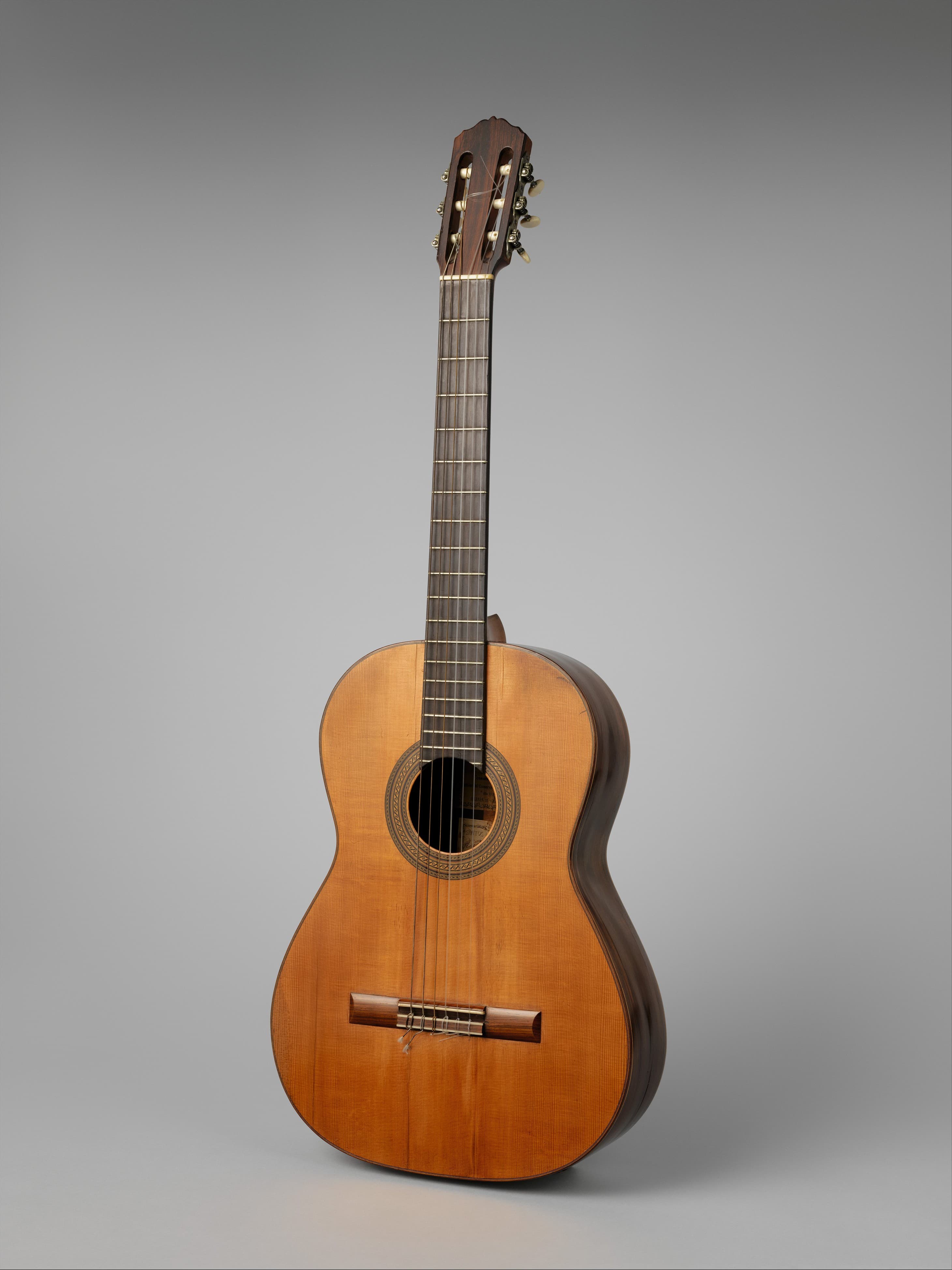
The Met dates the Ramírez / Hernández guitar to 1912 and the Hauser guitar to 1937; those are object dates. Its Hauser record describes Segovia’s use from 1938 to 1962. Making a guitar, first acquiring it and using it in concert are separate events, so the object date should not stand in for all three.
Sources: The Met: Manuel Ramírez / Santos Hernández, 1912, object 1986.353.2; The Met: Hermann Hauser, 1937, object 1986.353.1
Classical and flamenco guitars share roots but serve different responses
Flamenco makers and players developed instruments optimized for quick attack, rhythmic clarity and physical techniques such as golpe. Traditional examples often use light construction, cypress back and sides and a protective tap plate. Classical concert guitars often prioritize sustain, balance and a broader color range.
The categories overlap. Spruce, cedar, cypress and rosewood do not create guaranteed outcomes by themselves, and modern makers build many hybrids. Construction, top stiffness, action and the player's touch matter more than a single material label.
This history explains why “Spanish guitar,” “classical guitar” and “flamenco guitar” can overlap in conversation but should not be treated as exact synonyms when selecting an instrument.
Sources: The Met: documented Spanish-guitar development (2017)
Nylon-string development expanded during the 1940s
Earlier classical guitars used gut trebles with wound bass strings. Augustine’s own history describes gut shortages in the 1940s and Albert Augustine’s refinement of DuPont nylon monofilament with feedback from Andrés Segovia. It also describes nylon multifilament bass cores wound with metal. That is the maker’s account of its own development work; the cited page does not establish one first date for all nylon experiments, performances or commercial launches.
Nylon improved consistency and durability, but it did not turn every classical guitar into the same system. String diameter, tension, polymer formulation and winding affect feel, intonation and response. Fluorocarbon and composite materials later expanded the options.
The term “nylon-string guitar” now includes traditional classical, flamenco, crossover, cutaway acoustic-electric and thin-body stage instruments. Their shared string family does not erase differences in neck, body, bracing or intended technique.
Modern makers continue to reinterpret the classical system
Twentieth- and twenty-first-century builders have explored lattice bracing, double tops, alternative composites, elevated fingerboards, arm bevels and new neck structures. Some designs seek more projection or balance; others prioritize weight, comfort, climate stability or amplification. None has made the Torres tradition irrelevant, and historical construction remains active.
Crossover guitars use narrower nuts, radiused fingerboards, cutaways or onboard electronics to serve steel-string and electric players. They can be useful tools, but they do not automatically provide the spacing or response expected in formal classical study. The intended repertoire and teacher's requirements matter.
History should therefore guide comparison rather than enforce purity. A traditional instrument, flamenco guitar and stage nylon solve different problems within a related family.
A concise classical-guitar timeline
| Period | Development | Lasting significance |
|---|---|---|
| Renaissance | Four-course guitars documented | Early written guitar repertoire and identity |
| Baroque era | Five-course guitar widely used | Expanded harmony and accompaniment |
| Late 1700s–early 1800s | Six single strings become established | Core modern tuning and technique |
| 1850s onward | Torres concert-guitar system gains influence | Body, top and fan-bracing reference |
| Early 1900s | International concert tradition expands | New repertoire, teaching and maker collaboration |
| 1940s and later | Nylon-string development and adoption | More consistent synthetic string supply |
Sources: The Met: documented Spanish-guitar development (2017); The Met: six single courses, guitar dated ca. 1800; Augustine: its account of nylon-string development
Conclusion: tradition is a record of successful adaptation
The classical guitar developed through courses, six single strings, nineteenth-century concert design, performer-maker collaboration and synthetic strings. Torres established a central construction reference, while later workshops and performers carried it into international concert practice.
Modern classical, flamenco and crossover guitars are related outcomes of that history. The useful lesson is not that one historic specification is mandatory, but that string system, soundboard, body, neck and technique must work together for the intended musical role.
Frequently asked questions
Who invented the classical guitar?
No single person invented the whole instrument. Antonio de Torres is central because his nineteenth-century concert designs established a highly influential reference for later classical guitars.
When did classical guitars get six strings?
Six single strings became increasingly established around the late eighteenth and early nineteenth centuries, replacing earlier guitars with paired courses.
When were nylon guitar strings introduced?
Augustine’s current history describes nylon-string development amid gut shortages in the 1940s. Experiments, early performances and commercial introduction are separate milestones; this guide does not assign them one universal first year.
Did classical guitars originally use nylon strings?
No. Earlier classical and concert guitars used gut trebles and wound bass strings. Synthetic nylon was adopted in the twentieth century.
Is a flamenco guitar a classical guitar?
They share Spanish guitar ancestry and nylon strings, but traditional flamenco instruments often use lighter construction and a faster, more percussive response for a different playing context.
How this guide was prepared
The chronology uses The Met’s curatorial essay and object records; Augustine supplies a manufacturer account of nylon-string development. Object dates are kept separate from performance and commercial milestones. The course diagram is an editorial explanation, and the credited 1912 instrument image is a public-domain museum photograph. No historical instrument was authenticated, measured or played for this update.
Documentation checked .
The update corrects the course definition, links dated museum specimens, qualifies the nylon chronology and distinguishes a real collection photograph from modern illustrations.