The decision in brief
Electric-guitar history is best understood as a sequence rather than a single invention. Magnetic pickup experiments and commercial lap steels appeared in the early 1930s; amplified hollow-body guitars then gave guitarists a stronger role in large ensembles. Builders pursued solid and semi-solid structures to control feedback and simplify production. By the 1950s, repeatable solid-body designs, improved pickups and purpose-built amplifiers had established the electric guitar as a complete instrument system. Later effects, higher-gain amplification and digital processing expanded that system without replacing its basic string-pickup-amplifier relationship.
Before electricity, guitar design was a volume problem
For centuries, guitars produced usable sound by transferring string vibration through a bridge into a resonant wooden top and air cavity. That system worked well for solo playing, accompaniment and smaller rooms. It became harder to hear when dance bands and jazz ensembles placed the guitar beside drums, brass, reeds and amplified voices. Builders enlarged bodies, used arched tops and experimented with metal resonators, but acoustic projection still imposed limits.
Electric amplification changed the design question. Instead of asking the body to make all the audible sound, a pickup could convert string movement into an electrical signal, an amplifier could raise its level and a loudspeaker could return it to sound. The guitar, cable, amplifier and speaker therefore became one system. This distinction remains important: the electric guitar's unplugged loudness does not describe its intended performance function.
Early development also crossed instrument categories. Hawaiian-style lap steels, conventional “Spanish” guitars held against the body, pickups, radio technology and public-address equipment all contributed. Any history that begins with one familiar six-string solid body skips the experiments that made it possible.
The early 1930s established magnetic amplification
Commercially marketed electric lap steels appeared in the early 1930s, including instruments associated with George Beauchamp, Adolph Rickenbacker and the company then known as Ro-Pat-In or Electro String. The circular cast-aluminum instruments later nicknamed “Frying Pans” used a magnetic pickup to sense steel-string motion. Their playing position differed from a standard guitar, but the electromagnetic principle became foundational.
There is no single uncontested answer to “Who invented the electric guitar?” The answer changes with the definition: experimental pickup, patent, commercial lap steel, amplified Spanish-style guitar, solid-body prototype or nationally successful production model. A careful history states the category and the evidence rather than collapsing all of them into one first.
By the middle and later 1930s, amplified archtop guitars allowed players such as Charlie Christian to perform single-note lines with big bands. The guitar could move from quiet rhythm support toward a foreground melodic voice. This musical use was as important as the hardware: players demonstrated why the new volume and sustain mattered.
Rickenbacker’s history separates the company’s 1931 beginnings, pickup development and the cast-aluminum lap steels described in its early literature. Those milestones concern a lap-played electric instrument. They do not establish that a familiar fretted solid-body guitar appeared at the same moment.
Hollow bodies revealed both the opportunity and the feedback limit
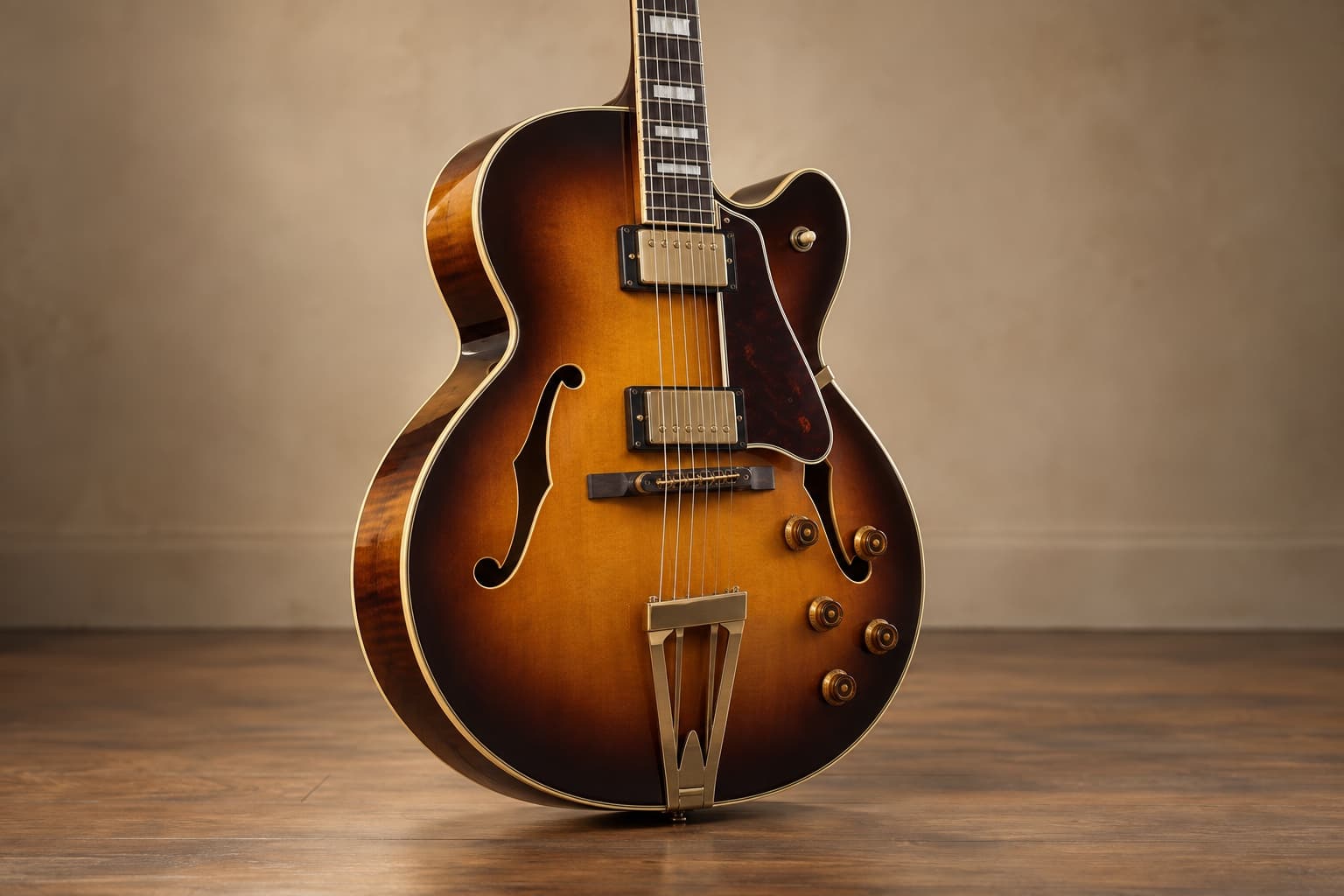
Early electric Spanish-style guitars retained hollow acoustic bodies because that was the established construction language. At moderate volume they combined familiar feel with amplification. At higher gain, however, sound from the loudspeaker could excite the body and strings, return through the pickup and create a self-reinforcing loop. Feedback could be unwanted noise or, later, a deliberate expressive effect.
Builders responded in several ways: stronger tops, smaller or thinner bodies, different pickup mounting and, eventually, solid or center-block construction. The semi-hollow guitar kept acoustic chambers while adding a solid center area that supported hardware and improved feedback control. Hollow, semi-hollow and solid-body guitars therefore represent different engineering compromises rather than a simple old-to-new quality ladder.
Magnetic pickups also meant that pickup position, coil construction, controls and amplifier response became part of the instrument's identity. Two guitars with similar outlines could behave differently because their electronic systems were different.
Sources: Yamaha: hollow, semi-hollow and solid-body construction
Postwar solid bodies turned experiments into repeatable products
Inventors and musicians explored solid or partly solid guitars before a national mass market existed. Les Paul's workshop “Log,” Paul Bigsby's instruments and other projects are important parts of the story, but claims about a single first solid-body guitar depend on whether the standard is prototype, order-built instrument or production model.
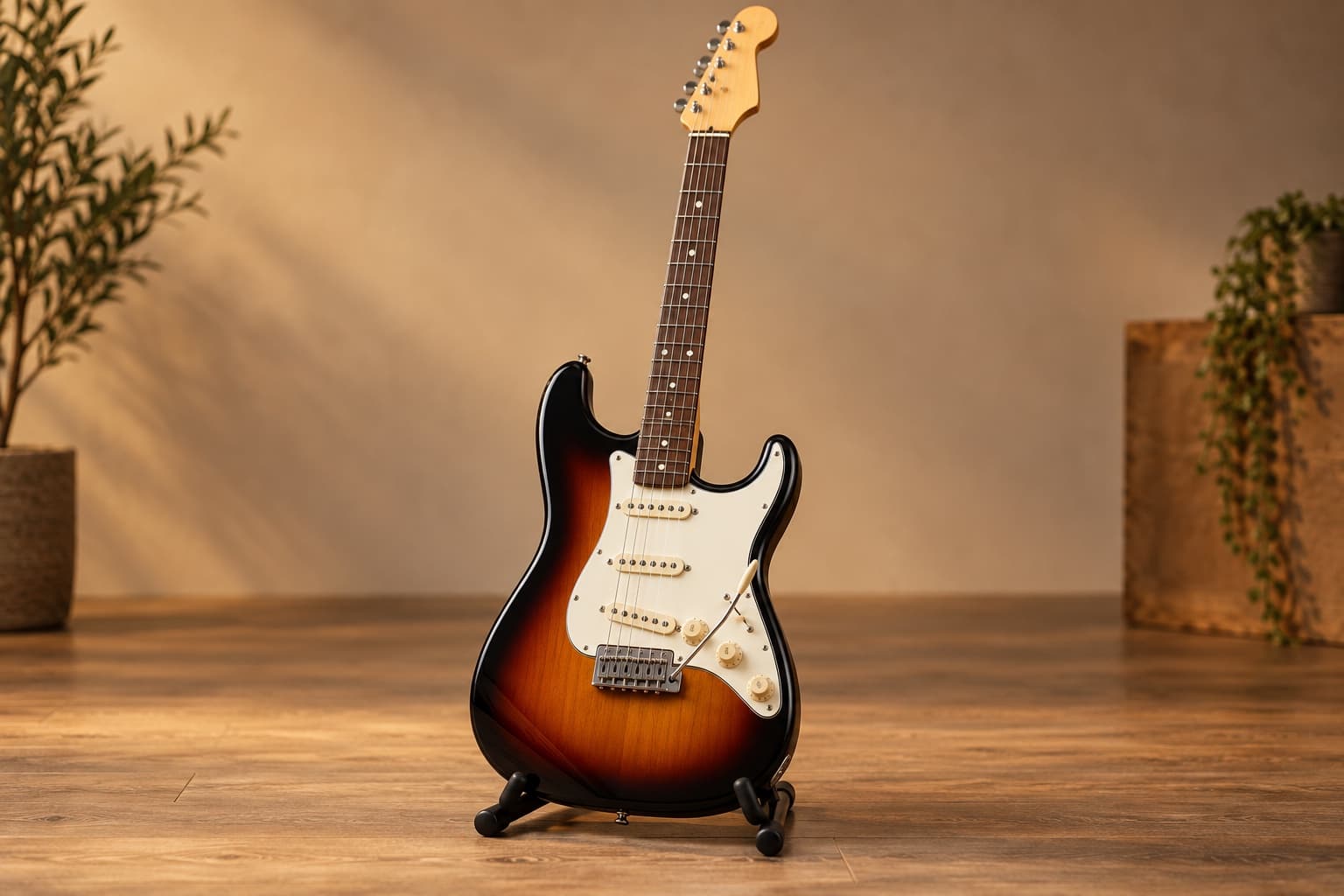
In the late 1940s and early 1950s, companies including Fender and Gibson established solid-body electric guitars as repeatable commercial products. Fender's Esquire, Broadcaster and Telecaster lineage emphasized modular construction, serviceable bolt-on necks and straightforward manufacturing. Gibson's Les Paul model, introduced in 1952, combined solid construction with the company's carved-top and set-neck traditions. The Fender Stratocaster followed in 1954 with body contours, three pickups and an integrated vibrato system.
These designs were not merely shapes. They organized scale length, neck attachment, bridge, controls, pickup placement and manufacturing into coherent systems. Their continued influence comes partly from how clearly each system solves a group of playing and production requirements.
A short model chronology makes the categories easier to compare: Fender dates the Broadcaster launch to 1950, the Telecaster name to 1951 and the Stratocaster debut to 1954. Gibson dates the Les Paul model to 1952. These are product milestones from the makers’ histories, rather than a single date for the invention of electric amplification.
Sources: Gibson: Epiphone history and Les Paul’s Log; Fender: Broadcaster, Telecaster and Stratocaster milestones; Gibson: the Les Paul model and its 1952 introduction
The 1950s and 1960s expanded pickups, amplifiers and musical roles
Humbucking pickups brought strong common-mode hum reduction to many instruments in the 1950s, while single-coil designs remained valued for attack and position contrast. Purpose-built amplifiers grew more powerful and added features such as tremolo and spring reverb. The Jazzmaster, Jazz Bass, Jaguar, SG and many other models showed that the design vocabulary was still open.
Players then pushed equipment beyond its original brief. Overdriven amplifiers, feedback, fuzz, wah, studio tape effects and unconventional techniques turned electrical artifacts into musical language. Surf, blues, soul, rock, funk and experimental music did not simply adopt a finished instrument; they helped define what the electric guitar was for.
Manufacturing also spread beyond the United States. European and Japanese makers developed their own interpretations, export models and production methods. By the end of the 1960s, the category included inexpensive student guitars, professional solid bodies, archtops, semi-hollows, twelve-strings and extended electronic options.
Modern development changed the surrounding system as much as the guitar
From the 1970s onward, higher-output pickups, active electronics, improved tremolo systems, alternate materials, locking hardware and extended-range instruments addressed specific stage and playing needs. Some ideas became standards; others remained specialized. The success of a feature depended on reliability, musical usefulness and whether players accepted the change.
Effects moved from amplifier behavior and studio processes into pedals, rack systems and digital processors. Modeling later made it possible to reproduce many amplifier and effect responses at lower volume or inside software. These changes expanded the instrument's context, but the quality of the basic setup—nut, frets, bridge, pickup balance and controls—still determines whether the guitar functions well.
Today's market combines historically derived formats with ergonomic bodies, headless designs, seven or more strings, MIDI control and software integration. “Vintage” and “modern” are not opposing quality grades; they describe different solutions and reference points.
Use history to read a modern electric guitar more accurately
| Historical pressure | Design response | Modern feature to inspect |
|---|---|---|
| Compete with louder ensembles | Magnetic pickup and amplifier | Pickup layout, controls and gain structure |
| Control feedback | Solid or center-block body | Body construction and intended volume |
| Repeatable production and service | Modular hardware and neck systems | Parts compatibility and setup access |
| Broader expression | Multiple pickups, vibrato and effects | Switching, bridge behavior and signal chain |
| Stage reliability | Improved hardware and noise control | Tuning path, shielding and power needs |
History is useful when it explains why a feature exists. It should not be used to claim that an older specification is automatically better or that one famous shape fits every player. Evaluate the complete instrument in its intended signal chain.
Conclusion: the electric guitar is an evolving system, not one isolated invention
The electric guitar emerged from many linked solutions: electromagnetic pickups, amplified performance, feedback control, solid-body construction, repeatable manufacturing and musical experimentation. Early lap steels and archtops established amplification; postwar makers established scalable solid-body formats; players, amplifier builders and effects designers expanded the vocabulary.
That history helps explain the choices visible on a modern guitar. Body construction reflects feedback and ergonomic goals, pickups define electrical response, and hardware connects expression with setup responsibility. The most useful historical question is not which model “won,” but which problem each design was built to solve.
Frequently asked questions
When was the electric guitar invented?
Commercial magnetic-pickup lap steels appeared in the early 1930s, while amplified Spanish-style guitars and later solid-body models followed. The date depends on which category is being called the electric guitar.
Was the Rickenbacker Frying Pan the first electric guitar?
It is widely treated as one of the earliest commercially produced electric guitars and a foundational electric lap steel. Calling it the single first electric guitar needs a clear definition because other experiments and instrument formats also existed.
Why did builders make solid-body guitars?
Solid construction reduced dependence on an acoustic resonating body, helped control feedback at performance volume and supported repeatable mounting of pickups, bridges and controls.
Did electric guitars replace hollow-body guitars?
No. Hollow and semi-hollow guitars remain active instrument families. They offer different resonance, ergonomics and feedback behavior rather than representing incomplete solid bodies.
Why are 1950s electric-guitar designs still common?
Several 1950s systems combined playable geometry, recognizable sounds, serviceable hardware and scalable production. Later instruments often adapt those systems because they remain useful, not because development stopped.
How this guide was prepared
This guide compares manufacturer histories and documented model milestones, separating pickup experiments, lap steels, Spanish-style guitars and commercial solid-body models. The feature-to-playing-role table is editorial analysis. No vintage instrument was authenticated, measured or played for this update. Images are modern editorial illustrations, not dated collection photographs.
Documentation checked .
Sources now sit beside the relevant historical claims; the update distinguishes early amplification from named production milestones and clarifies illustration limits.
Sources and further reading
- Rickenbacker: early electric-instrument history
- Gibson: Epiphone history and Les Paul’s Log
- Fender: Broadcaster, Telecaster and Stratocaster milestones
- Gibson: the Les Paul model and its 1952 introduction
- Yamaha: hollow, semi-hollow and solid-body construction
- Fender: its 1960s guitar and amplifier milestones