
The decision in brief
Record delivered quantities separately from inspected quantities. Preserve packaging and unit condition before any work, then check identity, condition and suitable playing functions under the model’s arrival instructions. Mark every unit as not checked, on hold, awaiting recheck or ready within a defined scope. Adjustments require an original record and a new check. A received carton or one passing sample does not make every guitar ready for display.
Define units, coverage and responsibility
Sample evaluation asks whether a model suits the range. Receiving asks what arrived and which actual units can be offered to customers. Count cartons and instruments separately; keep quantity received, quantity checked and quantity ready as distinct fields.
Link delivery/order references to carton and unit identifiers, expected version, included items, inspection owner and date. Record which checks are required and which are unfinished. NIST’s sampling overview concerns a defined lot-acceptance decision; inspecting one convenient carton does not establish the condition of every unit.
Sources: NIST: acceptance sampling and its purpose, section 6.2.1
Preserve evidence before intervention
Record visible carton condition and delivery discrepancies before opening as appropriate. Retain overall views, labels and damage details, then link each opened unit to the record. Keep relevant packaging while an issue is investigated and follow the actual carrier/seller reporting terms. This guide supplies no universal claim deadline or remedy.
Record what you see before cleaning, restringing or adjustment. Carton damage and instrument damage are separate observations; photos alone do not establish when damage occurred or who caused it. Keep the cause unconfirmed until supported by evidence.
Follow the model’s arrival conditions
Taylor advises gradual warming of an extremely cold guitar in its case in a comfortable room, away from direct heaters, followed by inspection and playing after warming. This is maker guidance, not a fixed waiting period or proof of an undamaged arrival. Follow the actual model’s instructions and investigate concerning changes.
Record relevant room/case conditions and changes. Do not apply one humidity target, stabilization time or action adjustment to all guitars. A present reading does not establish previous exposure or direct wood moisture; see the wood-moisture guide. Keep unexplained cracks, gaps or movement on hold for qualified assessment.
Sources: Taylor: gradual warming of an extremely cold guitar
Match each unit to the order
Verify the actual model/version, identifiers, finish, included items and approved specification documents. Observe body surfaces, joints, neck, frets, nut, bridge and accessible hardware without destructive or unauthorized checks. Mark inaccessible or undocumented properties as unverified.
Capture condition in context, including known repairs and shortages. A packaging photo does not validate protection performance; appearance does not prove hidden materials or electrical compliance. Route a mismatch or suspected structural fault to the named decision owner before display.
Retest after authorized work
Check tuning, strings, comfortable notes, normal controls and model-specific functions with an appropriate known working signal path. Use only approved power/connections and authorized battery access; leave unfamiliar work to competent staff. Record test coverage, conditions and symptoms.
If adjustment is authorized, preserve the received state and exact work. Recheck affected and connected functions under stated conditions before changing the status. Fender’s conditional setup guidance demonstrates why measurement locations and model instructions matter; no universal factory number or quick play test proves that a delivered unit is ready.
Sources: Fender: setup measurement conditions and model-specific guidance
Give every unit a visible status
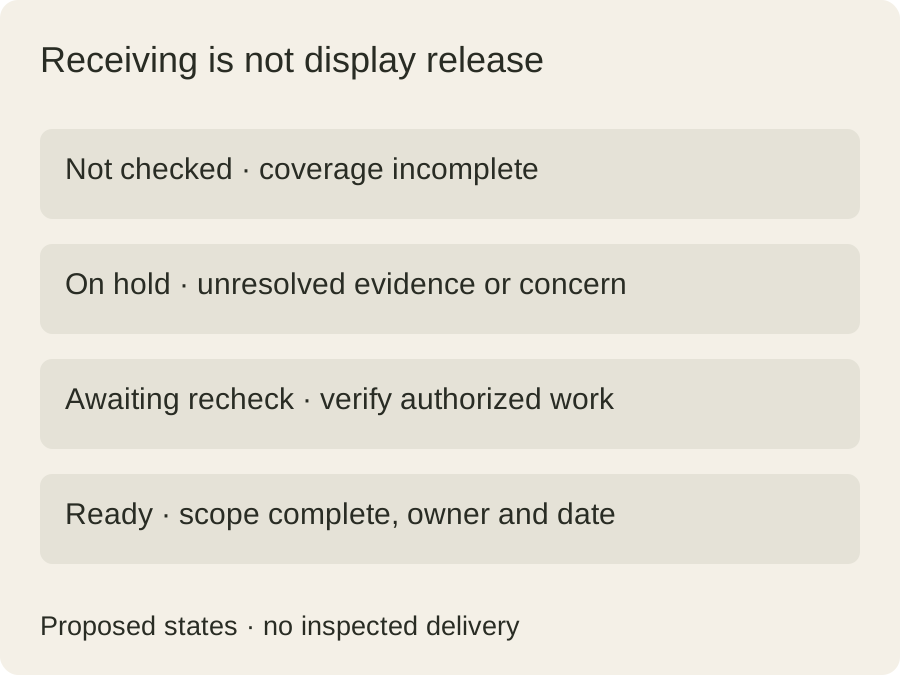
Use the statuses below or equivalent labels in the store’s system. Attach the reason, owner and next action. Unresolved structural, electrical or order-conformity concerns stay out of customer display; an untested unit is not a pass.
| Status | Meaning | Release action |
|---|---|---|
| Not checked | Inspection coverage incomplete | Complete required checks |
| On hold | Mismatch, unresolved concern or missing evidence | Responsible person resolves or declines |
| Awaiting recheck | Authorized work or new evidence requires verification | Record connected rechecks |
| Ready | Required checks completed within agreed scope | Named owner/date and accurate listing |
Release with a unit-specific record
Confirm included items, completed checks, remaining acceptable limitations and listing condition for this unit. Match the description and images to its actual condition. Reverb requires disclosed issues, missing parts and prior repairs under its own condition guidance; use the rules for the actual sales channel.
Keep the handoff between receiving, service and sales traceable. If conditions, strings or setup change, identify what needs another check. For online fulfilment, separately verify accessories and dispatch arrangements. Ready means the defined checks were completed; it is not a lifetime guarantee or a statement that every delivered unit passed.
Sources: Reverb: its condition categories and issue disclosure
Frequently asked questions
Does received stock mean stock is ready to sell?
No. Received, inspected and ready quantities describe different stages. Retain each unit’s coverage and status.
Can a post-adjustment pass replace the arrival finding?
No. Preserve both stages, authorization and connected rechecks. The original evidence remains relevant to the handoff.
How long must every delivered guitar acclimatize?
This guide sets no universal time. Follow model-specific arrival guidance and record relevant conditions; unresolved concerns require assessment.
How this guide was prepared
We checked Taylor’s cold-guitar advice, Fender’s conditional setup guidance, Reverb’s channel-specific disclosure rules and NIST’s sampling overview. The intake flow and status matrix are proposed editorial methods. We inspected no delivery, tested no packaging, diagnosed no damage cause and verified no carrier/seller terms or regulatory compliance. A ready status applies only to documented inspection coverage.
Documentation checked .
Added unit-level inspection coverage and release states, preserved arrival and post-work evidence separately, and qualified climate, sampling and listing claims; replaced decorative images with an intake status card.