
Direct answer
The decision in brief
A music store should plan its guitar range by customer jobs and price roles before choosing model counts. Cover the four core families only where local demand and staff capability justify them, give entry, step-up and specialist models distinct reasons to buy, and limit near-duplicates. Use sales, enquiry, demo and service evidence to adjust the mix over time.
Define what the range must accomplish
Range planning is the allocation of limited cash, wall space, staff attention and reorder capacity. The aim is not to display every possible specification. It is to give the store enough meaningful choice to serve its customers without making models compete for the same sale.
Begin with evidence the store already has: sales by family and price band, lost-sale notes, enquiries, demo requests, lesson-program needs, online search terms, service returns and seasonality. Separate sell-through from availability. A model with zero sales may have had no stock, weak display or no trained staff; a high seller may simply have been the only option.
Write a range promise
A small store might promise “clear first instruments with credible step-up options.” A specialist might focus on recording acoustics or modern electrics. The promise determines what belongs. It also prevents a supplier promotion from becoming a permanent category without evidence.
Build the architecture before selecting models
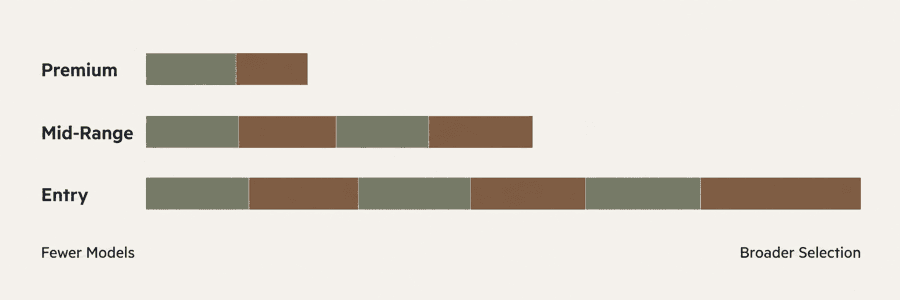
Create a grid with instrument family on one axis and customer role on the other. Useful roles include access, core, step-up and specialist. “Premium” is a price label, not a customer job, so describe what the higher tier improves: consistency, materials, electronics, finish, ergonomics, service support or a specific musical use.
| Role | Customer question | Range requirement |
|---|---|---|
| Access | Can I start comfortably and reliably? | Setup stability, clear choice, essential features |
| Core | Can this cover my main styles? | Versatility and easy staff explanation |
| Step-up | What improvement will I notice? | Visible and playable differentiation |
| Specialist | Does this solve my specific use? | Purpose-led design and informed demonstration |
Do not force equal model counts into every cell. Empty cells are acceptable when demand is low or a nearby model already serves the role. Record each deliberate gap and the evidence that would justify filling it.
Balance electric, acoustic, classical and bass coverage
The four families serve different buyers, accessories and staff conversations. Electric demand branches by body style, pickup layout and bridge. Steel-string acoustics branch by body shape, top construction and electronics. Classical guitars require clear nylon-string identification and suitable neck expectations. Bass may have lower unit count but remains essential for ensembles, schools and studios.
Allocate open-to-buy using local evidence rather than a universal percentage. A lesson-led store may require more entry classical and acoustic instruments. A rock-focused store may need broader electric pickup coverage. A distributor serving several countries should avoid treating one market’s bestseller as a global template.
- Give every family at least one clearly explained entry point when evidence supports stocking it.
- Keep adjacent models far enough apart in use, feel or value that staff can explain the step.
- Account for supporting inventory such as cases, strings, amplifiers and replacement parts.
- Review whether the team can set up and demonstrate the category properly.

Build a worked range plan from customer jobs
Consider a compact store with lessons, a general walk-in audience and limited wall space. The first pass identifies four recurring jobs: a dependable first instrument, a versatile electric for developing players, an acoustic for singing and accompaniment, and a bass for school or ensemble use. Instead of assigning equal model counts, the buyer records enquiry frequency, conversion, seasonal demand and the store's ability to demonstrate each job.
The access tier then receives a small number of clear choices. Two electric models might differ by pickup role and bridge type; two acoustics might differ by body comfort and top construction. A classical model supports the lesson program, and a bass covers common scale and control expectations. Step-up positions are added only where staff can show a meaningful improvement in feel, response, electronics, hardware or delivered consistency.
Every proposed model gets a range card: customer, use, price role, three demonstrable differences, adjacent alternatives, service requirements and reorder rule. When two cards read almost identically, the buyer revisits the model count before ordering. Finishes are managed as variants of a role, not as new roles by themselves.
This example is deliberately qualitative because percentages from another store would create false confidence. The store can add numbers after establishing its own baseline. The important step is to connect units to observed demand and a defined decision, then update the range as evidence accumulates.
Turn the architecture into an opening-order rule
Opening orders carry the most uncertainty. Use cautious breadth to test distinct customer roles and selective depth for the most supported access and core positions. Define a maximum inventory exposure by family and role before selecting individual models. Keep a reserve for reorders, replacements or a gap revealed after launch.
Lead time changes the decision. A fast, reliable replenishment model may need less safety stock than a seasonal or variable supply. Packaging damage, setup labor and warranty handling also affect the practical cost of depth. Record those operational factors beside unit economics so an attractive purchase price does not hide a heavy preparation burden.
Set a review date and an evidence threshold for every test model. Examples include a number of qualified enquiries, completed demonstrations, sales, lost-sale reasons or setup observations. Do not promise that a model will be retained because it appears in the first range. A documented exit or replacement rule protects cash and makes later assortment changes easier to explain.
Make the range understandable on the wall and online
Range design is incomplete if customers cannot see the logic. Group instruments by the decision a buyer is making, then use short labels to explain meaningful differences. A comparison card might show body type, pickup layout, neck feel, bridge, top construction and intended use. Avoid ranking every change as an upgrade.
Online category pages should mirror the same structure. Filters help discovery, but editorial introductions, comparison links and buying guides explain why a filter matters. Link family pages to the relevant specification guide, real model examples and the contact route. Search and AI systems can then follow the same relationship a customer uses.
Train staff with demonstrations rather than scripts full of adjectives. Each person should be able to show one access model, one step-up and one specialist choice in comparable conditions. Record questions that customers still ask. Those questions improve the next article, comparison table and buying cycle while keeping the store's language grounded in observable differences.
Use a scorecard that connects inventory to customer outcomes
A range scorecard should answer whether the architecture is working, not merely whether revenue increased. Review sell-through and weeks of supply by customer role, family and price band. Add gross margin after identifiable setup or service cost, stockout days, return reasons, lost-sale reasons and time to reorder. Interpret every metric in context.
High sell-through with repeated stockouts can signal under-buying, while low sell-through may reflect weak demand, poor display, missing staff knowledge or a price step customers cannot understand. Compare similar time windows and note promotions or supply interruptions. Do not punish a specialist model for moving more slowly when it provides credible category coverage and produces profitable planned sales.
Use a simple status for every range role: protect, investigate, expand, reduce or replace. “Protect” means the role and model are performing as intended. “Investigate” means evidence conflicts or is incomplete. “Expand” requires both demand and operational confidence. “Reduce” narrows quantity or variants. “Replace” starts a controlled comparison with a new candidate.
Pair the numbers with anonymized qualitative evidence. Staff can tag recurring questions, requested features and reasons a customer chose an adjacent model. A category buyer can then see whether an apparent gap is real or whether existing products are poorly explained. Avoid collecting unnecessary personal data; the decision normally needs the reason, not the customer's identity.
Set thresholds only after a baseline exists. A fixed industry percentage copied from another market will not reflect local rent, lead time, seasonality or music culture. The first quarter establishes patterns; later reviews can use those patterns to set cautious reorder and exit rules. Preserve the assumptions beside the result so a future buyer understands why the range changed.
Find and remove model overlap
Overlap occurs when two models target the same customer, price role and use with differences too small to change the decision. It ties up cash, fragments sales history and makes replenishment harder. Finish color alone may justify variants for a proven bestseller, but it should not disguise duplicate range roles.
Place models side by side in a feature matrix. Highlight only differences that customers can perceive or staff can demonstrate: neck feel, weight, acoustic body comfort, pickup behavior, bridge function, top construction, included electronics or verified setup consistency. Then ask which customer chooses each model and why.
If the answer depends on vague language such as “slightly better tone,” test the claim or remove it. Options include dropping one model, narrowing finish count, changing the price role, or defining a distinct application. Preserve a duplicate only when demand, availability risk or channel segmentation provides a documented reason.
Connect planning to sample and shipment inspection
A range plan is an assumption until products arrive. Approve a reference sample with the exact specification, accessories, packaging and setup notes. Record what was measured and what was adjusted. Where factory testing is part of the supply process, ask what was tested, how many units were checked and which acceptance limits were used.
At shipment inspection, check identity and carton condition before setup. Then sample appearance, neck function, frets, nut, bridge, tuners, electronics and playability using the same method. Log recurring issues by model and batch. A higher service burden can change the true role of an apparently attractive entry model.
Installation preparation also matters for acoustic-electric systems, active electronics and retail demo displays. Confirm battery access, output function, controls, included tools and compatibility before staff promise an application to a customer.
Measure the range and refresh it deliberately
Use a small scorecard: sell-through by model and role, weeks of supply, gross margin after service cost, demo-to-sale conversion where measurable, return reason, stockout frequency and lost-sale reason. Avoid judging a specialist model by the same velocity target as a core entry product.
Review monthly for operational exceptions and quarterly for architecture. Ask whether each model still has a role, whether the step-up is clear, and whether demand has moved between families or price bands. New models should enter through a defined gap or replacement rule.
For an initial order, buy breadth cautiously and depth selectively. Put more units behind proven access and core roles, while testing specialist demand with smaller quantities. Reorder evidence is more valuable than an oversized first shipment. Document the reasons so the next buyer can distinguish strategy from historical habit.
Conclusion: build a range with reasons, then improve it with evidence
A balanced guitar range is a set of deliberate customer choices. Start with local jobs, allocate roles across the instrument families, give each price step a demonstrable reason and remove models whose differences do not change the decision. Opening quantities should reflect uncertainty, lead time and service capacity as well as expected demand.
Make the architecture visible to staff and customers. Use comparison cards, demonstrations and linked guides that explain body, feel, construction and electronics in plain language. Track sell-through, stockouts, lost-sale reasons, setup burden and recurring questions by role instead of judging every model on one sales number.
No published percentage can replace the store's own evidence. Treat the first plan as a documented hypothesis, review it on a fixed rhythm and preserve the reasoning behind every expansion, reduction or replacement. The result is a clearer offer for customers and a more accountable buying process for the business.
Frequently asked questions
Questions buyers commonly ask
What guitar range should a small music store stock first?
Start with the customer roles the store can support confidently. Use a small number of reliable access and core models across the guitar families with demonstrated local demand, then add step-up or specialist choices when enquiries and sell-through justify them.
What is the best mix of entry, mid-range and premium guitars?
There is no universal percentage. Use local sales, enquiries, lesson programs, price sensitivity, staff expertise and service capacity. Treat any example mix as a hypothesis and revise it using sell-through and lost-sale evidence.
How can a store reduce overlap between similar guitars?
Compare each model’s customer, use, price role and perceptible differences. Remove or narrow variants when staff cannot explain why a buyer would choose one over the other.
Should every store stock electric, acoustic, classical and bass guitars?
Coverage should follow local demand and the store’s ability to demonstrate and support the category. A deliberate gap is better than poorly presented inventory, but lesson programs and ensemble needs may justify a basic presence in lower-volume families.
How often should a guitar assortment be reviewed?
Monitor exceptions monthly and review the overall architecture quarterly. Make changes when demand, supply reliability, service burden or model roles materially change rather than rotating products only to create novelty.
How this guide was prepared
This guide organizes model-selection questions into a repeatable retail decision framework. Manufacturer references support definitions and measurement context. They are not treated as universal acceptance limits. Guitar specifications, setup tolerances and audible results remain model-specific and should be verified against the current supplier specification sheet and a physical sample.