
Start here
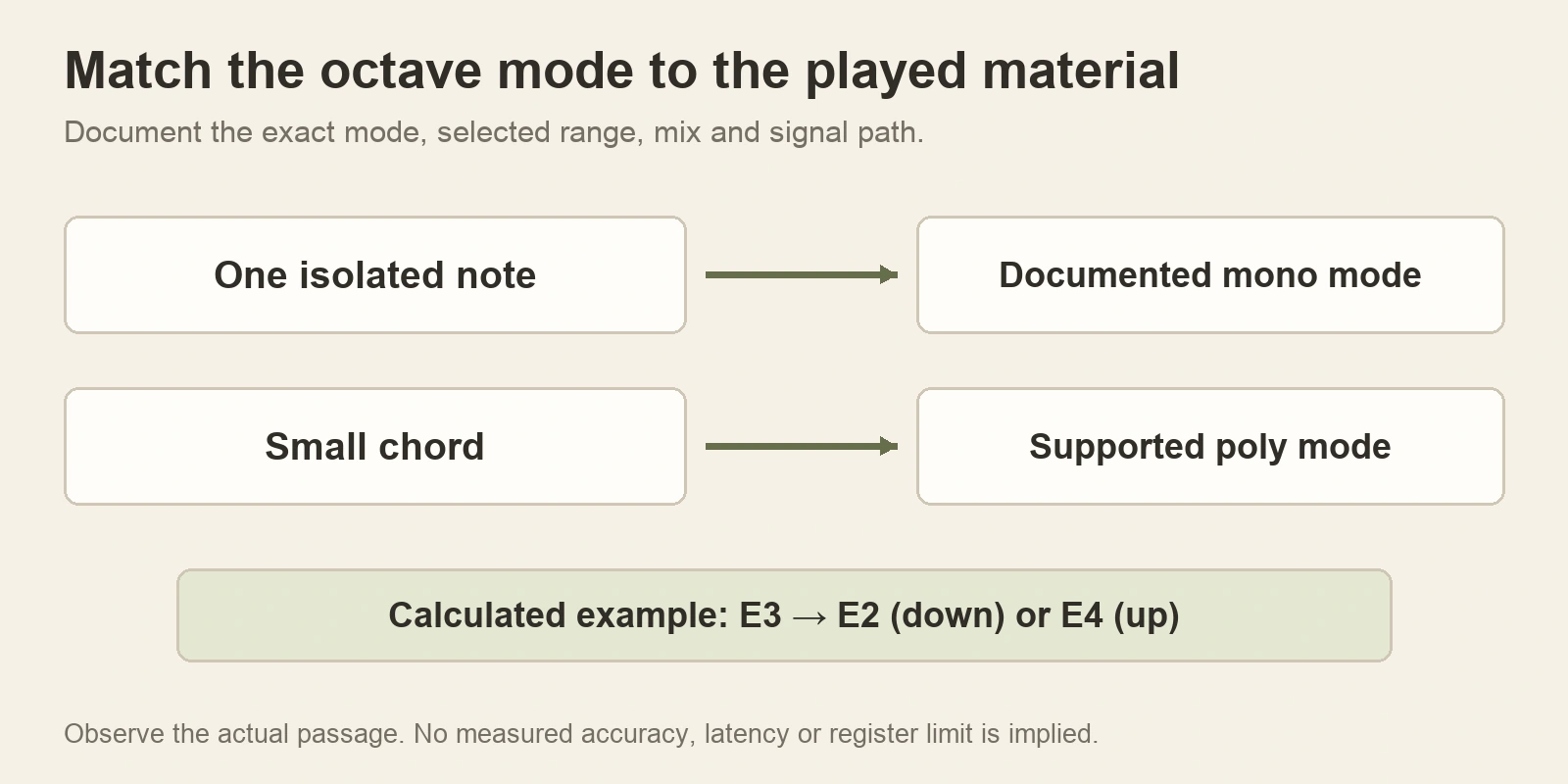
Check the pedal’s documented mode first: a monophonic octave mode is intended for one note at a time, while a supported polyphonic mode can process more than one. Begin with one clean, deliberately muted note, then add the musical material and earlier effects separately. Chord capability, range filtering and routing are model-specific.
Match the mode to the musical material
| Documented mode | Material to try first | What remains model-specific |
|---|---|---|
| Monophonic | One isolated note | Range, response and supported voices |
| Polyphonic | A small chord after the single-note check | Chord capability and selected range |
| Range-limited or lowest-note option | The intended bass note inside a chord | Which notes the exact setting selects |
BOSS documents an OC-5 Vintage mode with a mono role and a Poly mode for chords. Its Poly Range control can restrict which notes receive the effect, including a Lowest setting. That is a particular feature, not a definition of every polyphonic octave pedal.
If upper chord notes remain unshifted in a range-limited mode, first compare that result with the selected feature. Do not call an intended range choice a tracking fault.
Identify the octave and the dry mix
An octave is twelve semitones. In equal-tempered note arithmetic, E3 shifted down an octave is E2; shifted up it is E4. These are target note names. They do not prove what a particular processor produces or how quickly it responds.
Write down whether you want the original note mixed with the shifted voice. Confirm each direct and effect level, then the jack routing. BOSS documents a separate Direct Out on the OC-5; another pedal may route or mix these signals differently. A missing dry note can be a mix or output assignment rather than a pitch problem.
Simplify the path before comparing orders
BOSS recommends an early, clean input for some named pitch pedals, including the OC-5. Start with guitar, the correctly powered pedal and a supported receiving input. Keep the first comparison free of other processing.
Mute unused strings and play one deliberate note. Record the pickup, guitar volume, register, mode and mix. Reintroduce the intended drive or other earlier effects individually, following their input requirements. A changed result then belongs to a named route rather than an unexplained complete-board comparison.
Use four short passes and describe what happened
| Pass | Keep or add | Write down |
|---|---|---|
| 1 | One isolated note with other strings muted | Attack, pitch stability and ending |
| 2 | The same note in another needed register | Whether the symptom depends on register |
| 3 | The intended phrase; chords only in a supported mode | Transitions and note overlap |
| 4 | The documented full rig, one earlier effect at a time | Which addition changes the result |
Use the same phrase and settings when comparing one change. If the intended part contains chords, do not decide from a single sustained note alone. Conversely, do not use a chord to judge a mode documented for single notes.
Describe audible events such as an unstable pitch, a missing attack or a dry/effect imbalance. A listening note cannot support a millisecond latency value or a tracking percentage.
Keep the useful result and the open question
Record the pedal and mode, interval voices, selected range, dry mix, signal path and the exact passage. If a repeatable symptom remains in a supported simple setup, take that record to the maker’s support instead of guessing at an internal fault.
The pitch-expression comparison separates electronic pitch movement from a wah sweep. For signal order, continue with the pedal-order guide. An octave effect changes processed audio; it does not physically retune the strings or change their tension.
Download the blank comparison record (English CSV). The sheet starts blank; it contains no measured results.
How this guide was prepared
We read BOSS’s pitch-shifter introduction and OC-5 mode and Range documentation. We separated note-count capability from placement and designed a proposed progression from isolated notes to the actual passage. The octave example is a calculation, not an audio measurement.
Documentation checked .