The decision in brief
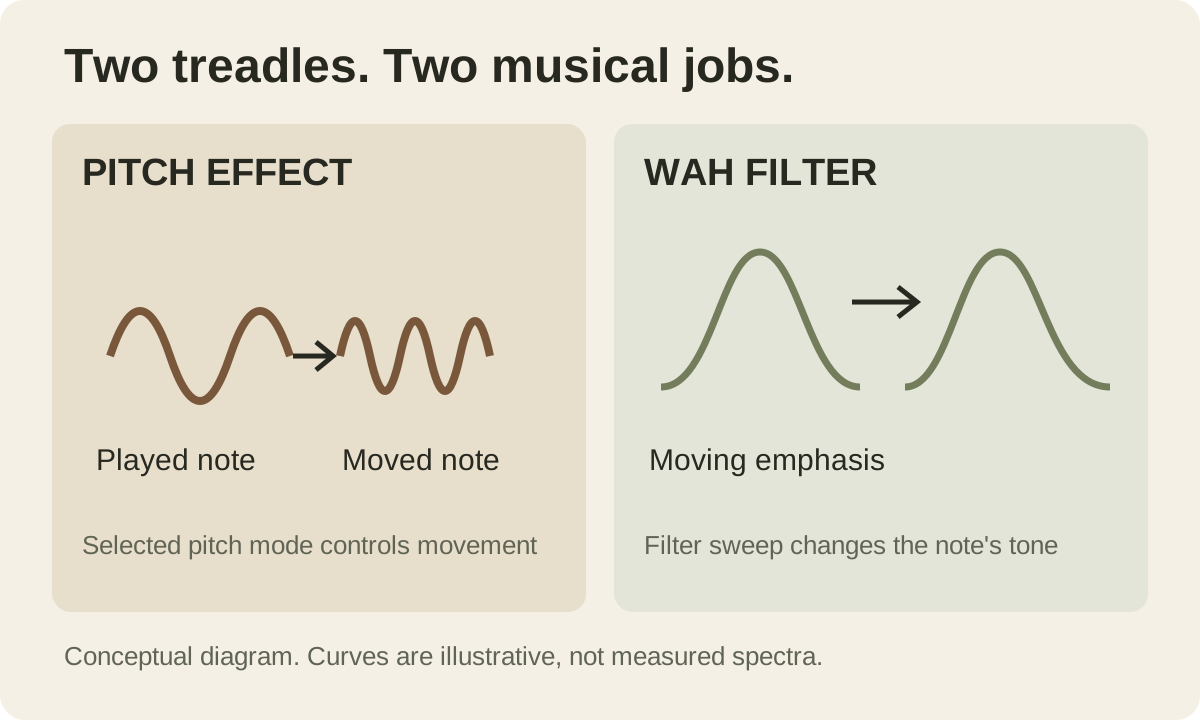
A Whammy pedal changes the pitch of the processed guitar signal; a wah sweeps a filter to change the emphasis of its frequencies. Both can use a rocking foot treadle, but they perform different musical jobs. Choose pitch shifting for electronic bends, octave movement or supported harmony effects. Choose wah for a moving, vowel-like tone on a note or rhythm part. Check the exact model's modes, switching, power and response with your own guitar: their similar shape does not make their controls or sound interchangeable.
What matters most
- Pitch movement and filter movement are separate effects, even when both use a treadle.
- A Whammy pedal processes audio; a guitar's whammy bar moves a bridge mechanically.
- Single-note, chord and harmony behavior depends on the selected device and mode.
- Compare endpoints, bypass, switching and musical control through the actual signal chain.
The central difference: pitch movement versus tone movement
Think first about the change you want to hear. If a sustained note should climb or fall electronically while your fretting hand stays in place, you are describing a pitch effect. If the note should keep its musical identity while its tone opens, closes or speaks like a vowel, you are describing a filter effect. That distinction is more useful than the pedal's outline or the genre shown in a demonstration.
DigiTech documents Whammy as a pitch-bending device with additional harmony and detune modes. Dunlop describes its wah designs in terms of voicing, frequency center and sweep. The names identify different processing families. A wah may make a note seem brighter, thinner or more pronounced, but its core function is not transposing the note by a selected musical interval.
Both effects can be expressive because your foot controls a changing sound while your hands continue playing. The expressive result still depends on timing and the chosen movement. A full heel-to-toe sweep on every beat is only one option. A small movement during a sustained phrase, or a deliberate stationary wah position, can serve a different musical purpose. Begin with that purpose before comparing feature counts.
Sources: DigiTech: Whammy Functions and Modes; Dunlop: Cry Baby Classic Wah
Whammy and wah compared at a glance
| Decision | Whammy / pitch expression | Wah |
|---|---|---|
| Main change | Processed pitch or a supported pitch-related mix | Moving frequency emphasis |
| Typical musical task | Electronic bends, octave movement, harmony | Vowel-like phrasing, rhythmic tone movement |
| What to check first | Mode, interval, input material and endpoints | Voicing, usable sweep and switching |
| Foot control | Expression movement plus model-specific enable control | Treadle movement plus model-specific enable control |
| Main listening question | Does the shifted part follow the phrase as intended? | Does the sweep emphasize the right part of the phrase? |
This table describes the musical roles, not every product carrying a related name. A multi-effects processor can contain both functions, and a separate expression pedal can control either if the host supports it. Confirm which parameter the treadle actually changes. A pedal assigned to volume will not become a wah simply because it looks similar.
Do not choose from an isolated effect demo alone. A sound that is dramatic by itself may occupy too much space in an arrangement. Compare one short rhythm part and one sustained melody in the listening path you will use. The result should help the phrase communicate, rather than merely prove that the device can produce an extreme sound.
Understand pitch, harmony and chord modes separately
In a pitch-bending mode, the processed note moves through the range selected on the device. An octave-up endpoint, for example, is a different musical destination from a smaller interval or a downward bend. Identify the endpoints before playing a phrase so the movement has a destination you can hear and repeat.
The fifth-generation Whammy manual describes Whammy effects without added dry signal and Harmony effects with the original signal mixed in. For Harmony, judge the balance between the original and added pitches and whether the selected interval fits the music. Its Detune modes work differently again: the treadle controls how much of an already detuned copy is mixed with the dry signal. That control is a mix change, so identify the selected group before expecting a pitch bend. Read the manual for the generation you actually have.
Chord handling also needs a separate check. The fifth-generation Whammy manual describes Classic and Chords settings; this does not establish that every pitch pedal tracks full chords in the same way. Try a clean single note, a two-note shape and the chord you intend to use. Listen for unwanted movement, unclear attacks and the feel of the response. Without a controlled measurement, describe what you hear and feel rather than assigning a precise latency or tracking score.
Judge a wah by its usable sweep and switching
Rock a wah slowly while sustaining a note, then repeat the movement with a short rhythmic pattern. Notice which part of the travel produces a useful sound. A sweep that feels dramatic at its extremes may require careful foot control to keep a musical phrase in the region you prefer. The useful range is a personal playing decision, not just a specification.
Switching deserves its own trial. Some designs engage through a toe switch; others use a movement or auto-off arrangement. Dunlop's 95Q manual, for example, documents bypass when the player's foot is removed. That is a model-specific feature. Do not assume that releasing a treadle will bypass another wah, or that pressing harder at the toe will switch every design on.
Check whether you can enter and leave the effect at the intended musical moment without an unexpected level change. If you want a fixed wah tone, verify that the switching and return mechanism allow the treadle to stay where you need it. If you want frequent short accents, consider how quickly you can activate and bypass the effect. A comfortable mechanism can matter more than several optional tone controls.
Sources: Dunlop: 95Q Wah Manual
A Whammy pedal and a whammy bar work differently
A guitar's whammy bar operates a tremolo or vibrato bridge mechanically, changing string tension and therefore the strings' pitches. A pitch pedal processes the electrical audio after it leaves the guitar. You can use that pedal with a fixed-bridge electric guitar because the bridge does not need to move. The electronic effect also does not make the strings feel physically looser as you press the treadle.
This difference affects the rest of a phrase. A mechanical bridge changes the source itself, including how held strings behave together. A pitch processor has its own modes and signal handling. Their results can overlap musically, but an electronic bend is not a promise to reproduce every interaction of a moving bridge, and a wah provides neither of these pitch-bending mechanisms.
If you are deciding on a guitar bridge, read the fixed bridge versus tremolo comparison separately. Bridge maintenance, tuning return and string changes belong to that instrument decision. If you already like your guitar and need a new processed sound, evaluate the effect in your present rig. There is no need to change the bridge merely because a pedal demonstration uses a guitar with a bar.
Use signal order as a starting point for listening
BOSS recommends a clean input as a useful starting point for pitch effects and discusses wah before drive as a conventional arrangement. Begin with a simple guitar-to-effect-to-amplifier path at a comfortable listening level. Establish what the device does before adding several gain stages, modulation effects or repeated audio.
Then add the overdrive or distortion you actually use and compare one change at a time. A wah before drive shapes the signal entering that gain stage; after drive it filters an already distorted signal. A pitch effect receiving a heavily processed input may respond differently from one receiving the direct guitar. Treat an alternative order as a musical experiment and check the relevant manuals' connection requirements.
If both effects are on the board, try the short phrase with only one enabled before combining them. Otherwise you may mistake a mode setting or level change for an interaction between pedals. A looper can help repeat a musical idea, but its position determines which processing is captured. Our looper signal-flow guide explains that distinction. Keep the source and comparison method clear when listening to alternative orders.
Sources: BOSS: Pedal Order and Signal Chain
A five-part pedal tryout that answers the buying question
1. Establish a reference
Tune the guitar, use a known cable and listen with the effect bypassed. Keep the pickup and amplifier settings fixed for the first comparison. Start at a level where an unexpected sweep or pitch change will remain comfortable.
2. Map the movement
Play one sustained note and move the treadle slowly. Name what each endpoint does and where the useful middle region lies. For pitch modes, compare that destination with a note you can play normally.
3. Play the intended part
Use an actual rhythm pattern, chord shape or melody from your practice. A device can sound impressive on one sustained note while being less useful for the part that motivated the purchase.
4. Test transitions
Enable and bypass the effect during the phrase. Check where your foot needs to be, whether the sound starts as expected and whether the perceived level makes the transition practical.
5. Repeat in the complete rig
Add the usual drive and other essential effects. Write a short observation about control, sound and any unresolved behavior. This is a decision worksheet, not a standardized performance test, and it works best when each comparison changes only one variable.
When this advice changes: different models and controllers
Measure usable pedalboard space with the cables connected and leave room for the treadle's full travel. A housing that fits between other pedals can still be awkward to operate if a plug or neighboring footswitch crowds your foot. Stand in the position you normally play and check whether the controls remain reachable without losing balance.
Read the exact power label and manual. Voltage, polarity, current capacity and connector requirements belong to the device and generation. Do not infer compatibility from another pedal's color, brand or treadle shape. For a used unit, identify the model, inspect the connectors and confirm that the supplied adapter matches the requirements before powering it.
For an expression input on a multi-effects unit, verify the compatible pedal type and calibration procedure. A connector that physically fits does not establish that the controller is wired as the host expects. For a built-in treadle, use the documented calibration process if the endpoints are not reached. Also consider whether you need presets or remote control. Those features are useful when a song requires them; they do not determine whether the basic sweep feels right.
When the result is unclear, isolate the cause
If a pitch effect produces an unexpected interval, first check the selected mode and the treadle position. Mute unused strings and try one clean sustained note. Then reintroduce the intended chord and earlier effects separately. This narrows the question to mode, source material or the surrounding signal chain instead of treating every unexpected sound as a faulty guitar.
If a wah sounds unusually thin or sharp, compare bypassed and enabled sound with the same note and amplifier setting. Check the full sweep rather than only the toe endpoint. Also confirm that you have identified input and output correctly. A change that is useful in a dense rhythm part may feel excessive in isolation, so return to the intended arrangement before deciding it is unsuitable.
A sudden mute, crackle or failure to switch calls for a basic connection and power check at a reduced level. Inspect the cable path and the documented controls. Do not open a mains adapter or assume an unfamiliar electrical fault is an effect setting. When a known working setup still fails, seek the manufacturer's service advice. Reliable operation is part of the buying decision, even for an effect used only occasionally.
Choose the effect that serves the phrase
For rhythmic tone movement or a vocal accent on an existing note, start by trying a wah. For an electronically moved melody, large pitch sweep or a supported harmony part, start by trying a pitch-expression device. If the arrangement needs both jobs, each effect still deserves a separate control and signal-order check.
- Write down the musical change you need.
- Confirm the effect family and exact model.
- Map the treadle's endpoints and switching action.
- Play the actual notes, chords and rhythm.
- Compare bypass transitions in the complete rig.
- Check power, cables, physical space and supported calibration.
- Choose from the useful result, not the most dramatic demonstration.
The clearest purchase is one you can explain in a sentence: this control creates this change in this part. A wah and a Whammy can both be expressive, but that expression comes from different musical tools. Learn the tool's behavior, keep the comparison repeatable and let the phrase decide how much movement it needs.
Frequently asked questions
Is a Whammy pedal the same as a wah pedal?
No. A Whammy processes pitch, with additional modes depending on the model. A wah sweeps a filter to change the signal's frequency emphasis. Similar foot treadles control different functions.
Can I use a Whammy pedal with a fixed-bridge guitar?
Yes. The pedal processes the guitar's audio and does not require the bridge to move. Check the device's input, power and selected mode in the exact manual.
Does a wah change the musical note I am playing?
Its main function is filtering rather than transposition. The changing emphasis can alter the perceived character of a note, but it is not a selected-interval pitch shifter.
Should pitch shifting and wah go before distortion?
A clean input is a useful starting point for pitch effects, and wah before drive is a conventional starting arrangement. Compare alternative orders for the actual part and verify connection requirements.
Does every wah turn off when I lift my foot?
No. Auto-off designs exist, but other wahs use different switching. Test the precise model's enable and bypass actions before relying on them in a song.
How this guide was prepared
We checked DigiTech's Whammy product documentation and fifth-generation English owner's manual, including the Whammy, Harmony and Detune descriptions and Classic/Chords switch. We also read Dunlop's Cry Baby Classic page, 95Q manual and BOSS's signal-order explanation. The named model examples support mode and switching distinctions; BOSS's order is a suggested starting point. The five-part tryout is an editorial proposal. We operated, connected and measured no pedals, recorded no tracking delay and performed no listening shootout. The retained diagrams are conceptual illustrations. AI assistance was used for source comparison and language review; no human technical reviewer is claimed.
Documentation checked .
Clarified fifth-generation Whammy dry-signal and Detune mix behavior, tied model and signal-order claims to section-level sources, and recorded the actual documentation review and its limits.