The decision in brief
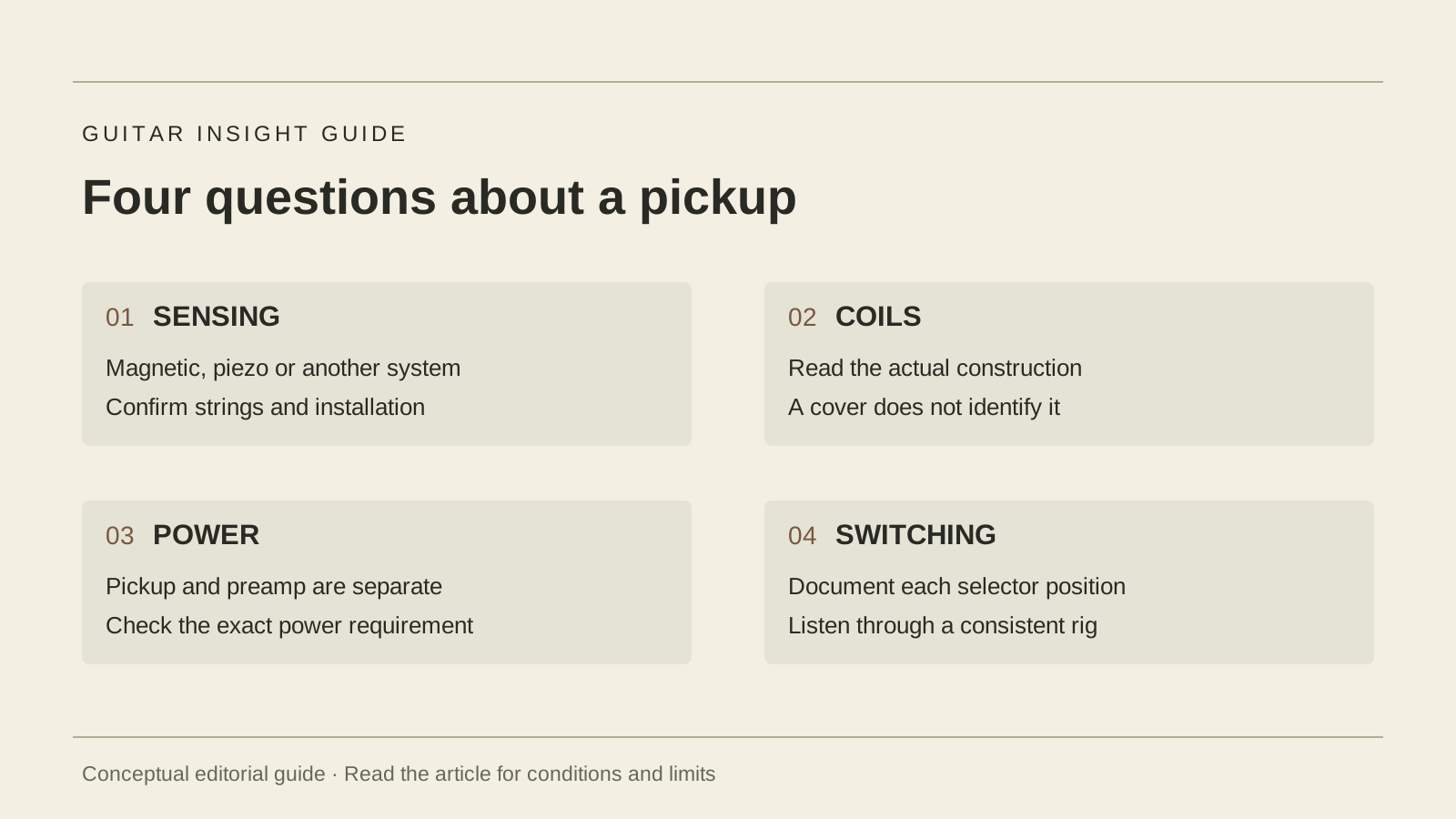
A guitar pickup turns string or instrument vibration into an electrical signal. To understand a specification, separate four questions: how it senses vibration, how its coils are arranged, whether electronics require power, and what the selector actually connects. Single-coil, humbucker, active, passive and HSS describe different parts of that system. Read them together with the guitar’s wiring and the listening setup.
The diagrams in this guide are original editorial concepts, not photographs, measurements or wiring instructions.
What matters most
- Read sensing method, coil layout, powered circuitry and switching separately.
- Verify the installed system and string compatibility on the exact instrument.
- Use documented modes and comparable listening conditions before replacing parts.
Read a pickup description in four passes
A listing can describe several features in one phrase. “Active humbucker” combines a coil-family label with a power requirement. HSS describes an arrangement on the guitar; it does not identify every switching option. A magnetic soundhole pickup describes a sensing method and location, not necessarily its coil count or power supply.
| Question | What to find | What remains open |
|---|---|---|
| Sensing method | Magnetic, piezo or another documented sensing method | Compatible strings and installation |
| Coil construction | Conventional single-coil, humbucker or a documented hum-cancelling design | Exact response and remaining noise |
| Power | Passive pickup, powered pickup or separate active preamp | Battery, controls and bypass behaviour |
| Selection | Pickup positions and active modes for each switch setting | The sounds you can actually use |
Use this map to read a specification or ask a seller a precise question. It does not predict sound from the labels.
Start with what the pickup senses
In a conventional magnetic electric-guitar pickup, suitable vibrating strings interact with a magnetic field and coil to produce a signal. Yamaha illustrates both magnetic pole pieces and a design using a magnet beneath metal rods. The visible cover alone cannot identify the construction.
Piezo systems use a different sensing principle. Yamaha’s electric-guitar guide describes piezo sensors as converting mechanical vibration rather than relying on magnets. Undersaddle describes a mounting position; confirm the sensor and its required input or preamp separately.
Acoustic pickup systems need a separate compatibility check. Fishman says its named magnetic soundhole models require ferrous or steel-core strings and do not work with nylon strings; its FAQ points nylon-string players toward a suitable undersaddle system. That is a product-family example, not permission to fit any undersaddle pickup to any guitar.
Check the exact guitar, string system, mounting and intended preamp before purchasing. A pickup that fits an opening may still be inappropriate for the instrument. For the instrument itself, see the steel-string and nylon-string comparison.
Sources: Yamaha: magnetic pickup mechanism and conventional coil designs; Fishman acoustic FAQ: magnetic soundhole pickups and string compatibility; Yamaha electric selection guide: piezo sensing of mechanical vibration
Keep coil design separate from pickup position
A conventional single-coil has one sensing coil. A conventional humbucker combines two coils so wanted string signal is retained while hum picked up similarly by the coils is reduced. That does not promise silence from the whole rig. Hum-cancelling designs can also occupy a narrow housing; identify the actual model.
The single-coil versus humbucker comparison covers that choice in detail. The separate neck and bridge pickup guide addresses physical position. Neither coil count nor position alone assigns a guitar to a musical genre.
Fender reads arrangement codes from bridge toward neck: HSS means a bridge humbucker followed by middle and neck single-coils. Yamaha’s electric-selection PDF illustrates the reverse reading direction with SSH for that physical arrangement. Follow the named maker’s convention and physical diagram. The letters do not tell you which coils operate in every selector position. For a layout decision, continue to HSS versus SSS.
Sources: Yamaha: magnetic pickup mechanism and conventional coil designs; Fender: reading pickup arrangement codes; Yamaha electric selection guide: its stated neck-to-bridge convention
A battery does not identify the pickup by itself
Powered electronics may be inside the pickup or in a separate preamp. Spector explicitly notes that some basses have passive pickups feeding an active tone-control circuit. This example shows why a battery compartment alone cannot identify the pickup’s construction. Read the model’s electronics description and diagram.
For an active system, record its specified supply and what any bypass switch bypasses. Do not assume an instrument will keep producing its normal signal without power. Consult the active and passive pickup guide for the separate power decision.
A push-pull control or extra switch can select different wiring modes. Get the actual mode list; a generic “versatile” description is incomplete. Our humbucker guide distinguishes series, parallel and split modes. Wiring colours and connectors need the exact manufacturer diagram.
Sources: Spector: passive pickups can accompany an active preamp
Read numbers with their measurement limits
DiMarzio says DC resistance is not a direct measure of pickup tone or output. Its own millivolt output figures provide a comparison within its range. Do not rank different makers’ pickups from a kΩ value or assume their output figures use one shared test.
Before a replacement, ask for the dimensions, mounting, string alignment, height clearance, lead or connector details and intended controls. If the seller supplies only a sound adjective, the compatibility question is still unanswered. Avoid routing or unfamiliar electrical work to discover whether a part fits.
Sources: DiMarzio: limits of DC resistance and maker output figures
Make a switch-position log before changing parts
The following is a proposed owner exercise. Its purpose is to learn what your guitar does, not to isolate a pickup’s laboratory response.
- Identify the guitar, pickup models if known, installed strings and tuning. Copy the documented selector modes.
- Use a known-working cable and a clean listening path. Start at a suitable low level and record the control settings.
- Play the same short passage in each useful position. Note the response and level change; listen to pauses separately.
- Repeat at the gain setting you use as a different condition. For recorded preference checks, compare similar playback levels.
- Write down the missing sound or unresolved symptom before proposing a replacement.
| Position / mode | Useful passage | Observation / next step |
|---|---|---|
| Record the exact selector setting | Clean chord or single-note phrase | Attack, balance, change in level |
| Record the same setting with gain | Your usual rhythm or lead passage | Drive response and noise in pauses |
| Unknown or intermittent setting | Stop guessing the wiring | Check documentation or ask a technician |
A selector or cable fault may need diagnosis. Buying a different pickup before identifying the symptom can leave the original problem. The amplifier guide helps check the rest of the listening route.
Frequently asked questions
Are all guitar pickups magnetic?
No. Magnetic systems are common on electric guitars, while acoustic systems can use other transducers. Read the exact system and string-compatibility instructions rather than inferring it from the guitar’s output jack.
Does a humbucker always have more output?
No. Coil-family labels do not specify a universal output ranking. Check the particular design and measurement method; DiMarzio also cautions against using DC resistance as a tone or output scale.
Should a beginner replace the pickups immediately?
First learn the selector, controls and listening setup. Identify a specific limitation and check the existing instrument for faults. A replacement becomes useful only when its fit and intended benefit are clear.
How this guide was prepared
We read Yamaha’s magnetic-pickup explanation and electric-selection PDF, Fender’s layout definitions, DiMarzio’s resistance clarification, Fishman’s acoustic compatibility FAQ and Spector’s active-preamp clarification on October 20, 2026. These documents support definitions and scoped examples, not a tested sound ranking. The signal map and switch-position log are original editorial tools. We installed, played, rewired or electrically measured no pickups and claim no human technical reviewer. AI assistance supported drafting, source comparison and language review.
Documentation checked .
Sources and further reading
- Yamaha: magnetic pickup mechanism and conventional coil designs
- Fender: reading pickup arrangement codes
- Fishman acoustic FAQ: magnetic soundhole pickups and string compatibility
- Spector: passive pickups can accompany an active preamp
- DiMarzio: limits of DC resistance and maker output figures
- Yamaha electric selection guide: piezo sensing of mechanical vibration