The decision in brief
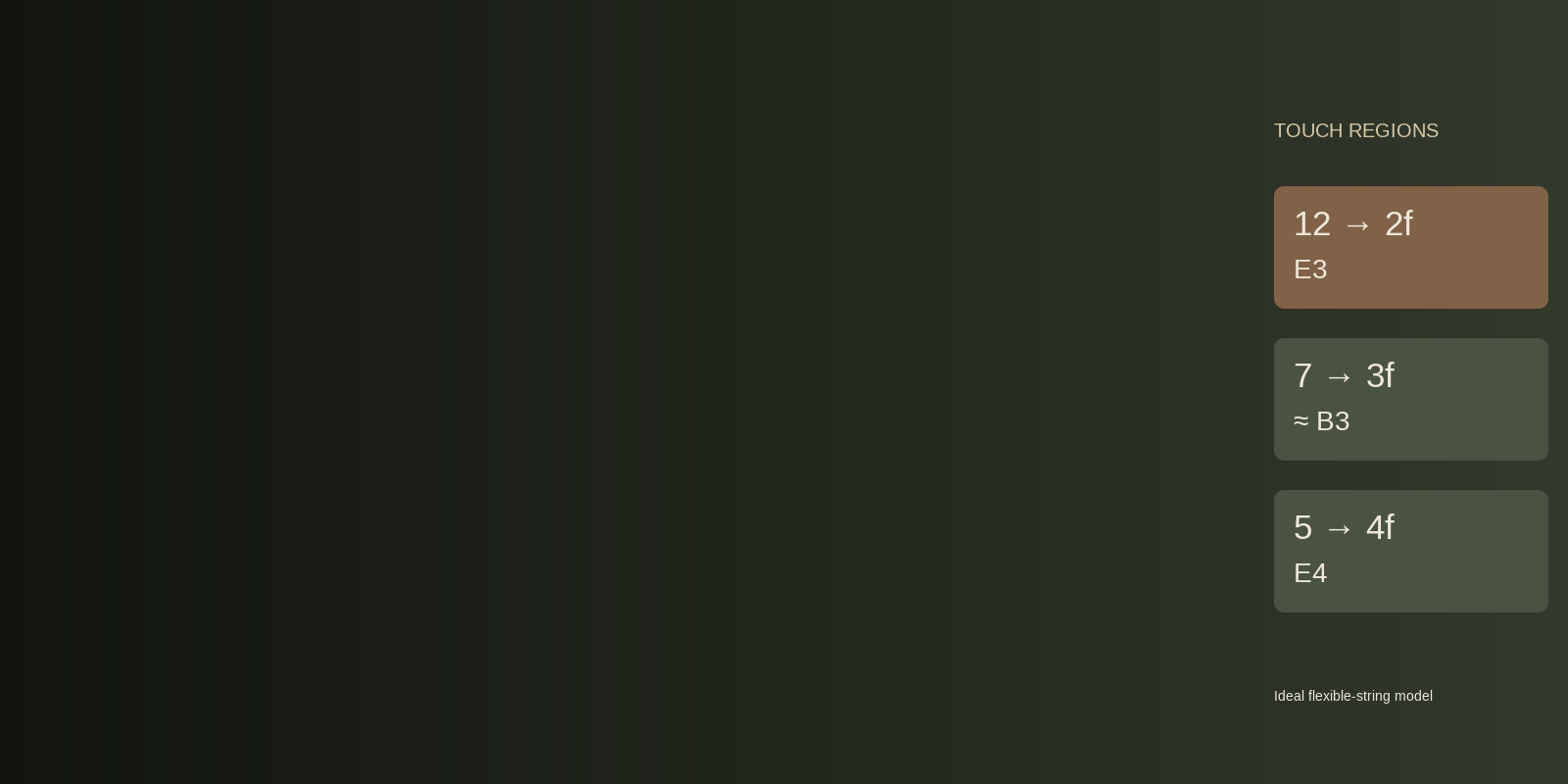
For a natural harmonic, lightly touch an open string near a vibration node, pluck elsewhere and release the touching finger. Do not press the string onto the fret. Near fret 12, the usual result is an octave above the open note; near fret 7, an octave plus a fifth; near fret 5, two octaves. Those are the second, third and fourth harmonics in an ideal-string model. Find the clear touch point on the actual string rather than treating a fret wire as an exact physical node.
Start with a light touch near fret 12
Use a tuned six-string guitar with no capo and begin on the open low E. Let one finger barely contact the string near the 12th-fret region, without pushing it against the fretboard. Pluck closer to the bridge than the touching point and lift the touching finger promptly. Keep other strings quiet so you can identify the result.
If the note stops immediately, check whether the finger pressed too firmly or stayed in contact. If the harmonic is weak, move the touch point a little and change the plucking location before blaming the setup. UNSW explains that light contact favors modes with a node at the contact point; plucking at that same node is unhelpful. There is no need to retune the string to make it sound like the harmonic.
Sources: UNSW Music Acoustics: modes, nodes and light-touch playing
Map the touch point to its sounding pitch
Let f mean the open string’s fundamental frequency. The ideal model gives harmonics at 2f, 3f and 4f. For open E2, the following names describe sounding pitch; the third harmonic is close to equal-tempered B3, rather than an exact equal-tempered match.
| Touch region | Ideal harmonic | Sounding reference | Ordinary fretted note there |
|---|---|---|---|
| Near fret 12 | 2f, second | E3: one octave up | E3 |
| Near fret 7 | 3f, third | Approximately B3 | B2 |
| Near fret 5 | 4f, fourth | E4: two octaves up | A2 |
Touching near fret 5 therefore does not produce the ordinary fretted A. The fingers are doing different things to the string. The ideal fractions are one half, one third and one quarter of the vibrating length from an end. Real effective length, fret placement and saddle compensation need not put a clear node exactly over the fret crown.
Sources: UNSW: integer harmonic frequencies and real-string limitations; UNSW Acoustics FAQ: third harmonic and equal temperament
Compare open, fretted and harmonic notes separately
- Check open string 6 as E with your usual tuner reference. Sound it and stop it deliberately.
- Fret string 6 normally at fret 12 and play the octave. Then release the fretting hand.
- Produce the natural harmonic near fret 12 using light contact. Listen for the similar octave register; record the two tuner readings separately if they are stable.
- Try the regions near frets 7 and 5. Identify the higher register before judging the touch. Change only one contact or plucking detail at a time.
This is a proposed observation routine, not a listening test we carried out. A clear harmonic does not prove that all fretted notes are in tune. Use the intonation guide for that separate pattern of checks; a jumping display first calls for the stable tuner-reading checks.
Keep the result within its limits
Natural harmonics use an open string. Fretting a note and then touching a node of that shortened string is a different, artificial-harmonic task; a pinch harmonic uses another contact technique again. A symbol over fret 7 can therefore require the notation key as well as the fret number.
Do not use an approximate match between harmonics on adjacent strings as proof of exact equal-tempered tuning. The harmonic ratios and the fret system are not identical, and real strings add further limits. Return to the open-string targets before playing chords.
A useful personal record names the string, open tuning, touch region, plucking location and whether the sound was clear or muted. Keep an uncertain result as an observation; seek a teacher’s help with the contact motion before attempting a hardware adjustment.
How this guide was prepared
We checked UNSW Music Acoustics’ string-vibration explanation and temperament FAQ on November 10, 2026. The low-E pitch map follows the second, third and fourth harmonics of an ideal flexible string and conventional E-standard note names. The touch-and-listen sequence is proposed, not performed. We measured no string length, spectrum, inharmonicity or player outcome.
Documentation checked .