
The decision in brief
Intonation is how accurately a guitar's fretted notes match the intended pitches after its open strings are tuned. Compare a fretted 12th-fret note with the 12th-fret harmonic or octave reference using a reliable tuner and light, consistent pressure. If the fretted note is sharp, an adjustable saddle usually needs to move away from the nut; if flat, toward it. First confirm fresh, suitable strings, tuning, relief and action, because a saddle cannot correct every pitch problem.
What intonation measures — and what it does not
A guitar is normally tuned by checking its open strings. Intonation asks a second question: do the fretted notes land close to their intended pitches? If an open E is correct but the fretted octave is noticeably sharp, the instrument can sound wrong in a high-position chord even though a tuner showed six correct open notes. Fender describes intonation as adjusting effective string length at the bridge so a string agrees with itself along the fretboard.
No fretted guitar is a mathematically perfect pitch machine. String stiffness, fret placement, pressure, action, nut height and the player's attack all influence what a tuner reads. A useful intonation check aims for a practical, repeatable compromise under normal playing conditions. It does not certify that every note, every tuning and every player will produce identical readings.
Keep three problems separate: tuning stability is whether the open string holds pitch; intonation is how fretted pitch compares with its reference; and action is the string's height above the frets. They interact, but each points to a different starting check. Our action guide explains the height measurement in detail.
Sources: Fender: harmonic/fretted-octave comparison and adjustable-saddle direction
Check the 12th fret in a repeatable order
Start with a reasonably fresh string of the intended gauge and the guitar's normal tuning. Use a tuner capable of resolving small pitch differences. Play in a comfortable position, mute the other strings and avoid pulling the neck or string sideways. A damaged or unevenly worn string can create a misleading reading; replace it before diagnosing the bridge.
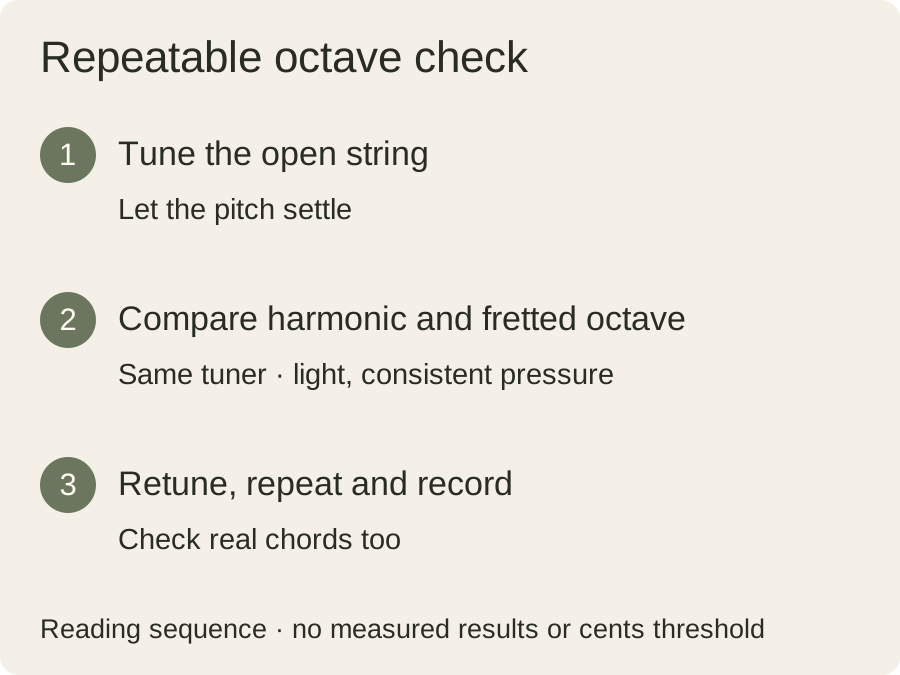
- Tune the open string accurately and wait for its pitch to settle.
- Sound the natural harmonic directly above the 12th fret wire, touching lightly without pressing the string down.
- Fret at the 12th fret with only enough pressure for a clean note. Do not bend the string sideways.
- Compare the fretted note with the harmonic on the same tuner, then repeat the test.
- Record the string/set, tuning, tuner resolution, fret, repeated sustained readings and current saddle position. Distinguish an unstable reading from a repeatable sharp or flat result.
Fender uses the fretted 12th-fret note and the harmonic as the basic comparison. The harmonic is a practical octave reference for this setup check, while the fretted note includes the extra stretch caused by pressing the string to the fret. A single pluck can be misleading: the attack can differ from the sustained pitch, so compare sustained readings using the same picking force. Repeat on all strings rather than adjusting one and assuming the rest will follow.
Sources: Fender: harmonic/fretted-octave comparison and adjustable-saddle direction
Read sharp and flat as directions, not diagnoses
| Fretted 12th-fret note | What it suggests | Usual adjustable-saddle direction |
|---|---|---|
| Sharper than the harmonic | After string and setup checks, lengthening may be appropriate | Move the saddle away from the nut |
| Flatter than the harmonic | After string and setup checks, shortening may be appropriate | Move the saddle toward the nut |
| Matches the harmonic | Octave check is close | Leave the saddle; also test real chords |
This rule describes a typical movable electric-guitar saddle, not every bridge on every instrument. A fixed acoustic saddle, a compensated classical bridge or a locking tremolo may require a different procedure or specialist work. Never cut an acoustic saddle because of one tuner reading.
Retune the open string after each small saddle movement, then check again. The pitch reference moves as the string length changes. If the saddle reaches the end of its travel or the results change unpredictably, stop and inspect the string, nut, fret condition and bridge geometry. The observed sharpness or flatness is a clue, not a complete repair plan.
Sources: Fender: harmonic/fretted-octave comparison and adjustable-saddle direction
When first-position chords sound wrong but the octave test looks good
A 12th-fret test can pass while an open-position chord still sounds sharp. Pressing a string down near the nut stretches it; an excessively high nut slot can make that stretch large enough to hear. Heavy fretting pressure, especially with high action, adds another variable. Check the first few fretted notes with the same light touch used in normal playing before moving the bridge again.
Compare the open string, first fret, third fret and octave. If the pitch error is concentrated close to the nut and diminishes up the neck, ask a technician to assess slot height and shape. Do not file a nut without the right tools and replacement plan: removing material is difficult to reverse and can create open-string buzz.
Sharp first-position notes can also reflect how a player grips a narrow chord, bends adjacent strings or uses a capo. Repeat the comparison with the normal player and a second person using a light, neutral touch. If the two results differ, describe the technique component honestly instead of presenting the guitar as defective.
Taylor’s 2018 acoustic-intonation explanation connects fretting with added string tension and discusses high or incorrectly cut nut slots and heavy fretting pressure. The first-position pattern is a reason to inspect these conditions; it cannot identify the cause by itself.
Sources: Taylor (2018): fretting stretch, nut-slot conditions and playing pressure
Set strings, relief and action before final intonation
Intonation belongs late in a complete setup. Fender's Stratocaster guide places fine intonation after the preceding setup checks and explicitly conditions its instructions on the installed factory strings and model. Its measurements and hardware procedure are not a universal setup for every guitar. A different gauge or tuning can change string tension and neck relief. Raising or lowering a saddle changes the string's path to the fret and therefore the amount of stretch during fretting.
Record the current condition before adjusting anything: tuning, string brand and gauge if known, visible string wear, relief, action, saddle position and the chords that sound wrong. Establish a stable string and tuning choice, inspect the nut and frets, and get action into a playable range. Then refine intonation. If several variables are changed at once, the improvement or failure cannot be attributed reliably.
After the octave check, play passages that matter: open chords, upper-position chords, single-note lines and bends. The most useful setup is the one that works in the player's normal tuning and attack, not a tuner photograph taken under artificial pressure. Return to the octave check if the practical result is still clearly wrong, but keep a record of the full pattern.
Sources: Fender Support: Stratocaster setup qualifications and Intonation (Fine Tuning)
Bridge design changes the adjustment path
Identify the exact bridge before using its adjustment instructions. Movable saddles, shared saddles, locking mechanisms and shaped acoustic saddles can require different procedures. Fender’s cited method is for a Stratocaster with its specified setup conditions; it does not define every bridge.
A floating bridge can respond to changes in the strings’ tension. Recheck tuning and balance under the model’s instructions rather than assuming each adjustment is isolated. On a shared saddle, a movement changes the speaking length of more than one string; record both results. This is a geometric observation and a suggested check, not a tested correction for a named bridge.
Taylor’s 2018 acoustic discussion starts with fresh strings and a complete setup before a technician addresses nut and saddle conditions. Fixed acoustic saddles may need model-specific shaping or structural assessment; do not copy a screw-driven electric-saddle procedure.
Do not force a seized screw, release an unfamiliar locking mechanism or reshape a saddle to chase an uncertain tuner reading. Stop for an instrument-specific assessment when the adjustment or structure is unclear.
Sources: Fender Support: Stratocaster setup qualifications and Intonation (Fine Tuning); Taylor (2018): fretting stretch, nut-slot conditions and playing pressure
Use a symptom map before blaming the saddle
| Pattern | First checks | Reason to pause |
|---|---|---|
| Only one string disagrees | String wear, twist, gauge, seating and saddle | New string still reads unpredictably |
| Mostly first-position notes are sharp | Nut slots, action and pressure | Slot work is needed |
| All strings shift after a tuning change | Relief, bridge balance and new tension | Floating bridge or truss rod behaves abnormally |
| One fret gives an isolated error | Fret height, wear and pressure | Structural fret work is suspected |
| Open strings will not stay tuned | String installation, nut binding and tuners | Pitch never stabilizes long enough to test |
These observations guide a next inspection; they do not prove a cause remotely. For a recently purchased instrument, document the condition before modifying it and review the seller's service or return terms. For a valuable or unfamiliar bridge, a qualified repairer can measure the fault without sacrificing adjustment range.
When this advice changes
Alternate tunings, heavy strings, unusually low action, strong attack and capos change the playing context. A guitar optimized for standard tuning may need a different setup for a much lower tuning. A capo can create sharp notes if clamped too hard even when the open-string octave test is good. Recheck the instrument under the conditions in which it will actually be played.
Classical and steel-string acoustics have different bridge and saddle construction from most electrics. Their intonation may be addressed through string choice, nut, saddle shape and overall geometry rather than a screw-driven saddle. Vintage instruments and instruments with fragile parts warrant a more conservative process.
If a passage is uncomfortable, stop and review the playing task and instrument rather than pressing harder to complete the check. Stop when the bridge will not move normally, a truss rod resists unexpectedly, frets are loose or an acoustic top or bridge appears to lift. Those are inspection questions, not invitations for further DIY adjustment.
Sources: Fender Support: Stratocaster setup qualifications and Intonation (Fine Tuning)
Keep a pitch record you can repeat
| Record | Write down |
|---|---|
| Instrument and strings | Exact model/bridge, installed set, tuning and date |
| Setup and reference | Known relief/action/nut conditions; tuner and resolution |
| Repeated readings | Open, harmonic, fretted octave and relevant low/high notes; attack and pressure |
| One change | Permitted adjustment, retuning and the repeated readings |
| Musical result | Your passage, useful improvement and unresolved limits |
The record is a proposed observation method, not a test we performed. A tuner with insufficient resolution or an unstable note may not support a fine adjustment. There is no universal cents threshold in this guide. Do not label the guitar defective from one reading, or claim that a matching octave proves every chord is correct.
Conclusion: match the check to the music
Good intonation starts with a stable open string and a repeatable comparison between its 12th-fret harmonic and fretted note. Sharp usually calls for a longer speaking length; flat usually calls for a shorter one on an adjustable bridge. Retune after each small change.
The octave check is only part of the answer. Strings, relief, action, nut height, frets, bridge design and fretting pressure determine what the player hears in real chords. Record the pattern across the neck before naming the cause, and use a technician where irreversible work or structural symptoms are involved.
A guitar is ready when its actual passages sound acceptably in tune for its player and use. The setup record should explain how that result was reached, including where an imperfect but sensible compromise remains.
Frequently asked questions
Why is my guitar in tune open but out of tune when fretted?
The string may need intonation adjustment, but high action, nut slots, worn strings or excessive fretting pressure can also sharpen notes. Map where the error occurs before moving a saddle.
Should I compare the 12th fret with the open string or harmonic?
A 12th-fret harmonic provides a convenient octave reference after the open string is tuned. Compare that with a lightly fretted 12th-fret note using the same tuner and repeat the test.
Which way do I move the saddle if the fretted note is sharp?
On a typical adjustable bridge, move the saddle away from the nut to lengthen the string slightly. Retune the open string and test again. Follow the procedure for the exact bridge.
Can old strings cause bad intonation?
Yes. Wear, corrosion, damage or uneven winding can produce unstable or misleading pitch. Test with suitable fresh strings before diagnosing the guitar's hardware.
Can I intonate an acoustic guitar myself?
Many acoustics use a shaped fixed saddle rather than a movable screw saddle. Check the strings and setup first; saddle reshaping, nut work or geometry problems should be assessed by a qualified technician.
Does correct 12th-fret intonation guarantee every chord is perfect?
No. Fret placement, string stiffness, nut height, action and finger pressure still affect notes elsewhere. Test real musical passages after the octave check.
How this guide was prepared
We checked Fender’s harmonic/fretted-octave comparison and saddle direction, and the model/factory-string qualifications and late fine-intonation step in its Stratocaster guide. The symptom map and pitch record are editorial observation aids. We did not measure or adjust an instrument, verify a particular tuner, or set a universal cents tolerance. The octave check is a practical reference, not proof of perfect pitches everywhere. We do not adopt the source’s generalisation about every note being correct, its gauge-based preset as a universal final setting, or raising action as a general substitute for length compensation. The hero is illustrative; the card supplies no test results. Taylor’s 2018 discussion supports the fretting-tension, nut-condition and pressure checks; the first-position symptom interpretation is editorial inference. Its bracing promotion is outside this guide’s evidence.
Documentation checked .
Added nearby technical references, model limits and a repeatable pitch record; qualified sharp/flat interpretation, removed the incorrect scale image and documented the limits of the check.