
The decision in brief
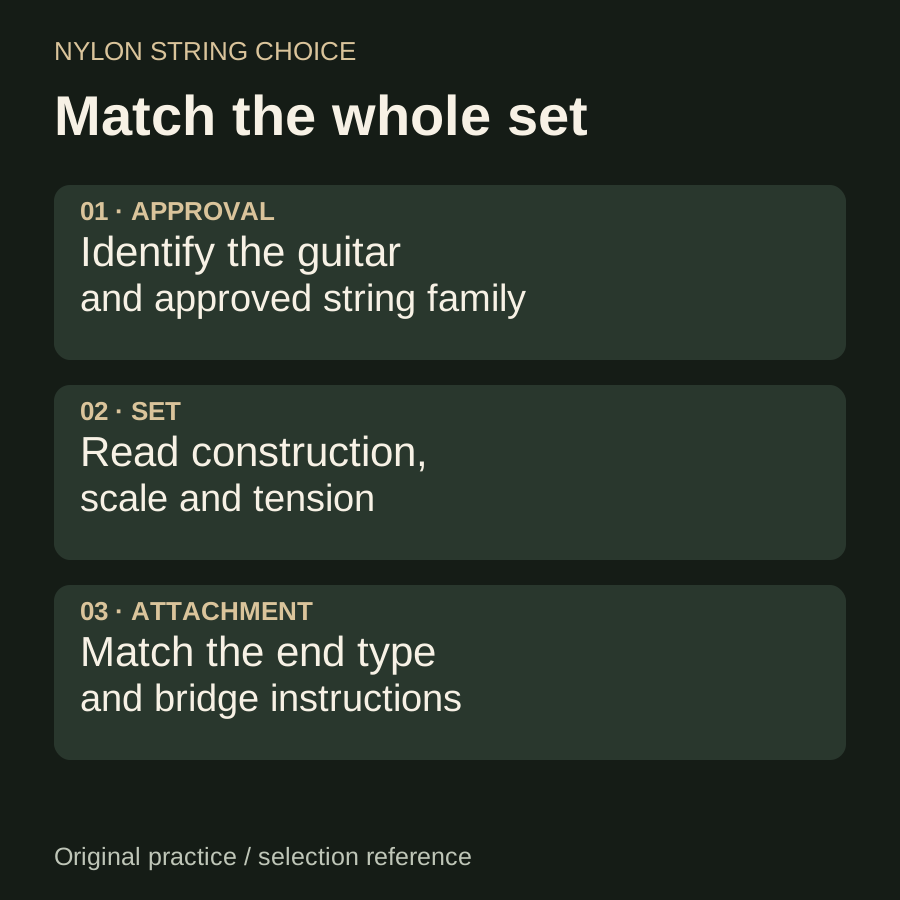
Choose a nylon-family set approved for your exact guitar, then check its complete construction, tension designation, length and end type. A conventional classical set can have plain nylon trebles and metal-wound basses with a nylon core; the shiny basses are not steel-core acoustic strings. Match the bridge and the maker’s instructions before comparing feel or sound.
What matters most
- Read the bass core separately from its metal winding.
- Check instrument approval, exact set and attachment before choosing.
- Record the complete set and comparison conditions instead of ranking tension labels.
Why some nylon strings look metallic
In Yamaha’s conventional classical-string example, the higher three strings are plain nylon and the lower three have a nylon-fibre core under a metal winding. D’Addario’s EJ45 specification provides a named example: clear nylon trebles and silver-plated copper over multifilament nylon bass cores.
The winding and core answer different questions. A silver-looking fourth string is not evidence that the guitar should take a steel-core acoustic set. Read the package and current product specification for each part of the set. Other synthetic or composite constructions need their own specifications; appearance does not establish their material.
Sources: Yamaha: conventional nylon trebles and wound bass construction; D’Addario EJ45: nylon construction, tie ends and normal-tension specification
Confirm the instrument before choosing the packet
Record the model, string count, intended tuning, scale and bridge instructions. Find the instrument maker’s approved string family and any tension restriction. Treat a previous owner’s unidentified set as unknown rather than as approval for a replacement.
Martin’s care guide warns against steel strings on classical instruments because their construction is not intended for that load. Do not fit a steel-core acoustic set to a guitar designed for nylon. An output jack or a cutaway does not change that string requirement.
For the broader instrument decision, use the nylon and steel-string guitar comparison. A specialist, repaired or unfamiliar design needs its actual maker’s guidance before a string change.
Sources: Martin Care & Feeding Guide: Strings, printed page 7
Read tension and attachment as separate fields
D’Addario lists EJ45 as a normal-tension, full-scale, six-string tie-end set. Its EJ34 Folk Nylon specification instead lists ball ends. These are examples of different products, not interchangeable loading instructions.
| Field | What to confirm | Do not infer |
|---|---|---|
| Construction | Treble material, bass core and winding | A metallic surface means a steel core |
| Tension designation | Exact set code and instrument approval | Hard or high tension is an advanced-player grade |
| Scale and tuning | The set’s intended instrument length and pitches | A small guitar can use any shortened full-size set |
| End type | Tie end or ball end and the bridge’s loading method | A ball end establishes complete compatibility |
Use normal, hard or high as the maker’s product designation. If comparing load matters, ask for the exact sets’ tension data at the same scale and tuning. The label alone gives no universal numerical load or promise of easier fretting, greater projection or better tone.
Ball-end nylon products exist, but a fitting that passes through a hole does not settle the instrument’s setup or string approval. Confirm the guitar’s requirements as well as the string maker’s intended use. Do not improvise bridge modifications to make a packet fit.
Sources: D’Addario EJ45: nylon construction, tie ends and normal-tension specification; D’Addario EJ34: an example of ball-end nylon strings
Choose a useful comparison
Start from a known, approved set that works on the instrument. Write down what you want to investigate: fretting feel, the balance between basses and trebles, response to your normal attack or upkeep. A vague aim to upgrade everything makes the result difficult to interpret.
Compare compatible sets while retaining tuning, guitar, passage and listening position as closely as practical. Note changes in treble material, bass construction, tension category and string age. If several differ, the observation belongs to the complete set; it cannot establish which feature caused the preference.
Try a short arpeggio, a familiar chord and a melody with your normal technique. Record whether the change helps that task. Stop an uncomfortable trial and seek appropriate playing or setup guidance rather than assuming a more demanding set must be better.
Use the actual bridge and tuner procedure
A tie bridge needs its documented tying method; a ball-end bridge needs its own seating method. Identify the correct route at the bridge and tuning rollers before releasing the old strings. Protect the instrument’s finish and have a qualified person demonstrate an unfamiliar attachment.
The worked example in our general restringing guide is for a pinned steel-string acoustic. Its pin seating and wrap counts must not be copied onto a classical tie bridge. That guide helps choose the right branch; it is not a nylon knot tutorial.
Bring the approved set gradually to the intended pitches and recheck after ordinary playing. Keep persistent slipping, a changed playing feel or unexpected hardware movement in the record. Follow the actual makers’ instructions for settling and adjustment. This article gives no guaranteed number of hours until the tuning will hold and no instruction to pull the strings hard.
Keep the package and a replacement record
| Record | Useful detail |
|---|---|
| Before | Guitar, approved current set, tuning and reason for the change |
| New set | Exact code, treble/bass construction, tension, length and ends |
| Installation | Correct bridge/tuner method and any authorised setup work |
| Comparison | Same passage, listening position, date and unmatched conditions |
| Outcome | Useful change, accepted compromise and unresolved symptom |
A recurring break at one contact point or persistent slipping deserves an installation and instrument check before buying another packet. Keep the exact string position and symptom; a new set does not identify the cause.
If the change works for your playing, retain the details for the next replacement. If an essential compatibility or condition question remains, resolve it with the maker or a qualified repairer before continuing. The wider string guide covers the other instrument families.
How this guide was prepared
We checked Yamaha’s classical-string construction explanation, D’Addario’s EJ45 and EJ34 specifications, and Martin’s care-guide warning about steel strings on classical instruments. The named sets illustrate construction and ends, not a recommended purchase or universal compatibility. Selection and comparison records are editorial suggestions. We installed or tested no strings and establish no settling time, longevity ranking or human expert review.
Documentation checked .