
The decision in brief
A reverb pedal adds a reverberant sound around the played note. Set the effect amount and tail length separately, and use pre-delay only if the pedal provides it. Compare a short phrase with pauses so you can hear the dry attack and the tail. Room, hall, plate and spring names describe effect types; the exact controls and connections depend on the pedal.
Hear the dry note and the reverberant sound separately
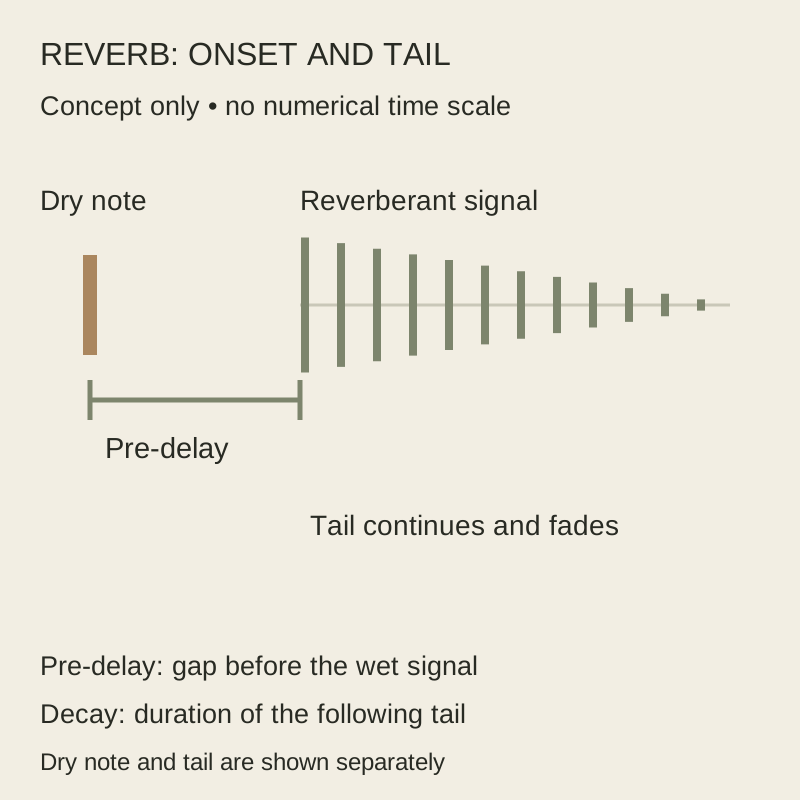
Here, the dry signal is the signal before this reverb is added; the wet signal is the reverb contribution. The dry path may already contain other effects. Reverb provides a continuing reverberant sound after an excitation. To hear its contribution, play a short note and leave silence rather than filling every moment with another chord.
A delay normally makes its repeat timing a central setting. A reverb may include many closely spaced events and can share a pedal with delay. The BOSS RV-6, for example, includes a +DELAY mode alongside its reverb modes. A pedal’s mode name matters when you describe what you hear.
Use the delay guide for repeat interval, feedback and rhythmic calculations. Here the main question is how the reverberant sound fits around the notes you want listeners to follow.
Sources: BOSS RV-6 Owner’s Manual: controls, modes and connection diagrams
Separate amount, decay and onset
| Function | Listening question | Documented example |
|---|---|---|
| Effect amount or mix | How much reverb is combined with the dry signal? | RV-6 E.LEVEL adjusts reverb volume; blueSky Rev C MIX balances dry and wet |
| Decay or reverb time | How long does the reverberant sound continue? | RV-6 TIME and blueSky Rev C DECAY describe this function |
| Pre-delay, if provided | How long before the reverberant signal appears? | blueSky Rev C PRE-DELAY |
| Tone or damping | How is the reverberant sound’s frequency balance shaped? | RV-6 TONE; blueSky Rev C damping controls |
Raising effect level and extending the tail are different changes. A long, quiet tail and a short, prominent tail can occupy a phrase differently. Keep one function fixed while comparing the other.
The cited blueSky Quick Start Rev C explicitly separates MIX, DECAY and PRE-DELAY. Its controls describe the version shown in that document. The RV-6 panel has no dedicated pre-delay knob. Do not assume a control or an identical mix law from another model’s layout.
Sources: BOSS RV-6 Owner’s Manual: controls, modes and connection diagrams; Strymon blueSky Quick Start Rev C: decay, mix and pre-delay (panel functions)
Use the mode label as a starting point
The RV-6 manual lists ROOM, HALL, PLATE and SPRING among its modes. Its descriptions identify simulated room and hall reverberation, plate reverb and an amp-style spring reverb. Those labels describe the intended effect family; they do not establish a measured acoustic space or a common decay time across products.
Begin in a plain mode that lets you hear the tail without additional features distracting from the comparison. If you choose a modulated, shimmer or combined-delay mode, record that choice. The added process becomes part of the result.
A mode that sounds attractive on a single held chord still needs the rhythm of the actual part. Do not judge the next chord’s clarity from the tail in isolation. Mode selection and playing context belong in the same setting record.
Sources: BOSS RV-6 Owner’s Manual: controls, modes and connection diagrams
Use a phrase with space after it
First play the phrase dry, with the amp and guitar settings fixed. Include a short note followed by a rest, then a short chord followed by another rest. Keep the pulse comfortable enough to make the stops deliberate. This supplies a repeatable reference for the attack and the gaps.
Engage reverb using the manual’s suggested starting procedure. Adjust amount until you can identify its contribution, then change decay while keeping amount fixed. Listen through the rest: does the tail continue into the next intended event, and is that useful for this arrangement?
If a pre-delay control is available, compare it separately. Its gap belongs between the dry event and the onset of the reverberant signal. It is not the tail’s duration. The diagram shows that distinction without claiming a waveform or a particular time setting.
Finally repeat the complete phrase with the backing or other parts you actually use. Record whether the note starts and chord changes remain easy to follow. There is no universal clear-setting value; this is a proposed listening exercise, and this article reports no audition result.
Check dry signal, bypass behaviour and routing
Read the exact connection diagram before making a mono, stereo or effects-loop setup. The RV-6 manual shows ordinary mono operation through INPUT A and OUTPUT A. It also shows a different arrangement with INPUT B alone for effect-only output: the direct sound is absent, and bypass mutes the outputs. Those are distinct intended setups.
That example is a reason to check the manual when the dry guitar disappears. Two input jacks do not make every single-jack choice equivalent. Follow the maker’s power and connection instructions and turn equipment down before changing connections.
The RV-6 manual also says its reverb sound remains after the effect is switched off. Tail behaviour on another pedal or bypass mode needs its own instructions; bypass is part of the musical transition to compare.
For placement around overdrive, amp loops and other effects, use the pedal-order guide. Confirm the actual devices’ level requirements. This article’s conceptual timeline is not a wiring diagram or approval for an unknown loop.
Sources: BOSS RV-6 Owner’s Manual: controls, modes and connection diagrams
Save the setting with its musical context
| Record | What to retain |
|---|---|
| Pedal and mode | Exact model, document revision where relevant and effect family |
| Connections | Mono, stereo or wet-only arrangement actually used |
| Separate controls | Amount, decay and pre-delay if available |
| Listening phrase | Pulse, deliberate rests and the arrangement used for the final check |
| Transition | What happens to dry sound and the tail when bypass is selected |
If the next chord becomes harder to follow, return to the last useful setting and change one control. Try a shorter tail while keeping amount fixed, then compare amount with that new tail held fixed. This sequence lets you describe which adjustment helped.
Keep a preferred setting with the song or exercise, rather than labelling it the correct setting for all clean or distorted guitar. If you also use delay, give repeat timing a separate check so both effects have an intentional role.
How this guide was prepared
We checked the BOSS RV-6 Owner’s Manual and Strymon blueSky Quick Start Rev C on November 2, 2026, including the original panel and connection diagrams. These are manufacturer instructions, not comparative sound measurements. The timeline is a conceptual timing diagram without a numerical scale; the listening sequence is an editorial proposal. We auditioned no pedals, verified no room simulations and make no best-model recommendation. Control details remain attached to the cited model and document revision.
Documentation checked .