The decision in brief
A delay pedal adds a later version of the input sound. Set the repeat interval with Time, repeat decay with Feedback, and effect audibility with the relevant Level or Mix control. For rhythmic delay, define the beat and subdivision before setting milliseconds or tap tempo. At a quarter-note tempo of 100 BPM, a quarter-note delay is 600 ms and a dotted eighth is 450 ms; these are calculated timings, not universal settings.
Begin with the dry note and one clear repeat
Dry means the sound without the added delay; the delayed contribution is the effect sound. Use a supported, simple signal path at a comfortable listening level. Start with low feedback and a modest effect level so the original attack and the first repeat can be heard separately.
Play one short note, then leave space. Notice the interval until its repeat and how later repeats fade. Repeat with a short phrase. The aim is to hear what each control changes before adding modulation, other effects or a faster musical part.
Check the pedal’s own mono connections, power requirements and mode instructions. A familiar socket shape does not establish a suitable supply or input. For the complete rig, the pedal-order guide keeps the receiving amplifier and any gain stages explicit.
Adjust time, feedback and level as separate questions
| Control | Question | Simple check |
|---|---|---|
| Time | When does the repeat arrive? | Listen to the first repeat after an isolated note |
| Feedback | How does the repeat sequence decay? | Leave space and hear the later repeats |
| Effect Level or Mix | How audible is the effect beside the dry sound? | Compare the phrase with the effect active and bypassed |
The DD-8 Owner’s Manual identifies Time, Feedback and E.Level with those distinct jobs in its ordinary delay use. It also documents mode exceptions: Time and Feedback do not serve their normal delay functions in LOOP, and Feedback controls the GLT effect’s depth in GLT. The panel name alone is not enough to describe every mode.
An effect-level control and a wet/dry crossfade need not behave identically. Use the actual manual before treating a clock-face position or a percentage as portable between pedals. The DD-8 manual also warns that some feedback settings can oscillate. Begin conservatively and reduce feedback if repeats build unexpectedly.
Make one adjustment at a time. A louder delayed sound can seem more prominent without the repeat interval changing; a longer interval can create more space without changing the initial effect level.
Sources: BOSS DD-8 Owner’s Manual: delay controls and mode exceptions; BOSS: The Complete Guide to Delay Pedals
Convert a defined beat into milliseconds
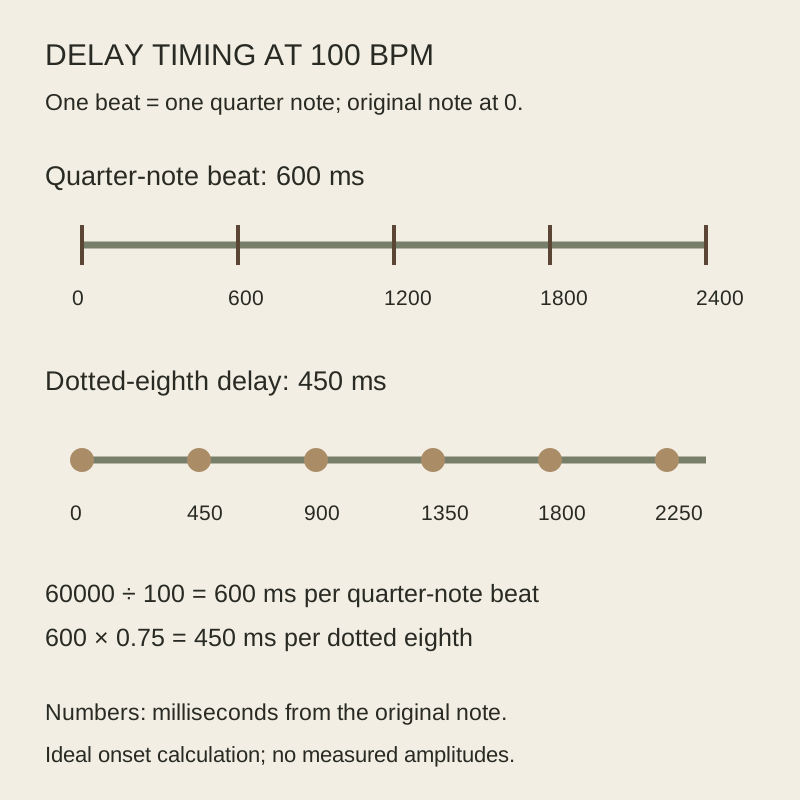
BPM means beats per minute. For the examples here, one beat is a quarter note. One minute is 60000 milliseconds, so a quarter-note interval is 60000 ÷ BPM. An eighth note lasts half that interval. A dot adds half of the note’s original duration, so a dotted eighth lasts 0.5 + 0.25 = 0.75 of a quarter-note beat.
At 100 quarter-note beats per minute, 60000 ÷ 100 = 600 ms. Multiplying by 0.5 gives 300 ms for an eighth; multiplying by 0.75 gives 450 ms for a dotted eighth. These are exact arithmetic values at that stated tempo, not measured pedal performance.
| Tempo | Eighth note ×0.5 | Dotted eighth ×0.75 | Quarter note ×1 |
|---|---|---|---|
| 80 BPM | 375 ms | 562.5 ms | 750 ms |
| 100 BPM | 300 ms | 450 ms | 600 ms |
| 120 BPM | 250 ms | 375 ms | 500 ms |
Choose a supported delay mode and range before entering a calculated value. Round only as required by the device’s resolution and record the displayed setting. A number calculated for one tempo is not a fixed recipe for every song.
If a score or metronome defines a different beat unit, first translate the desired note duration. For example, a dotted-quarter beat in compound metre is not the quarter-note beat assumed in this table. The formula requires the beat unit as well as the BPM number.
Tap the beat, then verify the repeat subdivision
Tap tempo records an interval according to a device’s procedure. The repeat can then follow a selected subdivision of that interval. Tap speed and repeat interval therefore need not be identical.
The DD-8 Reference Manual’s tempo section tells the player to tap quarter-note intervals. It gives a dotted-eighth TAP DIVISION example in which those taps produce a dotted-eighth delay. This is a specific documented function, not an instruction to tap dotted eighths on every pedal.
Check the active mode, the stored division and how your unit enters or leaves tempo input. The DD-8 manual notes that turning Time resets the delay time to the knob’s setting. A changed interval after touching that control may be expected behaviour rather than a failed tap switch.
Before a performance, play one note against the chosen metronome pulse and listen for the first repeat. Confirm the audible result instead of assuming an indicator’s flashing rate always displays the repeat subdivision.
Sources: BOSS DD-8 Reference Manual: tempo and TAP DIVISION (pp. 10–11)
Let the repeats supply space in a simple exercise
This is a proposed practice routine. At 100 quarter-note BPM, choose the supported 450 ms dotted-eighth setting, modest effect level and low feedback. Count a steady quarter-note pulse and play one short note on the first beat, then listen. The first calculated repeat falls three quarters of a beat later.
Return to the dry sound and make the attack and release consistent. Re-enable the delay and repeat the same task. Once the placement is clear, try a short, sparse rhythm and leave enough room to hear how the repeated attacks fit. Increase complexity only while you can still identify what you played and what the pedal added.
A delay does not correct late or early playing. Listen to your dry attacks against the pulse as well as the resulting pattern. The lead and rhythm practice guide provides a broader part-based exercise; a looper serves a different recording and playback task.
If the repeats obscure the next chord, first try fewer repeats or a lower effect contribution. A more suitable interval is another option. There is no requirement to keep a dotted-eighth rhythm when the part needs a different space.
Save the part as well as the setting
| Record | Why it matters |
|---|---|
| Tempo and beat unit | Defines the timing calculation |
| Mode, division and actual time | Separates the desired rhythm from the device’s setting |
| Feedback and effect control | Preserves repeat decay and audibility |
| Pedal position and amp channel | Records what processes the dry sound and repeats |
| Short musical task | Makes the setting useful in context |
A delay feeding distortion and a delay after a compatible preamp stage can respond differently. Describe the actual route instead of promising that “delay last” always means clean repeats. Follow the routing guide if that is the question you need to solve.
Keep the direct attack, repeat timing and musical preference as separate observations. The arithmetic can supply a clear starting interval; your supported equipment and the part determine whether it is useful.
How this guide was prepared
We checked the official BOSS DD-8 Owner’s Manual and Reference Manual and BOSS’s delay guide on November 1, 2026. Control behaviour is scoped to the documented modes. Timing examples are editorial calculations from a quarter-note beat: 60000 divided by BPM, with note-value multipliers. The timeline shows ideal onset times, not measured latency, repeat amplitude or a recording. Practice and comparison steps are proposed; we connected, played and tested no pedal or amplifier.
Documentation checked .